
Putnam Family Members Involved in the Salem Witchcraft Hysteria:

Putnam House, Danvers, Massachusetts, courtesy of Wikipedia.
“I desire to be humbled before God for that sad and humbling experience that befell my father’s family in the year about ’92…”
– Ann Putnam, Jr., 1706
John and Priscilla Gould Putnam founded the old colonial Puritan Putnam family in 17th-century Salem, Massachusetts. Originally from Buckinghamshire, England, the family immigrated to the Massachusetts Bay Colony in 1634. The head of the family, John Putnam, born in 1580, was already in his 50s when he immigrated. He had married Priscilla Gould in 1611, and the couple had seven children. Though already grown, some of John and Priscilla’s children immigrated with them, including his sons Thomas Putnam, Nathaniel Putnam, and John Putnam. The elder Putnam was well equipped to settle in a new colony, and he and his sons were granted land. Each of his sons would have children of their own, and it would be this third generation of Putnams who would be involved in the witch trial frenzy of 1692. More specifically, it would be the children of his oldest son, Thomas Putnam.
When colonists arrived in the Massachusetts Bay Colony and settled in Salem, they soon found the nearby land was not fertile, so many settlers moved outside the “city.” Numerous small farming communities emerged in the area. About five miles North of Salem was an area first known as Salem Farms, where the Putnam family controlled much of the land. Later, it became known as Salem Village. These outer lands surrounding Salem Towne did not have separate identities, and the farmers were required to be members of the Church of Salem. However, as settlements grew outside the larger community of Salem, some began to break away and form independent towns; the first was Wenham in 1643. Desiring autonomy from the larger city and its church, Salem Village began petitioning for its independence in the late 1660s. However, officials in Salem Towne initially refused to grant their independence, driving a dangerous wedge between the two communities. Many Salem Village members began to resent Salem Towne’s power over them. At the same time, those who lived in the larger community did not feel they needed to grant this autonomy.
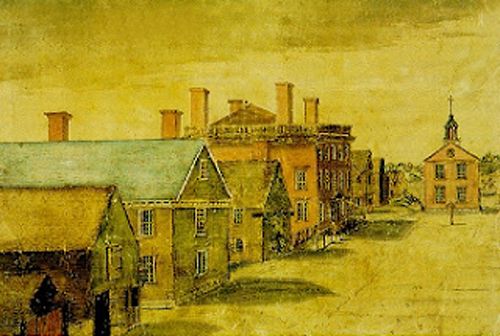
Salem Village, Massachusetts.
This created a wedge between the two communities and divided the village itself, as farmers began to draw “battle lines” between those who wanted to separate from Salem Towne and those who did not. However, the farmers continued to request it because of the distance from town. Finally, Salem Village was granted the right to build its own church and hire a minister in 1672. However, the villagers would officially remain members of the Salem Towne Church, which would govern the smaller parish. The village was also permitted to establish a committee of five to assess and gather taxes from the villagers, including church and non-church members, for the ministry. For the first time, Salem Village had some autonomy.
Unfortunately, when Salem Village gained the right to build its own church, it did not solve the problem of the two quarreling groups; rather, it made it worse. Two families emerged as leaders of the separate factions—the Putnams and the Porters. Both families were early settlers of the Massachusetts Bay Colony, had been successful, and were large landowners in Salem Village.
The Putnams were farmers who followed traditional Puritans’ simple and austere lifestyle. They, along with other farmers in Salem Village, believed that the thriving economy of Salem Towne, and more specifically, thriving merchants, made people too individualistic, which was in opposition to the communal nature that Puritanism mandated. On the other hand, though the Porters derived much of their wealth from agriculture, they were also entrepreneurs who developed commercial interests in Salem Towne and other areas and were active in the larger community’s government. Because of these differing viewpoints, the Porters’ diversified business interests helped increase their family’s wealth, making them one of the wealthiest families in the area. Meanwhile, the Putnam family’s wealth stagnated.
In 1672, one of the Porters owned a dam and a sawmill that flooded the Putnam farms, leading the Putnams to sue the Porters. That same year, when Salem Village was granted the right to hire a minister and build its own church, the Porters opposed separating from Salem Towne. Most of the 600 farming residents of Salem Village wanted a separate church and independence from Salem Towne. At the same time, those who had closer ties to the city’s economy and rich harbors opposed the separation.
After gaining the right to build their own church and choose their own minister, the Putnams also sought to “control” the church, thereby controlling the community. Thomas Putnam, Jr., led this group and forged an elite faction that would control village affairs for years. His allies included his brother, Edward Putnam; his brother-in-law, Jonathan Walcott; Walcott’s uncle, the innkeeper Nathaniel Ingersoll; and other Salem Church deacons, committeemen, and church elders.
After gaining the right to its own church and minister, Salem Village brought in the Reverend James Bayley in October 1672. He would stay until 1680, even though the village remained quarrelsome. He was followed by the Reverend George Burroughs, who would find himself in the midst of the witch hysteria years later, and Deodat Larson, who left in 1688. All three ministers had problems with the congregation and were left in conflict.