
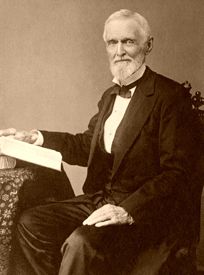
Jefferson Davis by C.E. Emery, about 1888.
The most famous Civil War treasure and one of Georgia’s greatest mysteries is hundreds of thousands of dollars from the Confederate treasury that went missing at the very end of the Civil War.
Confederate President Jefferson Davis was attending church on Sunday, April 2, 1865, when he learned that Lee’s defensive line at Petersburg, Virginia, had been broken and the fall of the Confederate capital at Richmond was imminent. Davis quickly advised his cabinet that Richmond was to be evacuated and that they would take the Confederate treasury with them. The men and the treasury were scheduled to depart on two trains on the only open line between Richmond and Danville, Virginia.
That evening, the first train with the cabinet members departed Richmond. Shortly after midnight, the second train, which carried the hard currency reserves of the Confederate States of America, left. It was under the command of Navy Captain William H. Parker, who had gathered all the remaining available personnel to provide a military guard.
Among the official records of the Confederacy were numerous crates and barrels containing gold and silver coins, bullion, silver bricks, and a substantial amount of fine jewelry donated by women across the South. In addition, more than $450,000 in gold from Richmond bank reserves was taken to prevent it from falling into the hands of the Union.
Although the news was bleak, the hope of all on board was that the South’s struggle could continue.
When the tracks ended at Danville, Davis and his staff began to travel south on horseback. Captain Parker ordered the treasure moved to wagons for transport to the old U.S. Mint in Charlotte, North Carolina. However, when Parker received word that the U.S. Cavalry was already in the immediate area, he zigzagged several times across the South Carolina-Georgia state line to evade capture.
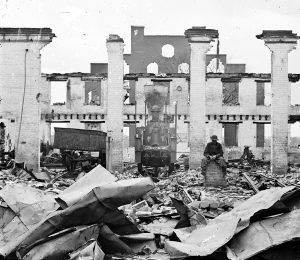
Richmond, Virginia Ruins.
In the meantime, Richmond lay in ashes as occupying Federal troops took control. Over the next several weeks, General Robert E. Lee surrendered, and President Abraham Lincoln was assassinated.
Captain Parker was to camp outside Washington, Georgia, to meet with Jefferson Davis and receive further instructions. Upon their meeting, the Richmond bank reserves were placed in a bank vault in Washington, Georgia. Most Confederate assets had been dispersed to pay soldiers and travel expenses. If there was any remaining, its outcome remains unknown.
Only days later, the Richmond reserves, amounting to some $450,000, were in the hands of occupying Northern troops who set out to take the money to a railhead in South Carolina. Along the way, the Union soldiers camped near Chennault Crossroads, and it was here that on May 24, 1865, bushwhackers attacked the wagons, and some $250,000 was lost. The bandits were stragglers from the Federal and Confederate armies who had heard of the treasure being transported.
Bank officials eventually recovered some $111,000 of the stolen money. Union General Edward A. Wild led a search of the area for more gold and earned notoriety for the arrest and torture of the Chennault family, who Wild believed were hiding gold.
When Jefferson Davis was finally captured by members of the Fourth Michigan Cavalry near Irwinville in south Georgia on May 10, 1865, he had only a few dollars. The fabled riches of the vast “Confederate Treasure” could not be found.
Though it would seem that the robbers would have made off with their stolen caches, tales of Confederate gold buried in Wilkes County have persisted since the war’s end.
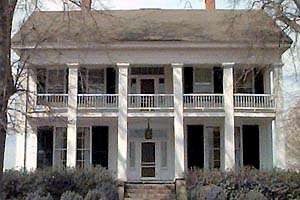
Chennault Plantation, Washington, Georgia.
Through the years, rumor has it that many gold coins have been found along the dirt roads near the Chennault Plantation, located at the crossroads of GA 44 and GA 79.
©Kathy Alexander/Legends of America, updated November 2025.
Also See:
Sources:
Cleveland Civil War Roundtable
Geocaching
Georgia Encyclopedia
Southern Sentinal