
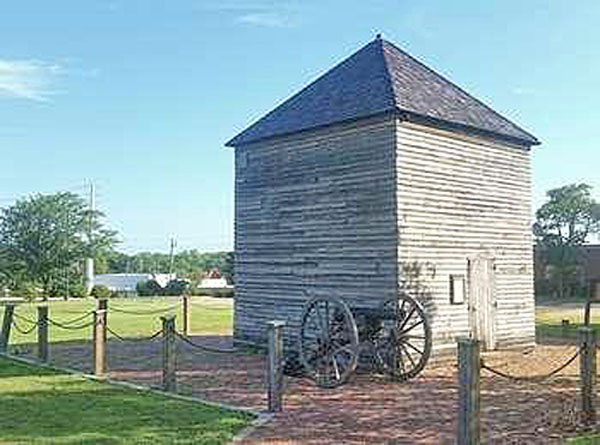
Fort Blair, Kansas, courtesy of the National Park Service.
Fort Blair, Kansas, also known as Lunette Blair, was a Civil War-era blockhouse and earthwork in Bourbon County. It was constructed in 1863 to fortify the southwestern approach to Fort Scott against Confederate raids.
Fort Scott was established on May 30, 1842, as one of several frontier outposts along the permanent Indian frontier to enforce federal policies of Indian removal, regulate trade with displaced tribes, and maintain peace between white settlers and Native American groups East of the line. Positioned in southeastern Kansas, the fort filled a gap in the military road system connecting Fort Leavenworth, Kansas, to Fort Gibson, Oklahoma, facilitating U.S. Army operations amid the forced relocation of tribes, including the Cherokee, Creek, and Seminole, under the Indian Removal Act of 1830.
During the Bleeding Kansas period from 1854 to 1861, Fort Scott served as a crucial federal military base amid the growing violence between Free-State abolitionists and pro-slavery settlers, often fueled by Missouri border ruffians. U.S. troops stationed at the fort intervened in territorial disputes, such as the Battle of Paint Creek in April 1858, where they clashed with free-state forces led by James Montgomery. This conflict highlighted the fort’s role in maintaining federal authority against irregular warfare from both sides.
The Marais des Cygnes Massacre on May 19, 1858, saw pro-slavery militiamen under Charles Hamilton kill five free-state men near Trading Post, Kansas. This attack, which was reportedly planned at Fort Scott’s Western Hotel, exemplified the mutual atrocities occurring in the border region. It underscored the strategic importance of the fort for Union control, aimed at preventing pro-slavery dominance in Kansas elections and governance.
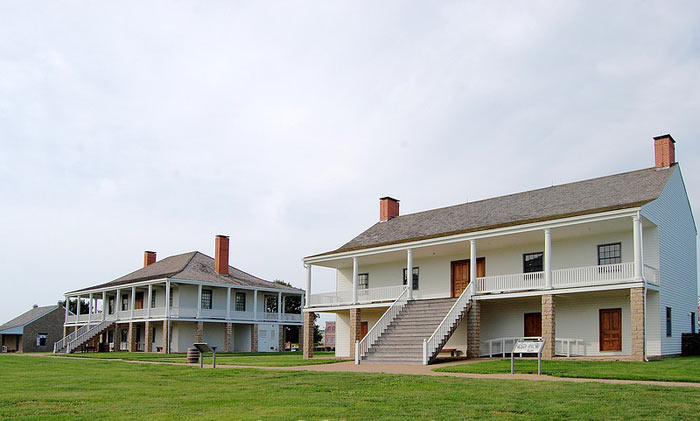
Hospital and hotel at Fort Scott, Kansas by Kathy Alexander.
By the early 1860s, Fort Scott played a crucial role in supporting Union logistics in the Trans-Mississippi Theater. It provided rations, forage, and equipment, and hosted regimental camps, serving as a refuge for various groups, including formerly enslaved individuals fleeing from bondage. At its peak, approximately 2,000 federal troops were stationed in the area, which supported operations that constrained southern advancements and strengthened anti-slavery militias, even though there were no significant battles fought at the site itself.
Throughout the Civil War, Confederate armies coveted the stores of Union supplies at Fort Scott and attempted to capture them. To protect the town, U.S. Army Engineers built four blockhouses, or lunettes, called Forts Lincoln, Henning, Insley, and Blair in 1863.
Fort Blair was built and named in honor of Brevet Brigadier General Charles W. Blair, a Kansas resident and Union Army officer who commanded the Fort Scott post from late 1862 through much of 1863. As a former inhabitant of Fort Scott, Blair led during this time, coordinating defenses against guerrilla threats in the volatile border region. His forces helped organize volunteer units to patrol and suppress pro-Confederate activities in eastern Kansas.
The two-story square log blockhouse, measuring 16 by 16 feet, stood 15 feet high. It consisted of a wooden blockhouse built of thick boards, covered with rough boards, and roofed with wood shingles. The blockhouse was enclosed by a rectangular wall of log palisades covered on the outside by earthworks, which were surrounded by a wide, deep ditch. It had openings for rifles and small cannons. These were to be used by armed men and cannon in case Confederate guerrillas or regular forces attacked the town and post.
Fort Blair was the second-largest of the three blockhouses and was in South Fort Scott, between Main Street and Scott Avenue. The fort was several blocks south of the main part of Fort Scott’s post.
Approximately 40 miles of entrenchments encircled the town to protect vital Union supplies and supply lines along the Kansas-Missouri border. These fortifications highlighted Fort Scott’s strategic importance in the Trans-Mississippi Theater, where irregular warfare and guerrilla activity heightened border conflicts during the war.
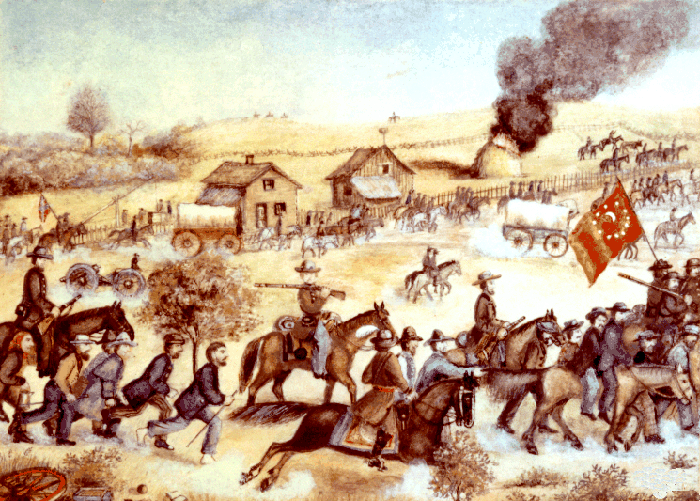
Battle of Mine Creek, Kansas by Samuel J. Reader
Fort Blair was used to guard Fort Scott when Confederate Major General Sterling Price passed through the area in late October 1864, following their defeat at the Battle of Mine Creek. This was near the end of his failed raid into Arkansas, Missouri, and Kansas. General Sterling Price’s army diverted its plans to capture the town after assessing its strong defenses, and not one shot was fired when he passed within sight of the post.
Fort Scott was closed as a military post in October 1865. The U.S. Army auctioned off the lunettes, with Fort Blair relocated multiple times for civilian use, including as a carpenter’s shop for several decades and later as a symbolic logo for the Western Automobile Insurance Company in a city park on the former parade grounds.
By 1959, after two more moves, the blockhouse had fallen into disrepair, leading to its reconstruction. It now stands on Skubitz Plaza, adjacent to Fort Scott National Historic Site, as the sole surviving example of these defenses, which the National Park Service accepted for preservation in 2021.
©Kathy Alexander/Legends of Kansas, updated June 2026.
Also See:
Bourbon County, Kansas, in the Civil War
Fort Scott Military Post – National Historic Site
Sources: