
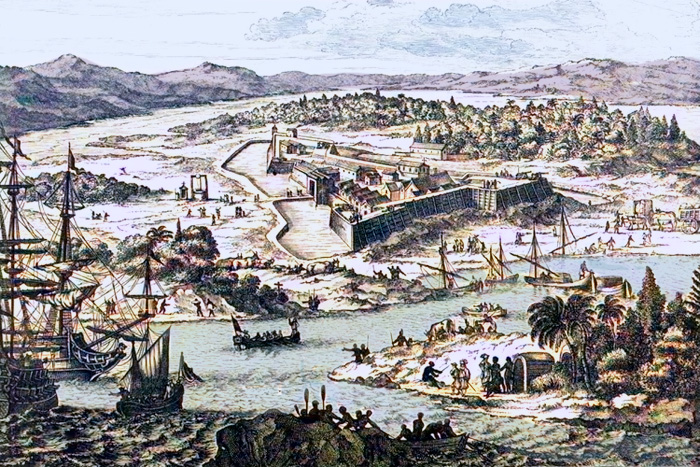
Charlesfort, South Carolina.
Charlesfort, South Carolina, was a French Colonial Fort established in May 1562 on the south tip of Parris Island in Beaufort County.
Charlesfort was established when a French expedition, organized by Huguenot leader Admiral Gaspard de Coligny and led by the Norman navigator Jean Ribault, landed at the site on the May River in May 1562, before moving north to Port Royal Sound. Ribault, with 150 French Huguenots, built a small earth-and-log fort named Charlesfort after the then-French King, Charles IX. It was the first French settlement in the present-day United States.

Jean Rebault by Lee Adams, 1959.
To establish a French claim to the area, Ribault also erected engraved columns in several locations, including the fort site and Daws Island across the river from it.
After the fort was completed, Jean Ribault returned to France for supplies and more colonists. He left behind 28 men to garrison the fort until he returned. However, he was arrested in England after becoming involved in the period of unrest known as the French Wars of Religion, which prevented his return. Before long, the garrison at Charlesfort believed themselves either abandoned or that Ribault had been lost at sea.
Afterward, most of the settlers’ stores were burned, and Captain Albert de la Pierria died in a mutiny, possibly as a reaction to his heavy discipline. Without supplies or leadership, and beset by hostility from the native population, the garrison built a 20-ton ship and, in 1563, all but one sailed for France without a compass. During the long voyage in an open boat, they were reduced to cannibalism, with one crew member, named La Chère, being killed and eaten. The 20 survivors were finally rescued in English waters by an English ship, and some eventually reached France.
In 1564, Hernando de Manrique de Rojas commanded a Spanish force from Cuba that burned Charlesfort to the ground and took captive the one Frenchman who had remained, along with the local Native Americans nearby. Rojas also removed the engraved columns that Ribault had emplaced to establish the French claim to the area.
The Spanish returned in 1566 and founded Santa Elena, the first capital of Spanish Florida, on the site of Charlesfort. It was established under Pedro Menéndez de Avilés, the first governor of Spanish Florida. Fort San Salvador, a simple blockhouse, was built first, and later in the year, Fort San Felipe was built directly on top of the old French fort, with a new moat.

Jesuit Missionaries.
This colony had a sizeable population, including missionaries and soldiers. The settlement became the base of operations for the Jesuits and military working in the northern zone of Spanish Florida. From this base, the Spanish founded six other forts during the Captain Juan Pardo Expedition into the interior and the Appalachian Mountains. But local Native American tribes resisted, killing the garrisons and destroying all the forts in 1568. The fort was occupied until 1570, when it was destroyed by fire.
The Spanish then built a second fort, also called Fort San Felipe, at an unknown nearby location. The fort and town were abandoned in 1576, in part due to local native hostility.
In 1577, the Spanish returned and built Fort San Marcos. It was used until 1582 or 1583, when a second Fort San Marcos was constructed. This fortification had a moat dug around it in 1586, in anticipation of an attack by Sir Francis Drake.
In January 1577, the French returned on the ship Le Prince, led by Nicholas Strozzi. The ship was lost as she entered Port Royal Sound. Afterward, the men built a triangular fort called Fort San Marcos, measuring 130 feet on each side, enclosing five buildings. Natives killed many of them, and the rest were taken captive by the time the Spanish returned in spring 1578.
Between 1578 and 1580, the Spanish obtained the captives from the natives and hanged almost all of them.
In 1586, Francis Drake led an English force in a raid on St. Augustine, Florida. The Spanish abandoned Santa Elena the following year, and its remaining settlers were relocated to St. Augustine to strengthen it. At its height, Santa Elena had about 60 dwellings and an estimated population of 400-450.

Charlesfort Monument.
The Spanish never pressed their colonial claims to the area again, focusing on other areas of the American continent.
In the summer of 1917, some of the earthworks associated with the first Fort San Felipe were leveled by United States Marine Corps personnel, filling in part of the moat.
In the 1920s, Major George Osterhout led an excavation of the site, which he concluded was that of Charlesfort. In response to this determination, a memorial marker was placed at the site.
Osterhout’s interpretation was soon disputed, and by the 1950s, archaeological consensus was that the site was part of Spanish Santa Elena. It was only after a series of excavations spanning the 1970s to the 1990s that the whole history and layout of the area were identified. Identification of the French fort location was made possible by the restricted distribution of distinctly French artifacts and by evidence that multiple moats had been dug around the site of the first Fort San Marcos.
Because of their remarkable state of preservation and their importance in understanding early French and Spanish colonial practices, the site was designated a National Historic Landmark in 2001.

Charlesfort-Santa Elena Site Marker,
Today, the Charlesfort-Santa Elena Site is an early colonial archaeological site on Parris Island, South Carolina. It contains the archaeological remains of a French settlement of Charlesfort. The site is accessible through the United States Marine Corps Recruit Depot in Port Royal, South Carolina.
©Kathy Alexander/Legends of America, updated November 2025.
Also See:
Civil War Battles in South Carolina
South Carolina – The Palmetto State
South Carolina Photo Galleries
Sources:
Fort Wiki
South Carolina Encyclopedia
Wikipedia- Charlesfort
Wikipedia – Santa Elena