
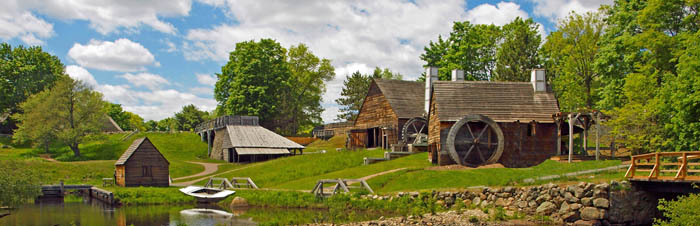
Saugus Iron Works, Massachusetts, by the National Park Service.
The Saugus Iron Works National Historic Site in Massachusetts is the site of the first integrated ironworks in North America.
Although some attempts at iron manufacturing had been made in Virginia as early as 1619, it would be years later before the iron industry began in Saugus. In 1646, only 26 years after the first permanent settlement had been established in Massachusetts, a partnership between the Company of Undertakers for the Iron Works in New England began the construction of an ironworks under the direction of Richard Leader. The partnership benefited from the initiative of John Winthrop, Jr., and legal encouragement given by the Massachusetts General Court in 1641.
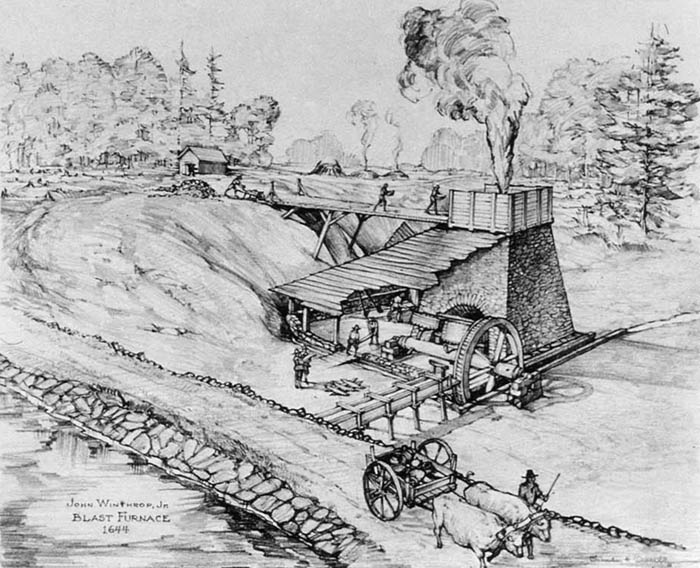
Saugus, Massachusetts, Blast Furnace, 1644.
John Winthrop the Younger, a governor’s son, became one of its strongest promoters, and some wealthy Puritan men became part-owners in the iron works. Other Puritan men who were farmers worked part-time at the ironworks to make extra money. When it began operations, the ironworks were called Hammersmith.
Many of the ironworkers were recruited from England for their special iron-making knowledge. Skilled ironworkers were neither Puritans nor property owners, so they had no say in the colony’s governance. Unfortunately, the skilled ironworkers and the Puritans often disagreed on religious practices and laws, and on how to behave in the community. The ironworkers often got into trouble for drinking, gambling, fighting, swearing, not attending the Puritan church, and wearing fine clothes.
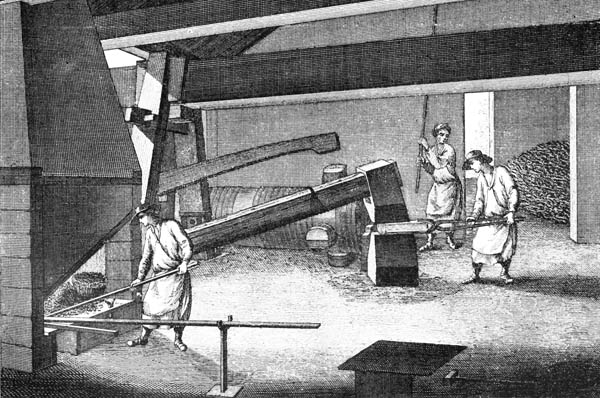
Iron Forge.
Some of the ironworkers were indentured servants, who agreed to work for an employer for a set period without wages or with limited wages. These indentured servants usually worked for three to seven years in exchange for their passage to New England and for the costs of food, clothing, housing, and other necessities upon arrival. Wives of ironworkers sometimes accompanied their husbands under their indenture agreements.
Other indentured servants were former Scottish soldiers who were defeated at the Battle of Dunbar in the English Civil War in 1650. After the English captured them, they were sent to the Massachusetts Bay Colony to work as indentured servants for seven years. Some of the Scots worked at the ironworks, while others were sold to different businesses in the colony. These men worked as woodcutters, charcoal makers, or unskilled laborers for the most part. They were placed in company housing and were given what they needed to live and work. Some lived with skilled workers who taught them skills such as blacksmithing and carpentry. They were required to work at the ironworks to repay their debts from their voyage, as well as for food, shelter, medical care, and clothing.
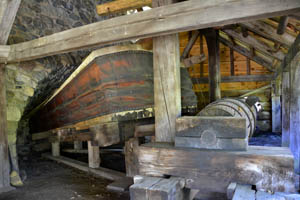
Saugus Iron Works, Massachusetts, by the National Park Service.
The works were more than a blast furnace producing crude pig iron and castware. Its forge manufactured bars of wrought iron, from which colonial farms and enterprises could make the tools and hardware needed—hoes, shovels, hinges, and other items. Its rolling and slitting mill turned out rod iron that could be shaped into nails, which were much needed in the colonies. The works comprised a blast furnace, a casting house, a forge with two fineries and a chafery, a rolling and slitting mill, and various storehouses and other buildings.
Although the Iron Works produced a respectable quantity of iron, it seldom operated at a profit due to high labor costs, financial mismanagement (which may have included embezzlement), and several lawsuits. Finally, after years of active and widely distributed production, a growing scarcity of raw materials seriously affected operations. Imported iron wares undercut Saugus iron in the market, and by 1670, the works had been abandoned and were beginning to fall into ruins. The iron industry did not flourish again in the colonies until the 18th century.
Saugus Iron Works had entirely disappeared by the 1940s, when a project to reconstruct it began. Rebuilding involved six years of research and construction, with funds totaling $1.5 million. The reconstruction was based on archaeological evidence and historical documents, and partially on conjecture.
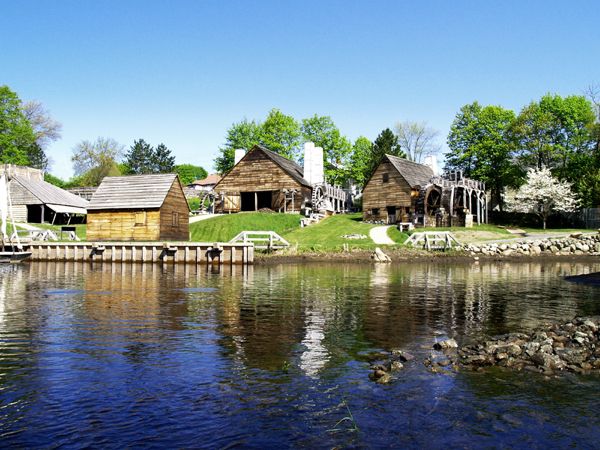
Saugus Iron Works National Historic Site.
The Saugus Iron Works was opened to the public on September 18, 1954. Restored and supported by today’s American iron and steel industry, it is a full-scale model of the original 17th-century works and has a unique public interest and educational value.
In 1968, by an Act of Congress, the ironworks became Saugus Iron Works National Historic Site and were officially added to the National Parks system.
The historic site, encompassing nine acres, includes the reconstructed blast furnace, forge, rolling mill, shear, slitter, and a quarter-ton trip hammer. It also features a 17th-century historic home, three reproduction industrial buildings, seven waterwheels, a blacksmith shop, a museum, and a stream.
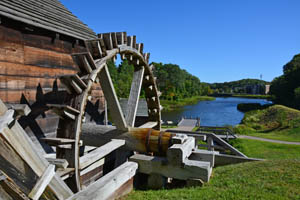
Saugus Iron Works, Massachusetts, by the National Park Service.
The museum is a great place to begin your exploration of the Saugus Iron Works National Historic Site. The museum has two rooms full of exhibits and artifacts excavated during the on-site archaeological dig in the 1940s-1950s. The park is open seasonally, from May through October.
It is located in Saugus, Massachusetts, about 10 miles north of Boston, on U.S. 1.
More Information:
Saugus Iron Works
244 Central Street
Saugus, Massachusetts 01906
781-233-0050 or 781-231-7341
Compiled by Kathy Alexander/Legends of America, updated December 2025.
Also See:
Historic Sites and Buildings of Massachusetts
National Parks, Monuments & Historic Sites
Sources:
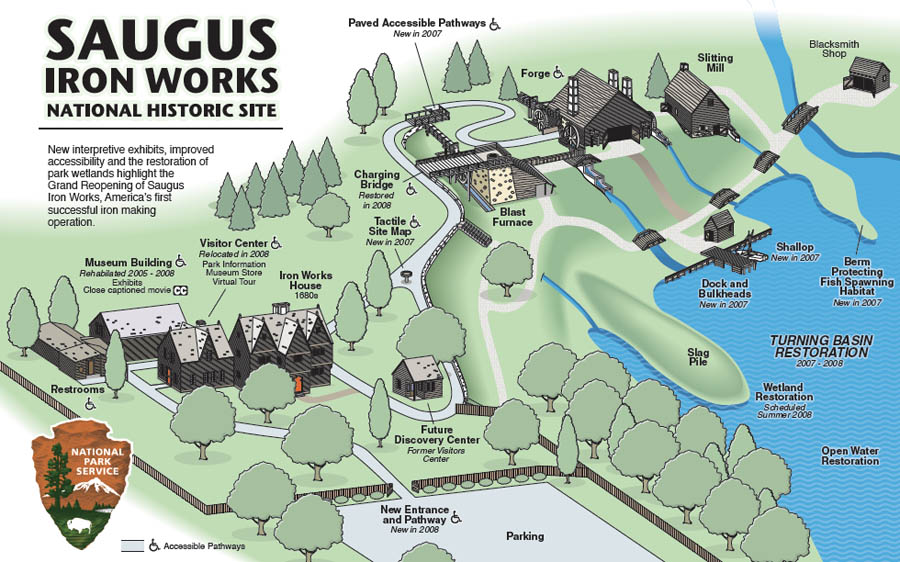
Saugus Historical Site Map by the National Park Service.