

Council Grove, Kansas, 1885.
Council Grove, the county seat of Morris County and one of Kansas’s most historic towns, is situated on the Neosho River in the eastern part of the county.
Travelers mentioned the place where Council Grove now stands as early as 1820. In 1825, a treaty was negotiated with the Osage Indians for a right-of-way for the Santa Fe Trail, a portion of which would later become the main street of Council Grove. The treaty between U.S. commissioners and the Osage Indian chiefs was concluded in “The Grove,” thereby giving the place its name.
Long before a town ever developed, many who traveled along the Santa Fe Trail gathered their wagons here and moved westward in larger groups, as beyond the “Grove” the trail was often fraught with Indian attacks.
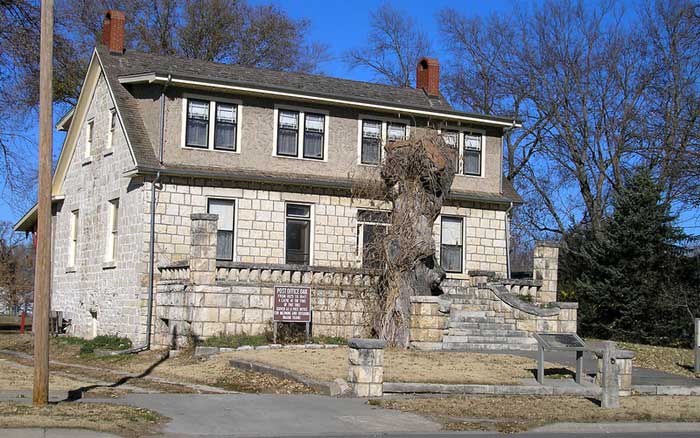
Council Grove Post Office Oak. The old oak tree has since been removed and replaced with a pole. By Kathy Alexander.
As early as 1825 and for the next two decades, a large oak tree, known as “The Post Office Oak,” was used by passing caravans to leave messages for incoming travelers. These messages, placed in a cache at the base of the tree, contained information about water, danger, and opportunities on the trail.
In the spring of 1846, the Kanza Indians signed a treaty with the government, ceding their reservation along the Kansas River near Topeka in exchange for a new but smaller reservation in the upper valley of the Neosho River in what is now Morris County. In April 1847, the 20-square-mile Kanza reservation was established near Council Grove, and the Indians were moved.
That same year, Seth M. Hays became the first settler in the settlement of Council Grove. Here, he established a trading post for trade with Indigenous peoples. He also built the first house, a log cabin, on the north side of the old Santa Fe Trail near the west bank of the Neosho River. The cabin served as both a store and a dwelling, housing Mr. Hays, his adopted daughter, and a freed slave.
In 1848, Mitchell came to Council Grove as a government blacksmith, bringing his wife, the first white woman in Morris County.
In 1849, the Methodist Episcopal Church began building the Kaw Mission at Council Grove. It opened in 1850, and Thomas S. Huffaker was its first teacher, a position he held until 1854, when the school closed. The Kaw Mission would later become the first school for the settlers’ children.
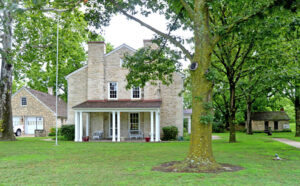
Kaw Mission at Council Grove, Kansas by Kathy Alexander.
Over the next several years, many other traders arrived in the area and established trading posts along the Santa Fe Trail. The traders thrived for years because Council Grove was the last trading post on the trail before travelers reached New Mexico.
From 1849 to 1854, it was a very prosperous period for Council Grove, and its reputation as a trading post made it a well-known point, at least to all those making a trip across the plains. By 1854, the men doing business in Council Grove were Seth M. Hays, the Choteau brothers, the Columbia brothers, and Charles H. Withington, and these, with a few employees and several men in the employ of the Government, constituted the entire settlement, not only of Council Grove but of Morris County.
In October 1854, Governor Andrew Reeder visited Council Grove, intending to make it the territorial capital, but the land was then an Indian possession.
The first hotel in the town was built by M. Gilkey in 1856 on the south side of Main Street, directly opposite the log cabin built by Seth Hays in 1847. Baker and Sewell built the next home. The following year, Seth Hays also built the Hays House, the oldest continuously operating restaurant west of the Mississippi River today. The Last Chance Store was built in the same year.
In 1858, the Legislature approved the incorporation of the Town Company of Council Grove, with the following men as officers: T.S. Huffaker, Christopher Columbia, Seth Hays, and Hiram Northrup. Soon, the townsite was surveyed, and a settlement “officially” began. The first newspaper, the Kansas Press, was established in 1859 by S.N. Wood.
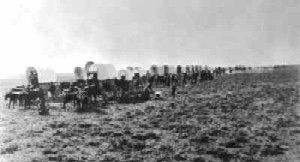
Wagon Train.
Although the area had a considerable business from its earliest days, the town’s growth was relatively slow. Its business was derived chiefly, if not wholly, from the Indians and wagon trains traveling over the Santa Fe Trail. In 1860, there were but two stores in town, one operated by Seth Hays and the other by Malcolm Conn. At that time, the entire county had only about 770 residents. The severe drought of 1860 devastated Morris County and all of Kansas, further reducing the county’s population.
In 1861, S.N. Wood sold the Kansas Press to A.I. Baker, who changed the newspaper’s name to the Council Grove Press. However, Baker ran the paper for only about a month before he suspended publication. In the meantime, the Civil War erupted. When Colonel S.N. Wood returned to Council Grove, he found that Missouri bushwhackers had killed A.I. Baker, and he resumed newspaper publication. Wood continued to manage the paper until 1865, when he sold it. The following year, it moved to another county.
In 1866, the town’s prosperity received another severe blow when the Stage Line Company moved to Junction City. The long wagon trains that previously formed at Council Grove were then formed at Junction City and moved westward over the Smoky Hill Trail, cutting off much of the prosperous trade.
In 1867, Seth M. Hays built the first substantial home in the settlement, constructed of bricks from a local factory. The historic home remains on Wood Street and is operated as a museum by the Morris County Historical Society.
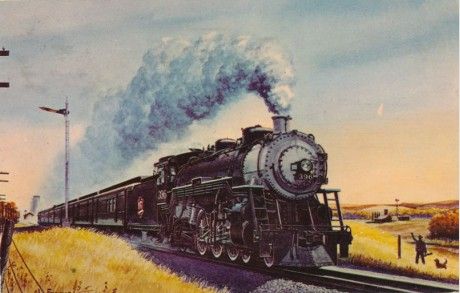
Missouri-Kansas-Texas Railroad.
The first school was established in Council Grove in 1868. That same year, the Missouri-Kansas-Texas Railroad was built through Morris County, bringing many new citizens to Council Grove.
Morris County received its last Indian scare in June 1868 when some 400 Cheyenne Indians flooded Council Grove armed and painted for war. Though they were destined for a confrontation with the Kanza Indians, the settlers of Council Grove, taken entirely by surprise, held themselves in readiness for whatever might happen. The Indians, however, moved on, taking up their differences with the Kanza Indians. An Indian battle occurred outside Council Grove, known as the Cheyenne Outbreak of Morris County.
On April 30, 1869, the city settlement became a third-class city, and in June 1870, the first election for city officers was held, at which R.B. Lockwood was elected mayor. By 1871, several new settlements had emerged in the county, and a county seat contest ensued. When Parkerville became an incorporated town, it challenged Council Grove for the county seat, and an election was held to resolve the matter. Both sides resorted to various forms of fraud, including bringing in men by the hundreds for voting purposes. At that time, the county’s population was 2,225. The number of votes cast was 1,312, of which 899 were for Council Grove and 413 for Parkerville. The question was not brought up again.
By 1872, the Santa Fe Railroad was completed to the Colorado border, and the Santa Fe Trail’s days as the main transportation route were over.
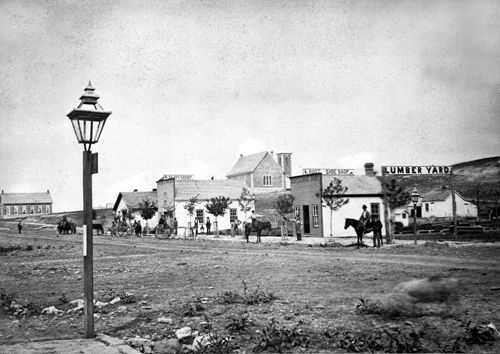
Council Grove, Kansas, about 1875.
In 1873, the Kanza Indians were removed from their reservation in Morris County and relocated to the Oklahoma Territory, thereby opening additional land in the county for white settlement.
On November 9, 1875, a fire destroyed the school building, Shamleffer’s Mill, and other city property, resulting in a total loss of $35,000. No steps were taken to rebuild the schoolhouse until 1883, when a stone building was erected.
Though Council Grove had its ups and downs, it continued on and by the early 1880s had a large stone courthouse, a large steam-powered flouring mill, nine grocery stores, two hardware stores, several dry goods stores, three restaurants, a furniture store, a bank, three livery stables, a lumber yard, four hotels, and four churches.
By the early 1900s, the town had grown to a population of over 2,500 people and had two banks, an international money order post office with five rural routes, express and telegraph offices, a telephone exchange, an electric lighting plant and waterworks, grain elevators, three newspapers, an opera house, several good hotels, and numerous retail businesses.
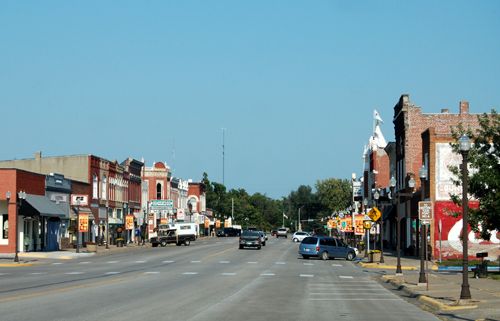
Council Grove, Kansas Main Street, today by Kathy Alexander.
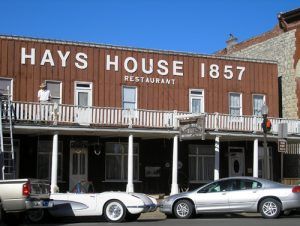
The Hays House is the oldest operating restaurant west of the Mississippi River, by Kathy Alexander.
Over the next century, Council Grove moved forward while maintaining its economic mainstay of agriculture and ranching and carefully preserving its history. Today, the small town has a population of approximately 2,140. It provides a vivid peek at its former Santa Fe Trail days at more than 24 historical sites, including the Hays House, the oldest continuously operated restaurant west of the Mississippi River, the Kaw Mission, Hermits Cave, remnants of Santa Fe Trail ruts, several museums, and more. Historic Tour brochures provide a self-guided tour of these historical sites and are available for pickup at the Chamber of Commerce, 207 W Main Street.
Council Grove also offers recreational opportunities at two lakes—the 3,000-acre Council Grove Reservoir and City Lake —which provide camping, boating, fishing, and picnicking.
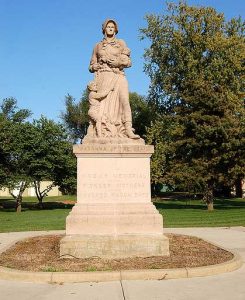
Council Grove Madonna of the Trail Monument by Kathy Alexander.
More Information:
Council Grove/Morris County Chamber of Commerce
207 W. Main Street
Council Grove, Kansas 66846
620-767-5413
©Kathy Alexander//Legends of America, updated January 2026.
Also See:
Santa Fe Trail Through Morris County
See Sources.