
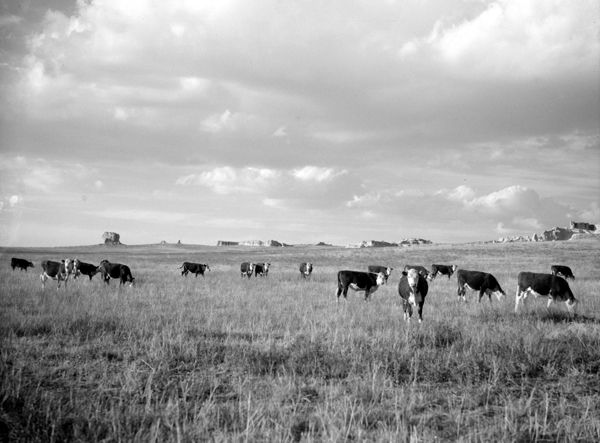
Wyoming cattle by Arthur Rothstein.
Into the vast open range of Wyoming, where thousands of buffalo once roamed, came great herds of cattle in the 1880s. At this time, most of the land was in the public domain and was utilized primarily by large cattle ranchers, but as more and more small homesteaders moved into the region, the cattle barons began to resist.
In 1884, the entire range was monopolized by about 20 large ranches that allowed their cattle to roam freely. Each spring, a roundup was held, during which the cows and calves belonging to each ranch were separated, and the calves were branded. However, calves were sometimes taken and branded before they could be rounded up, prompting large ranch owners to punish cattle rustlers aggressively. Because the cattle barons generally ran their ranches with a “hands-off” approach, hiring cowboys and foremen to do the work, they usually forbade their own employees from owning cattle. This eliminated any temptation to take a few orphan or stray calves. In the beginning, property and water rights were usually respected among big and small ranches based on who was first to settle the land and the size of the herd. However, as more and more homesteaders moved into the region, some of the large ranches banded together to monopolize large areas of the open range to prevent newcomers from settling.
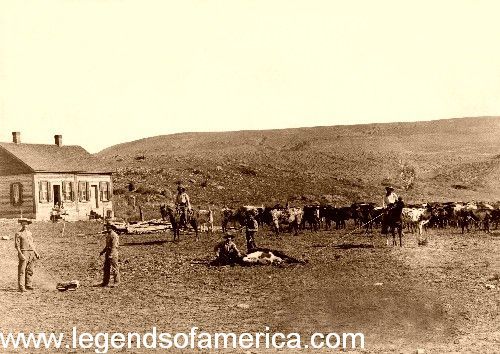
Branding Cattle in 1891.
Adding fuel to the fire was an increasing number of missing cattle, especially the unbranded calves. Though the vast majority of small ranchers were hard-working men, some saw the maverick calves as a way to build their herds and would unscrupulously make away with them before the large ranch round-ups. Before long, the cattle barons began to blame the homesteaders for any missing cattle. The cattle barons were also unhappy as they watched more and more of the open range being taken over by large sheep herds – a blasphemy to a cattleman.
The tension increased between the cattle barons and the smaller ranch owners after a summer of drought was followed by severe blizzards during the winter of 1886-1887. Thousands of cattle died of the bitter cold, and more were lost to wolves and cattle rustlers. At the same time, cattle prices plummeted, causing the cattle barons’ profits to drop dramatically and even put a few of them out of business.

Cowboy in the Winter in Wyoming by Charles Belden.
By this time, the large ranches were greatly outnumbered by homesteaders who had little sympathy for their problems. Time after time, cattle thieves were hauled into court, but it was almost impossible to get a jury to convict anyone. Finally, the cattle barons decided to take matters into their own hands and stepped up the number of range detectives hired by the Wyoming Stock Growers Association to help curb cattle rustling. The Association also drew up several new rules that made it extremely difficult for anyone to register a new brand and employed stock inspectors at shipping points to confiscate cattle with unregistered brands.
The large ranchers also began to aggressively appropriate land where they controlled the water supply and excluded smaller ranchers from participation in the annual roundup. At the same time, the detectives hired by the Association were increasingly implicated in the deaths of several small ranchers and suspected cattle thieves.
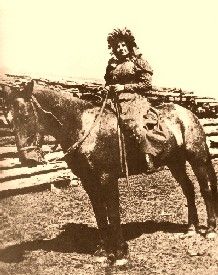
Ellen Watson, aka “Cattle Kate”.
Things really came to a head when homesteaders Ella Watson, aka Cattle Kate, and Jim Averell were accused of cattle rustling and hanged in July 1889. Though the small area ranchers were enraged, the intimidation continued.
Finally, in the spring of 1892, the angry small ranchers decided to form their own association, the Northern Wyoming Farmers and Stock Growers Association.
In response, the Wyoming Stock Growers Association decided to hire some 50 men, including several known Texas killers, to eliminate the alleged rustlers in Johnson County. On April 5, 1892, a large party of cattlemen, five stock detectives, including Frank M. Canton, and 23 gunfighters, under the command of Major Frank Wolcott, set out from Cheyenne on their way to Buffalo. Beyond Casper, the force, called the “Regulators,” began cutting the telegraph lines along the way to prevent an alarm.
The armed men first targeted Nate Champion of the KC Ranch, who had actively promoted the rival Northern Wyoming Farmers and Stock Growers Association and a competing roundup. However, according to Dale Champion, Nate’s Great Great Great Nephew, his research found that Nate was not actively promoting the association or a competing roundup. In fact, Champion tells us that the Association had appointed Nate as their leader during a meeting he wasn’t even at. When Nate found out, he declined the nomination, but word had already gotten out about the meeting. Dale Champion says, “By their choosing Nate, they signed his death warrant.”
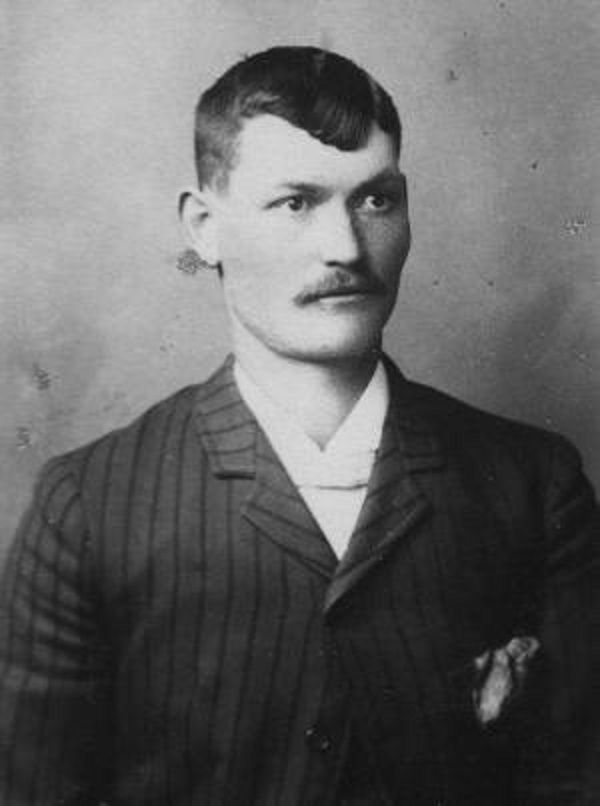
Nate Champion.
When the hired guns arrived, they found only four men at the ranch cabin. Two trappers passing through were captured, but Nate Champion and cowboy, Rueben “Nick” Ray, were shot and killed. Dale Champion adds, “At the time of Nate’s death, he had eight pack horses, all just paid for, and nearly 200 head of cattle of his own. He was getting ready to take a ranch and homestead it. He had a good reputation as an honest businessman.”
Jack Flagg, a suspected rustler during the siege, and his stepson, Alonzo Taylor, unwittingly crossed the firing zone. Though the gunfighters chased them, the pair escaped, warning the people of Buffalo of the group of armed men. The following day, Buffalo Sheriff Red Angus led a posse of 200 men to find the gunfighters. Holed up at the TA Ranch on Crazy Woman Creek, the posse laid siege to the ranch and Wolcott’s men.
A standoff occurred until one of the “Regulators” escaped and contacted the Wyoming Governor. In no time, the Sixth Cavalry from Fort McKinney proceeded to the TA Ranch to save the Association members from the sheriff’s posse. Early on the morning of April 13th, the standoff came to an end when the cattlemen surrendered to the 6th Cavalry.
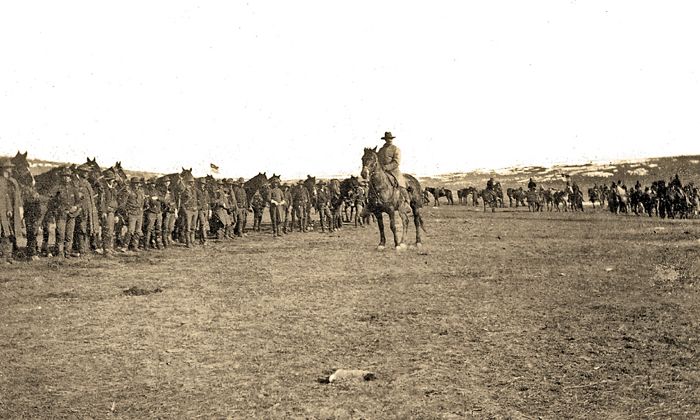
Wolcott’s Regulators surrendering at the TA Ranch in Wyoming.
In the protective custody of the cavalry, Wolcott and his men were transferred to Cheyenne. The Texas gunfighters immediately disappeared after bail was made and they were released. Court proceedings began for the locals, and a trial was eventually set for January 1893. But as time dragged on, material witnesses disappeared, and finding impartial jurors proved to be next to impossible. Ultimately, the high cost of the trial led the court to dismiss the entire case.
At Legends’ Photo Print Shop.
Though the Johnson County War was over, scattered violence continued for over a decade as rustlers continued to be hanged.
©Kathy Alexander/Legends of America, updated March 2026.
Also See:
Cattle Kate – Mystery of a Lynching
Tom Horn – Wyoming Killer for Hire
The Homestead Act – Creating Prosperity in America
Wolcott’s Regulators of the Johnson County War
See Sources.