|
Legends Home
Site
Map
What's New!!

American History
Ghost Towns
Ghostly Legends
Historic People
Native Americans
The Old West
Photo
Galleries
Roadside Attractions
Rocky Mtn Store
Route 66
Travel
Destinations
Treasure Tales
Legends Blog
Free E-Newsletter

P.O. Box 19423
Lenexa,
KS 66285
913-708-5119
Please report
broken links, missing pictures, or other problems online by clicking
HERE or send us an
email.
Thanks!
| |
|
|
|
Complete List of
Old West Vigilantes
More Lists: Explorers | Gunfighters | Lawmen | Native Americans | Outlaws | Outlaw Gangs | Scoundrels | Soldiers | Trail Blazers & Cowboys | Vigilantes | Women |
|
|
|
<<
Previous
1 2 3 Next >>
|
|
Shelby County Texas Regulators - In 1839 land disputes, fraudulent
land transactions, and cattle rustling in Harrison and Shelby Counties led
to the formation of the Regulators the following year. The principal
leaders of the Regulators were Charles W. Jackson and Charles W. Moorman
with its primary goal to prevent cattle rustling. However, as the
Regulators' actions became too extreme a counter-vigilante
group was formed, called the Moderators, to "moderate" the Regulators.
This opposing faction's principal leaders were Edward Merchant, John M.
Bradley, and Deputy Sheriff James J. Cravens. The roots of the
conflict lay in the land disputes over the neutral ground that lay between
the American and Mexican borders. As the violence between the two factions
escalated and eventually spread to San Augustine, Nacogdoches, and other
East
Texas
counties, the conflict became known as the
Regulator-Moderator War. Of the whole affair, Sam Houston reportedly stated, "I think it advisable
to declare Shelby County, Tenaha, and Terrapin Neck free and independent
governments, and let them fight it out." By the time the conflict was
finally resolved in 1844, at least ten people had been killed, including
Regulator leader Charles W. Jackson.
Stuart's
Stranglers or the Montana Stranglers (1884) - Granville Stuart,
best known as being a
Montana
cattleman, he is also credited as earning his living as a miner, a
merchant, horsetrader, banker, rancher, real estate investor, historian
and writer. What many may not know is that he was also the leader of an
extremely successful group of
Montana
vigilantes.
In the early 1880’s,
Montana was
still a wild and lawless place with wide expanses of land and with more
heads of cattle living there than people. Under those conditions, it was a
haven for cattle rustlers and horse thieves. In April, 1884, a number of
cattlemen met in Helena to try to come up with a solution to this ever
growing problem, but they could not agree to a solution other than to
gather as much information as possible on the rustlers.
Determining that the leaders of these rustling
gangs were a number of hard cases, Stuart soon gathered up 14 fighting men
to go after the outlaws and stop the thievery. Though Stuart called his
men a “Vigilante Committee,” much like those that had operated in the
Virginia City area two decades prior, they would forever be remembered
“Stuart’s Stranglers” or the “Montana Stranglers.”
|
|
|
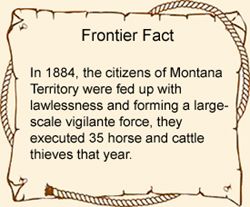
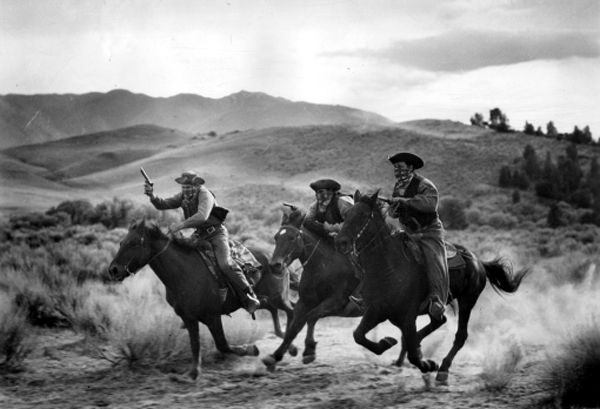
Within no time dozens
of
Montana
outlaws had either been strung up in trees or riddled with bullets.
The
Montana Stock
Growers’ Association was so appreciative of Stuart’s efforts that they
elected him president of the organization that summer of 1884.
Texas Vigilantes
- In the two decades following the
Civil War,
Texas
was a lawless place and in many sections of the
Texas
frontier, courts and jails had not been established. In others, the
authorities could not be depended on to take action against the many
criminal elements flooding into the state. To counteract the
outrages caused by these
outlaws,
vigilante groups formed all over
Texas
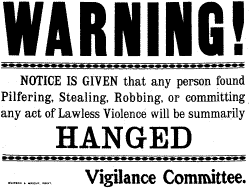
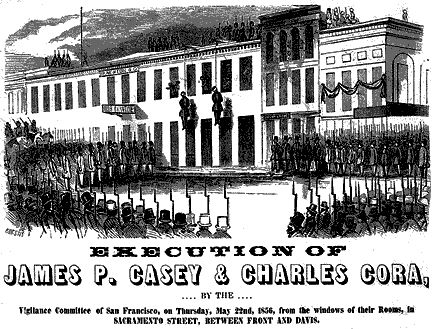
to stamp out lawlessness and rid communities of desperadoes. Often formed
by decent law-abiding citizens, most
vigilante groups handled criminals by imitating legal court
procedure where the offender was "tried" before a
vigilante judge and a jury.
|
| |

A
Texas
vigilante court is about to hang a gang member
that shot up a saloon in a dispute over a
prisoner taken
by the sheriff. From Frank Leslie's
Illustrated
Newspaper, November 12, 1881.
|
|
|
Convictions often resulted in
whippings or expulsion from the community, but at least 17
Texas
vigilante groups used hanging to curb the criminal mentality. Though their original focus may have been admirable, many of these
vigilante committees degenerated into warring mobs committing
criminal acts themselves.
At other times, these groups were used for
private vengeance or personal gain. While many of the groups were
successful, driving out murderers, horse thieves, cattle rustlers, and
train robbers, they were finally put to an end in 1897 when the
Texas
Rangers broke up a group of
vigilantes who frequently gathered at Buzzard Roost. Over
the years, these many
vigilante groups claimed some 140 lives, with the most active
being the san Saba County Lynchers, who killed approximately 25 people
between 1880 and 1896.
|
|

Fort Griffin Administration Building, June, 2007, Kathy Weiser
This image available for
photographic prints and
downloads
HERE! |
Tin Hat Brigade (1874-1878) - The
best known and probably the most active vigilance committee in
Texas
was that of the Tin Hat Brigade of
Fort
Griffin. The settlement that
grew up around the post quickly became a bustling frontier town
attracting an array of buffalo hunters, tradesmen, soiled doves, and
cowboys passing through with their cattle herds on the Western Trail.
The town also attracted a host of the
outlaws,
thieves, and desperate characters, becoming a hotbed for violence.
Before long, the town sported a roster of those who passed through the
area that reads like a "whos-who of the
American
West," including
Pat Garrett,
Doc Holliday,
Wyatt Earp, Johnny Golden,
John
Wesley Hardin,
Lottie Deno, and Mollie McCabe. |
|
|
Law and order was much
needed in the wild and wooly community, in fact it became so bad, that in
1874, the lawlessness required the military to declare martial law on the
town as the
Fort Griffin
soldiers tried to run many of the lawbreakers out of town for good.
However, this was not enough for a certain faction of men who in the town
who decided to take the law into their own hands. Seeing to the protection
of the lives and property of the people in the surrounding area, this band
of men, who called themselves the Tin Hat Brigade, determined that swift
"justice" was more effective. Soon, many a horse thief was found hanging
from a tree near the river.
In 1874, a man named
John Larn
joined the brigade and the respect that
Larn gained
as a member of this group helped to get him elected sheriff of
Fort Griffin
in April, 1876. That same month, the
Tin Hat Brigade caught a man in the act of stealing a horse
and promptly hanged him to a pecan
tree. Leaving his body hanging there for all to see, they also left a pick
and shovel below his gruesome remains for anyone who might have wished to
remove the thief and bury him. In the next three months the
Fort Griffin
vigilantes shot two more horse thieves and hanged six others. In the
meantime, Sheriff
Larn
hired
John Henry Selman to work for him, but the two were not what they
appeared to be.
Instead of controlling the area crime, they controlled the vigilantes,
rustling cattle and otherwise terrorizing the county. After serving less
than a year as sheriff,
Larn
resigned and moved on to outright cattle rustling. Within a year, a
warrant had been issued for
Larn's
arrest, and the the new Sheriff William Cruger, who had formerly been
Larn's
deputy, was tasked with arresting him. Bringing
Larn
in on June 22, 1878, he shackled him to the floor of the jail house to
prevent a breakout by
Larn's supporters. Instead,
the next night, the Tin Hat Brigade stormed the jail intending to
hang
Larn.
When they found they couldn't lynch the shackled man, they shot him in his
cell. At about the same time an
unknown man was found hanging outside of town and the town marshal,
William C. Gilson, went missing. The rumor was that Gilson knew too much
about the going-ons of the vigilantes and was killed in order to keep him
quiet.
©
Kathy Weiser/Legends
of America, updated March, 2008
|
|
<<
Previous
1 2 3 Next >>
|
|
From the Rocky Mountain General Store
Old
West Exclusive Products -
Legends of America and the
Rocky Mountain
General Store now provide a number of
exclusive products that you won't find anywhere else!
Utilizing our vintage photos,
Old West
words, and original graphics, you'll find selections for
t-shirts, bumper stickers,
Old West prints and calendars, and much more. Click
HERE to see the entire line.
|
| |
|