

Sacagawea guided Lewis and Clark on their expedition of 1804-06.
A French-Canadian explorer, trader, and a member of the Lewis and Clark Expedition, Charbonneau was born in Boucherville, Quebec, on March 20, 1767. Located near Montreal, this community had strong links to exploration and the fur trade. When he grew up, he worked for a time as a fur trapper with the British-owned North West Company. He was first mentioned in recorded history in May 1795, when John McDonell, the recorder of one of the North West expeditions, described him unfavorably:
“Tousst. Charbonneau was stabbed at the Manitou-a-banc end of the Portage la Prairie, Manitoba, in the act of committing a Rape upon her Daughter by an old Saultier woman with a Canoe Awl – a fate he highly deserved for his brutality – It was with difficulty he could walk back over the portage.”
While working for the North West Company, he encountered the Mandan and Hidatsa tribes living on the upper Missouri River near present-day Bismarck, North Dakota. By 1797, he was living among them, which would remain his home for the rest of his life. He then became a free agent, trapping for several different fur companies operating in the region. He also sometimes worked as a laborer and an interpreter of the Hidatsa language. During this time, he took two wives, both Shoshone women whom the Hidatsa tribe had captured in about 1800. The Hidatsa sold the pair – Sacagawea and another named Otter Woman- to Toussaint.
In October 1804, when the Lewis and Clark Expedition arrived at the upper Missouri River villages, Sacagawea, who was about 16 years old at the time, was pregnant with their first child. Over the winter, Meriwether Lewis, William Clark, and their men built Fort Mandan and worked to recruit members for the expedition. Lewis and Clark were not overly impressed with Charbonneau, who, even though he had lived with the Hidatsa for several years, did not know the Hidatsa language very well, and he could not speak English. However, they did like that his wives were Shoshone and needed an interpreter for that language as well. Sacagawea spoke both Shoshone and Hidatsa. With several men in the expedition who could translate Charbonneau’s French to English, they hired him on November 4, 1804, and he moved to Fort Mandan a week later. During that winter, Toussaint’s and Sacagawea’s son, Jean-Baptiste Charbonneau, was born on February 11, 1805.
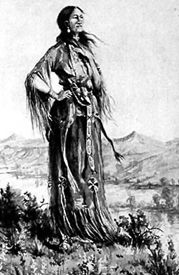
Sacagawea drawing by E.S. Paxson.
Before the expedition left, Charbonneau, knowing how critical Sacagawea would be to Lewis and Clark when dealing with the Shoshone, attempted to dictate the terms of his employment, refusing to perform the duties of an enlisted man and stand regular guard. When the captains would not agree, Charbonneau said he would not go. Lewis and Clark told Charbonneau to move out of the fort with his family. However, four days later, Charbonneau offered his apologies, and the captains signed him on again. He was one of only five people on the expedition who were not in the military. When it was time to leave, his wife, Otter Woman, was not with the group.
His performance during the journey was mixed – Meriwether Lewis called him “a man of no peculiar merit.” On two occasions, his lack of boating skills created two near disasters. On April 13, 1805, just a few days after leaving Fort Mandan, he nearly capsized a boat until another man corrected the situation. A month later, he nearly did it again while at the helm of a boat that contained papers, books, instruments, medicines, and many trade goods. Meriwether Lewis was irate, writing that Charbonneau was “perhaps the timidest waterman in the world.” On another occasion, William Clark had to reprimand him for shirking his duties and intervene in a marital dispute in which Toussaint hit his wife, Sacagawea.
However, Charbonneau did make several contributions to the expedition’s success. He sometimes served as a cook and was praised by several party members. He had skills in making bargains with Indian tribes and was helpful when the expedition encountered French trappers from Canada.
Along the journey, William Clark became very fond of Toussaint’s and Sacagawea’s son, Jean-Baptiste, whom he nicknamed “Pomp.” Despite the challenges that Clark and Meriwether Lewis had with Toussaint, Clark extended his fondness for his son to the entire family. He offered to set them up in St. Louis, Missouri, after the expedition, which included providing Jean-Baptiste with an education.
On August 14, 1806, the Corps arrived back at the Mandan villages, and Charbonneau was paid $500.33 for his 19 months with the group. He initially declined Clark’s offer to relocate to St. Louis, Missouri, preferring to live with the Mandan and Hidatsa. However, by the fall of 1809, he had changed his mind, and he, Sacagawea, and Jean-Baptiste moved to Missouri, settling on a 320-acre land grant. However, farming didn’t suit him, and in the spring of 1811, he sold the farm, and he and Sacagawea returned to the north, leaving Jean-Baptiste in the care of William Clark.
Toussaint then took a job with Manuel Lisa’s Missouri Fur Company and was stationed at Fort Manuel Lisa Trading Post in South Dakota. Sacagawea gave birth to a daughter whom they named Lizette. While Charbonneau was on an expedition, Sacagawea died on December 22, 1812, at Fort Manuel, of a disease called “putrid fever.” She was only about 24 years old. However, oral traditions of the Shoshone say that Sacagawea rejoined the Shoshone on their Wind River Reservation, where she lived a long life, dying in 1884.
Toussaint signed over formal custody of his son, Jean Baptiste, and daughter, Lisette, to William Clark, and records show that Clark legally adopted them in August 1813. Jean Baptiste Charbonneau lived a long and adventurous life, traveling to Europe and later becoming a guide with John Fremont and other mountain men. He died in 1866 at age 61 on the trail to a gold strike in Montana. It is not believed that Lizette survived childhood, as there is no later record of her among Clark’s papers.
Charbonneau continued to work as a trapper and, from 1811-38, also worked for the Upper Missouri Agency’s Indian Bureau as a translator. He most likely gained this position with the help of William Clark, who was the governor of the Missouri Territory in 1813. Upon Clark’s death, Charbonneau’s employment with the government came to an abrupt halt. Toussaint Charbonneau continued his life as a mountain man, working for the American Fur Company and accompanying Prince Maximillian’s expedition in 1833. During his life, he was known to have had five Native American wives, all of whom were very young at the time. His last known wife was a young Assiniboine girl who was just 14 years old when they married in 1837. He was more than 70 years old.
Surviving records show that Charbonneau was widely disliked by others working in the Missouri Territory, including those on the Lewis and Clark Expedition.
Toussaint Charbonneau died at Fort Mandan in 1843.
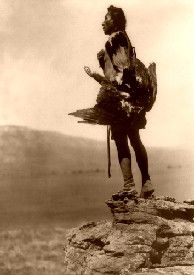
Eagle Catcher, Hidatsa.
©Kathy Alexander/Legends of America, updated June 2025.
Also See:
Corps of Discovery – The Lewis & Clark Expedition
List of Old West Explorers, Trappers, Traders & Mountain Men
Sacagawea – Leading Lewis & Clark
Trading Posts and Their Stories
Trappers, Traders & Pathfinders
See Sources.