

Ellen “Nellie” Cashman, 1874.
Nellie Cashman was one of the Old West’s original female entrepreneurs, as well as a prospector and an “angel of mercy.” Wandering the frontier mining camps of the West in search of her fortune, she soon became known throughout the West for her charity, courage, and determination.
Ellen “Nellie” Cashman was born in Queenstown, County Cork, Ireland, in 1845, to Patrick Cashman and Frances “Fanny” Cronin. Her father died when she was a very young child, just five years old; she and her sister, Fanny, immigrated with their mother to the United States during the potato famine.
They first settled in Boston before moving to Washington, D.C. There, Nellie got her first job working as a lift operator in a hotel where she often overheard Civil War politics. On one occasion, she even met General Ulysses S. Grant, who urged her to go West.
Evidently, taking Grant’s advice, the family made their way to San Francisco, California, between 1865 and 1869. Fannie soon married and began to raise a family. However, an adventurous Nellie, enamored with the gold rush stories of the West, was soon hired out as a cook in various Nevada mining camps, including Virginia City and Pioche.
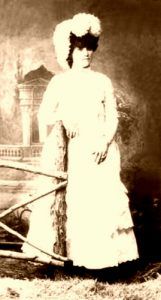
Nellie Cashman
After carefully saving her money, she opened the Miner’s Boarding House at Panaca Flat, Nevada, in 1872. She was said to have always been a great friend to the miners, often feeding them and providing lodging if they had no money.
Later, Cashman would be described as “Pretty as a Victorian cameo and, when necessary, tougher than two-penny nails.” And that she was. These few Nevada mining camps were among the first places Cashman spent time, always starting a business, doing a little prospecting on the side, and looking after the miners.
In 1874, when gold was discovered in the Cassiar Mountains of British Columbia, Canada, Nellie joined up with 200 Nevada miners headed northward. At Telegraph Creek, she set up another boarding house for miners. Again, she looked after the miners, helping when they needed it and caring for them when they were ill. A devout Catholic, Nellie began collecting money for Sisters of St. Anne in Victoria to build a hospital. Appreciative of her care, they quickly helped.
Later, Cashman traveled to Victoria to deliver $500 in donations to help the nuns build St. Joseph’s Hospital. While there, she heard that 26 miners had been stranded in a snowstorm back in the Cassiar Mountains. Wasting no time, she organized a rescue expedition with six men and several pack animals carrying 1,500 pounds of supplies, and set off to find the stranded men. Unfortunately, conditions in these mountains were so hazardous that even the Canadian Army had refused to mount a rescue. When they heard about Cashman’s expedition, the commander sent his troops to find her and return her and the men to safety. However, when they did find her, she refused to return without the stranded miners.
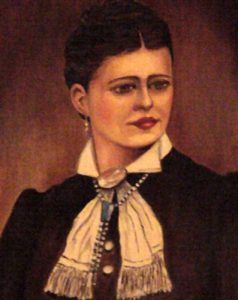
Nellie Cashman
After 77 days, sometimes treading through as much as ten feet of snow, she finally found the men, who numbered more than 75 rather than the rumored 26. Suffering from severe scurvy, she loaded them up with Vitamin C in their diets and nursed them back to health.
When the Cassiar strike played out, Nellie headed for the silver fields of Arizona in 1879. After settling in Tucson in 1879, she opened the Delmonico Restaurant, the first business in town owned by a woman. Though she often gave her food away free to the hungry, her restaurant was a success. But her time in Tucson was short-lived; in 1880, she sold the restaurant and moved on to the new silver rush and the booming town of Tombstone.
Upon her arrival, she first ran a boot and shoe store briefly before opening the Russ House Restaurant. According to one popular legend, Doc Holliday was present when a client complained about Nellie’s cooking. When Holliday drew his sidearm and asked the customer to repeat what he had said, the embarrassed customer replied, “Best I ever ate.”
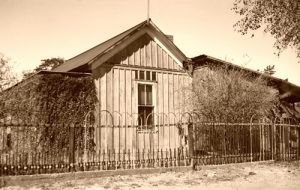
Nellie Cashman’s house in Tombstone, Arizona
She continued her work for the Catholic faith, raising money to build the Sacred Heart Catholic Church in Tombstone, and worked as a nurse. Before enough money was raised to build the church, she convinced the owners of the Crystal Palace Saloon to allow Sunday church services there. Also raising money for the Salvation Army, the Red Cross, the Miner’s Hospital, and any miner who might have fallen on hard times, she soon earned the nickname “Angel of Mercy.”
When her brother-in-law died in 1881, Nellie invited her sister, Fannie, who had five children, to join her in Tombstone.
In December 1883, five killers committed a robbery in Bisbee, leaving behind four people dead. Known as the Bisbee Massacre, the law quickly put them on their trail. Captured and taken to trial in Tombstone, the men were scheduled to hang on March 8, 1884. However, the town soon took on a carnival-like atmosphere, and it issued free tickets for the event. But when Sheriff Ward ran out, an enterprising businessman built bleachers around the gallows and began selling more tickets.

Bisbee Massacre Grave
Nellie objected adamantly to the circus that was surrounding the event. Outraged at the citizens’ behavior and feeling that no death should be “celebrated,” she soon befriended the five convicts, visiting them often and providing them with spiritual guidance. She pleaded with Sheriff Ward to place a curfew on the town when the hangings were to take place. Ward conceded, and the vast majority of interested onlookers were not allowed to watch the “event.
After they were executed, the men were buried in Tombstone’s Boot Hill cemetery. However, Cashman also found out that there was a plan to rob the bodies from their graves for a medical school study. This, too, outraged her, and she hired two prospectors to guard the graves for ten days, which were left undisturbed and remain at Boot Hill today.
Later that year, when a group of miners attempted to lynch mine owner E.B. Gage during a labor dispute, Nellie drove her buggy into the mob. She rescued Gage, spiriting him away to Benson, Arizona.
After returning from an unsuccessful gold expedition to Baja, California, her widowed sister Fannie died of tuberculosis, leaving Nellie to raise her five children. In 1886, Nellie sold the Russ House and left Tombstone with the children. After traveling to several places in Arizona, including Nogales, Jerome, Prescott, Yuma, and Harqua Hala, she again set up restaurants and worked part-time prospecting. Later, she wandered other mining camps in Wyoming, Montana, and New Mexico. Under her care, all five children became successful, productive citizens despite their constant wandering.
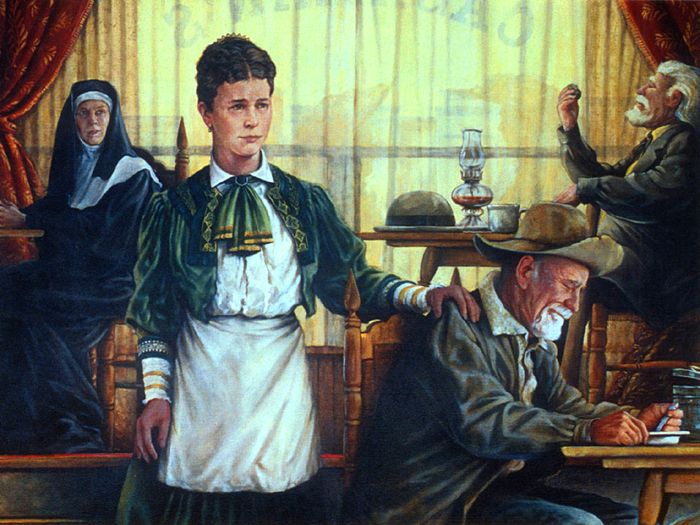
Nellie Cashman in Arizona by Fred Calleri
When the Klondike Gold Rush began, Nellie headed to the Yukon in 1898. In Dawson City, she set up yet another restaurant and mercantile, again helping the miners whenever needed. Then, in 1904, she went to Fairbanks, where she opened a grocery store. Meanwhile, she collected claims in the region when she could.
Nellie finally settled down in Victoria, British Columbia, in 1923. In January 1925, she died of pneumonia in the very same hospital she had helped to build – St. Joseph’s. Because of her giving spirit, she was known throughout the West when she died, and her eulogy was published in papers as far away as New York. The diminutive woman, who often dressed as a man and never married, had made her mark as one of the first women entrepreneurs in the West, as well as a miner and an “Angel of Mercy.” Throughout the various mining camps, she had variously been called the Frontier Angel, Saint of the Sourdoughs, Miner’s Angel, Angel of the Cassiar, and The Angel of Tombstone.
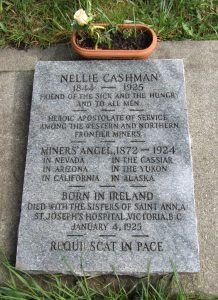
Nellie Cashman’s Grave at Ross Bay Cemetery in Victoria, British Columbia, Canada
On March 15, 2006, Nellie Cashman was inducted into the Alaska Mining Hall of Fame.
©Kathy Alexander/Legends of America, updated October 2026.
Also See:
Tombstone – The Town Too Tough to Die
Women of the Klondike Gold Rush
See Sources.