
By Edgar Beecher Bronson in 1910
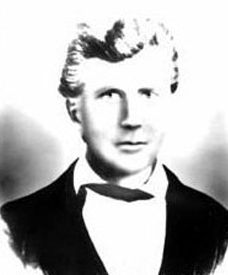
Oliver Loving.
From San Antonio to Fort Griffin, Texas, Oliver Loving was a name to conjure with in the mid-1860s. His tragic story is still told and retold around campfires on the Plains.
One of the thriftiest of the pioneer cow-hunters, he was the first to realize that if he was to profit by the fruits of his labor, he must push out to the north in search of a market for his cattle. The Indian agencies and mining camps of northern New Mexico and Colorado, as well as the Mormon settlements of Utah, were the first markets to attract attention. The problem of reaching them seemed almost hopeless. Immediately to the north of them, the country was trackless and practically unknown. The only thing certain about it was that it swarmed with hostile Indians. No one knew what the conditions were as to water and grass, two prime essentials to moving herds.
To be sure, the old overland mail road to El Paso, Chihuahua, and Los Angeles, California, led out west from the head of the Concho to the Pecos. Once on the Pecos River, which they knew had its source indefinitely in the north, a practicable route to market should be possible.
But the trouble was to reach the Pecos River across the 90 intervening miles of waterless plateau called the Llano Estacado, or Staked Plain. This plain was christened by the early Spanish explorers who, looking out across its vast stretches, could note no landmark, and left behind them driven stakes to guide their return. An elevated tableland averaging about 100 miles wide and extending 400 miles north and south, it presents, approaching anywhere from the east or the west, an endless line of sharply escarped bluffs from 100 to 200 feet high that with their buttresses and re-entrant angles look at a distance like the walls of an enormous fortified town. And indeed, it possesses riches that are well worth fortifying.
While without a single surface spring or stream from Devil’s River in the south to Yellow House Canyon in the north, this great mesa is nevertheless the source of the entire stream system of central and south Texas. Absorbing thirstily every drop of moisture that falls upon its surface, from its deep bosom pours a vitalizing flood that makes fertile and has enriched an empire, — a flood without which Texas, now producing one-third of the cotton grown in the United States, would be an arid waste. Bountiful to the south and east, it is niggardly elsewhere, and only two small springs, Grierson and Mescalero, escape from its western escarpment.
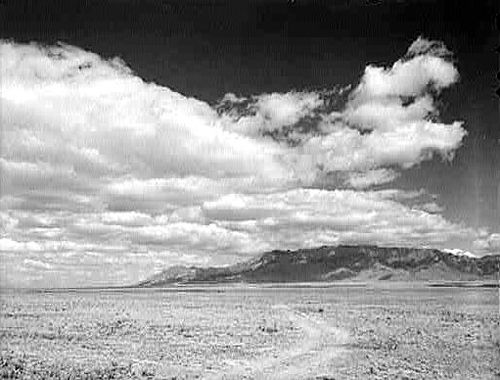
The staked plains of New Mexico.
A driven herd normally travels only 12 to 16 miles a day and even less than this in the early Spring when herds usually are started. It, therefore, seemed a desperate undertaking to enter upon the 90 mile “dry drive,” from the head of the Concho to the Horsehead Crossing of the Pecos, wherein two-thirds of one’s cattle were likely to perish for want of water.
Oliver Loving was the first man to venture it, and he succeeded. He traversed the Plain, fought his way up the Pecos, reached a good market, and returned home in the Autumn, bringing a load of gold and stories of hungry markets in the north that meant fortunes for Texas ranchmen. This was in 1866. It was the beginning of the great “Texas trail drive,” which during the next 20 years poured six million cattle into the plains and mountains of the Northwest. Oliver Loving was the pioneer of this great industrial movement.

Fort Sumner, New Mexico. Photo by Kathy Alexander.
At Fort Sumner, New Mexico, situated on the Pecos about 400 miles above Horsehead Crossing, was a large Government post, and the agency of the Navajo Indians, or such of them as were not on the war-path. Here, on his drive in the Summer of 1867, Loving made a contract for the delivery at the post the ensuing season of two herds of beeves. His partner in this contract was Charles Goodnight, later for many years the proprietor of the Palo Duro ranch in the Texas Panhandle.
Loving and Goodnight were young then; they had helped to repel many a Comanche assault upon the settlements, had participated in many a bloody raid of reprisal, had more than once from the slight shelter of a buffalo-wallow successfully defended their lives. So they entered upon their work with little thought of disaster.
Beginning their round-up early in March, as soon as green grass began to rise, they selected and cut out cattle of fit age and condition. By the end of the month, they reached the head of the Concho with two herds, each numbering about 2,000 heads. Loving was in charge of one herd, and Goodnight of the other.
Each outfit was composed of eight picked cowboys, well drilled in the rude school of the Plains, a “horse wrangler,” and a cook. To each rider was assigned a mount of five horses, and the loose horses were driven with the herd by day and guarded by the “horse wrangler” by night.
The cook drove a team of six small Spanish mules hitched to a mess wagon. In the wagon were carried provisions, consisting principally of bacon and jerked beef, flour, beans, and coffee; the men’s blankets and “war sacks,” and the simple cooking equipment. Beneath the wagon was always swung a “rawhide”– a dried, untanned, unscraped cow’s hide, fastened by its four corners beneath the wagon bed. This rawhide served a double purpose: first, as a carryall for odds and ends; and second, as furnishing repair material for saddles and wagons. In it were carried pots and kettles, extra horseshoes, farriers’ tools, and firewood; for often long journeys had to be made across the country which did not furnish enough fuel to boil a pot of coffee. On the sides of the wagon, outside the wagon box, were securely lashed the two great water barrels, each supplied with a spigot, which are indispensable in trail driving. Whereas, in this instance, exceptionally long dry drives were to be made, other water kegs were carried in the wagons.
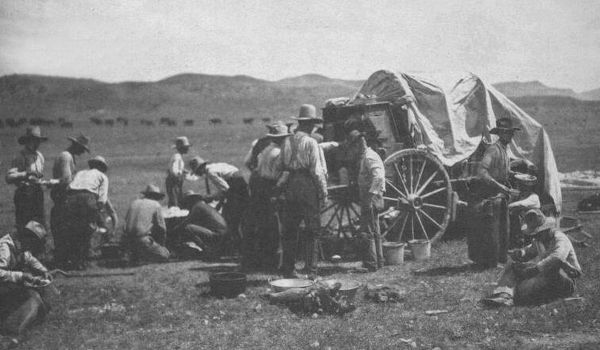
Cowboys near Silver City, New Mexico.
Such wagons were rude affairs, great prairie schooners, hooded in canvas to keep out the rain. Some of them were miracles of patchwork, racked and strained and broken till scarcely a sound bit of iron or wood remained, but, all splinted and bound with strips of the cowboy’s indispensable rawhide, they wobbled crazily along, with many a shriek and groan, threatening every moment to collapse, but always holding together until some extraordinary accident required the application of new rawhide bandages. I have no doubt there are wagons of this sort in use in Texas today that went over the trail in 1868.
The men need little description, for the cowboy type has been made familiar by Buffalo Bill’s most truthful exhibitions of plains life. Lean, wiry, bronzed men, their legs cased in leather chaparejos, with small boots, high heels, and great spurs, they were, despite their loose, slouchy seat, the best rough-riders in the world.
The cowboy character is not well understood. Its most distinguishing trait was absolute fidelity. As long as he liked you well enough to take your pay and eat your grub, you could, except in very rare instances, rely implicitly upon his faithfulness and honesty. To be sure, if he got the least idea he was being misused he might begin throwing lead at you out of the business end of a gun at any time; but so long as he liked you, he was just as ready with his weapons in your defense, no matter what the odds or who the enemy. Another characteristic trait was his profound respect for womanhood. I never heard of a cowboy insulting a woman, and I don’t believe any real cowboy ever did.
Men whose nightly talk around the campfire is of home and “mammy” are apt to be a pretty good sort. And yet another quality for which he was remarkable was his patient, uncomplaining endurance of a life of hardship and privation equaled only among seafarers. Drenched by rain or bitten by snow, scorched by heat or stiffened by cold, he passed it all off with a jest.
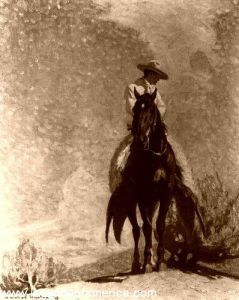
Range Rider.
Of a bitterly cold night, he might casually remark about the quilts that composed his bed: “These here durned huldys ain’t much thicker’n hen skin!” Or of a hot night: “Reckon ole mammy must ‘a stuffed a hull bale of cotton inter this yere ole huldy.” Or in pouring rain: “‘Pears like ole Mahster’s got a durned fool idee we’uns is web-footed.” Or in a driving snowstorm: “Ef ole Mahster had to git rid o’ this yere damn cold stuff, he might ‘a dumped it on fellers what ‘s got more firewood handy.”
Vices? Well, such as the cowboy had, someone who loves him less will have to describe. Perhaps he was a bit too frolicsome in town and too quick to settle a trifling dispute with weapons, but these things were inevitable results of the life he led.
In driving a herd over a known trail where water and grass are abundant, an experienced trail boss conforms the movement of his herd as closely as possible to the habit of wild cattle on the range. At dawn, the herd rises from the bed ground and is “drifted” or grazed, without pushing, in the desired direction. By nine or ten o’clock, they have eaten their fill, and then they are “strung out on the trail” to water. They step out smartly, two men–one at either side–“pointing” the leaders; and “swing” riders along the sides push in the flanks, until the herd is strung out for a mile or more, a narrow, bright, particolored ribbon of moving color winding over the dark green of hill and plain. In this way, they easily march off six to nine miles by noon. When they reach water, they are scattered along the stream, drink their fill, and lie down. Dinner is then eaten, and the boys not on herd doze in the shade of the wagon, until, a little after two o’clock, the herd rises of their own accord and moves away, guided by the riders.
Rather less distance is made in the afternoon. At twilight, the herd is rounded up into a close, circular, compact mass and “bedded down” for the night; the first relief of the night guard rides slowly around, singing softly and turning back stragglers. If properly grazed, in less than a half-hour the herd is quiet and at rest; and, barring an occasional wild or hungry beast trying to steal away into the darkness, so they lie till dawn unless stampeded by some untoward incident.
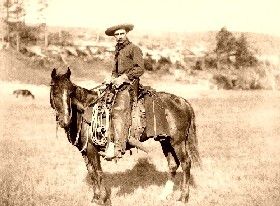
Cowboy on Horse.
Every two or three hours, a new “relief” is called, and the night guard is changed. Round and round all night, the guards ride, jingling their spurs and droning some low, monotonous song, recounting through endless stanzas the fearless deeds of some frontier hero or humming some love ditty rather too passionate for gentle ears.
But when a 90-mile drive across the Staked Plain is to be done, all this easy system is changed. The pace must be forced to the utmost in order to make the journey, and the cattle must be kept on their legs and moving as long as they can stand.
Therefore, when Loving and Goodnight reached the head of the Concho, two full days’ rest were taken to recuperate the “drags,” or weaker cattle. Then, late one afternoon, after the herd had been well grazed and watered, the water barrels and kegs filled, the herd was thrown on the trail and driven away into the west, without halt or rest, throughout the night.
Thus, driving in the cool of the night and of the early morning and late evening, resting through the heat of midday when travel would be most exhausting, the herd was pushed on westward for three nights and four days.

Charles Goodnight.
On these dry drives, the horses suffer most, for every rider is forced, in his necessary daily work, to cover many times the distance traveled by the herd. Therefore, the horses, doing the heaviest work, are refreshed by an occasional sip of the precious contents of the water barrels–as long as it lasts. By night of the second day of this drive, every drop of water is consumed, and thereafter, with tongues parched and swollen by the clouds of dust raised by the moving multitude, thin, drawn, and famished for water, men, horses, and cattle push madly ahead.
Come at last within 15 miles of the Pecos, even the leaders, the strongest of the herd, are staggering along with dull eyes and drooping heads, apparently ready to fall in their tracks. Suddenly, the whole appearance of the cattle changes; heads are eagerly raised, ears pricked up, eyes brighten; the leaders step briskly forward and break into a trot. Cow-hunters say they smell the water. Perhaps they do, or perhaps it is the last desperate struggle for existence. Anyway, the tide is irresistible. Nothing can check them, and four men gallop in the lead to control and handle them as much as possible when they reach the stream. Behind, the weaker cattle follow at the best pace they can. In this way, over the last stage, a single herd is strung out over a length of four or five miles.
Great care is needed when the stream is reached to turn them in at easy waterings, for in their maddened state they would bowl over one another down a bluff of any height; and they often do so, for men and horses are almost equally wild to reach the water, and indifferent how they get there.
However, the Pecos was reached, and the herds watered with comparatively small losses, and both Loving’s and Goodnight’s outfits lay at rest for three days to recuperate at Horsehead Crossing. Then, the drive up the wide, level valley of the Pecos began, through thickets of tortilla and mesquite, horses and cattle grazing belly-deep in the tall, juicy zacaton.
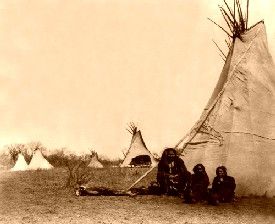
Comanche Camp, 1873.
The perils of the Llano Estacado were behind them, but they were now in the domain of the Comanche and hourly danger of ambush or open attack. They found a great deal of Indian “signs,” their trails and camps, but the “signs” were ten days or two weeks old, which left room for hope that the war parties might be out on raids in the east or south. After traveling four days up the Pecos without encountering any fresh “sign,” they concluded that the Indians were off on some foray; therefore it was decided that Loving might with reasonable safety proceed ahead of the herds to make arrangements at Fort Sumner for their delivery, provided he traveled only by night, and lay in concealment during the day.
In Loving’s outfit were two brothers, Jim and Bill Scott. They had accompanied his two previous Pecos drives and were his most experienced and trusted men. He chose Jim Scott as his companion on the dash to Fort Sumner.
When dark came, Loving mounted a favorite mule, and Jim his best horse; then, each well-armed with a Henry rifle and two six-shooters, with a brief “So long, boys!” to Goodnight and the men, they trotted off up the trail. Riding rapidly all night, they hid just before dawn in the rough hills below Pope’s Crossing, ate a snack, and then slept undisturbed till nightfall.
As soon as it was good dusk, they slipped down a ravine to the river, watered their mounts, and resumed the trail to the north. This night also was uneventful, except that they rode into, and roused, a great herd of sleeping buffalo, which ran thundering away over the Plain.
Dawn came upon them riding through a level country about 15 miles below the present town of Carlsbad, without cover of any sort to serve for their concealment through the day. They, therefore, decided to push on to the hills above the mouth of Dark Cañon. Here was their mistake. Had they ridden a mile or two to the west of the trail and dismounted before daylight, they probably would not have been discovered. It was madness for two men to travel by day in that country, whether fresh sign had been seen or not. But, anxious to reach a hiding place where both might venture to sleep through the day, they pressed on up the trail. And they paid dearly for the penalty of their foolhardiness.
Other riders were out that morning, riders with eyes keen as a hawk’s, eyes that never rested for a moment, eyes set in heads cunning as foxes and cruel as wolves. A war party of Comanche was out and on the move early, and, as is the crafty Indian custom, was riding out of sight in the narrow valley below the well-rounded hills that lined the river.
But while they hid themselves, their scouts were out far ahead, creeping along just beneath the edge of the Plain, scanning its broad stretches keenly, alert for quarry. And they soon found it.
Loving and Jim were in sight!
To be sure, there were only two specks in the distance, but the trained eyes of these savage sleuths quickly made them out as horsemen and white men.
Halting for the main war party to come up, they held a brief council of war, which decided that the attack should be delivered two or three miles farther up the river, where the trail swerved in to within a few hundred yards of the stream. So the scouts mounted, and the war party jogged leisurely northward and took stand opposite the bend in the trail.
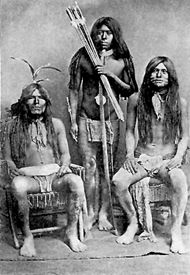
Comanche warriors.
On came Loving and Jim, unwarned and unsuspecting, their animals jaded from the long night’s ride. They reached the bend. And just as Jim, pointing to a low round hill a quarter of a mile to the west of them, remarked, “Thar’d be a blame good place to stan’ off a bunch o’ Injuns,” they were startled by the sound of thundering hoofs off on their right to the east. Glancing round, they saw a sight to make the bravest tremble.
Racing up out of the valley and out upon them, barely 400 yards away, came a band of 40 or 50 Comanche warriors, crouching low on their horses’ withers, madly plying quirt and heel to urge their mounts to their utmost speed.
Their animals were worn out, and escape by running was hopeless. Cover must be sought where a stand could be made, so they whirled about and spurred away for the hill Jim had noted. Their pace was slow at best. The Indians were gaining at every jump and had opened fire, and before half the distance to the hill was covered, a ball broke Loving’s thigh and killed his mule. As the mule pitched over dead, providentially, he fell on the bank of a buffalo-wallow–a circular depression in the prairie two or three feet deep and eight or ten feet in diameter, made by buffalo wallowing in a muddy pool during the rains.
Instantly, Jim sprang to the ground, gave his bridle to Loving, who lay helpless under his horse, and turned and poured a stream of lead out of his Henry rifle that bowled over two Comanche, knocked down one horse, and stopped the charge.
While the Indians temporarily drew back out of range, Jim pulled Loving from beneath his fallen mule, and, using his neckerchief, applied a tourniquet to the wounded leg which abated the hemorrhage, and then placed him in as easy a position as possible within the shelter of the wallow, and behind the fallen carcass of the mule. Then Jim led his own horse to the opposite bank of the wallow, drew his bowie knife, and cut the poor beast’s throat: they were in for a fight to the death, and, outnumbered twenty to one, must have breastworks. As the horse fell on the low bank and Jim dropped down behind him, Loving called out cheerily:
“Reckon we’re all right now, Jim, and can down half o’ them before they get us. Hell! Here they come again!”
A brief “Bet yer life, ole man. We’ll make ’em settle now,” was the only reply.
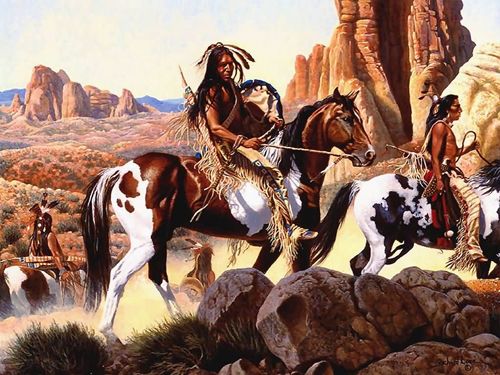
Comanche war party by Richard Luce, courtesy First People.
Stripped naked to their waist-cloths and moccasins, with faces painted black and bronze, bodies striped with vermilion, with curling buffalo horns and streaming eagle feathers for their war bonnets, no warriors ever presented a more ferocious appearance than these charging Comanche. Their horses, too, were naked except for the bridle and a hair rope loosely knotted around the barrel over the withers.
On they came at top speed until within range, when with that wonderful dexterity no other race has quite equaled, each pushed his bent right knee into the slack of the hair rope, seized bridle and horse’s mane in the left hand, curled his left heel tightly into the horse’s flank, and dropped down on the animal’s right side, leaving only a hand and a foot in view from the left. Then, breaking the line of their charge, the whole band began to race around Loving’s entrenchment in single file, firing beneath their horses’ necks and gradually drawing nearer as they circled.
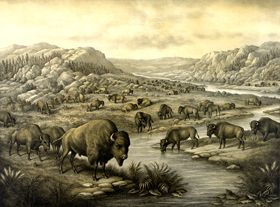
Buffalo Bulls in a Wallow, Louis Kurz, 1911.
Loving and Jim wasted no lead. Lying low behind their breastworks until the enemy was well within range, they opened a fire that knocked over six horses and wounded three Indians. Balls and arrows were flying all about them, but, well sheltered, they remained untouched. The fire was too hot for the Comanche, and they again withdrew.
Twice again during the day, the Indians tried the same tactics with no better result. Later, they tried sharpshooting at long range, to which Loving and Jim did not even reply. At last, late in the afternoon, they resorted to the desperate measure of a direct charge, hoping to ride over and shoot down the two white men. Up they came at a dead run, five or six abreast, the front rank firing as they ran. But, badly exposed in their own persons, the fire from the buffalo-wallow made such havoc in their front ranks that the savage column swerved, broke, and retreated.
Night shut down. Loving and Jim ate the few biscuits they had baked and some raw bacon. Then they counseled with one another. Their thirst was so great, it was agreed they must have water at any cost. They knew the Indians were unlikely to attempt another attack until dawn, and so they decided to attempt to reach the stream shortly after midnight. Although it was scarcely more than 1,500 yards, that was a terrible journey for Loving. Compelled to crawl noiselessly to avoid alarming the enemy, Jim could give him little assistance. But going slowly, dragging his shattered leg behind him without a murmur, Loving followed Jim, and they reached the river safely and drank.

The Pecos River near Langtry, Texas, by Kathy Alexander.
It was now necessary to find new cover. For long distances, the banks of the Pecos River are nearly perpendicular and ten to 20 feet high. At flood, the swift current cuts deep holes and recesses in these banks. Prowling along the margin of the stream, Jim found one of these recesses wide enough to hold them both, and deep enough to afford good defense against a fire from the opposite shore. Above them, the bank rose straight for 20 feet. Thus, they could not be attacked by firing, except from the other side of the river; and while the stream was only 30 yards wide, the opposite bank afforded no shelter for the enemy.
In the gray dawn, the Indians crept in on the first entrenchment and sprang inside the breastworks with upraised weapons, only to find it deserted. However, the trail of Loving’s dragging leg was plain, and they followed it down to the river, where, coming unexpectedly in range of the new defenses, two of their number were killed outright.
Throughout the day they exhausted every device of their savage cunning to dislodge Loving, but without avail. They soon found the opposite bank too exposed and dangerous for attack from that direction. Burning brush dropped from above failed to lodge before the recess, as they had hoped it might. The position seemed impregnable, so they surrounded the spot, resolved to starve the white men out.
Loving and Jim had the leisure to discuss their situation. Loving was losing strength from his wound. They had no food but a little raw bacon. Without relief, they must inevitably be starved out. It was therefore agreed that Jim should try to reach Goodnight and bring aid. It was a forlorn hope, but the only one. The herds must be at least 60 miles back down the trail. Jim was reluctant to leave, but Loving urged it as the only chance.
As soon as it was dark, Jim removed all but his underclothing, hung his boots around his neck, slid softly into the river, and floated and swam downstream for more than a quarter of a mile. Then he crept out on the bank. On the way, he had lost his boots, which more than doubled the difficulty and hardship of his journey. Still, he struck bravely out for the trail, through cactus and over stones. He traveled all night, rested a few hours in the morning, resumed his tramp in the afternoon, and continued it well-nigh through the second night.
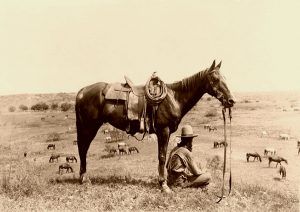
Horse Wrangler by Erwin E. Smith, 1910
Near morning, famished and weak, with feet raw and bleeding, totally unable to go farther, Jim lay down in a rocky recess two or 300 yards from the trail and went to sleep.
It chanced that the two outfits lay camped scarcely a mile farther down the trail. At dawn, they were again en route, and both passed Jim without rousing or discovering him. Then a strange thing happened. Three or four horses had strayed away from the “horse wrangler” during the night, and Jim’s brother Bill was left behind to hunt them. Circling for their trail, he found and followed it, followed it until it brought him almost upon the figure of a prostrate man, nearly naked, bleeding, and apparently dead. Dismounting and turning the body over, Bill was startled to find it to be his brother Jim. With great difficulty, Jim was roused; he was then helped to mount Bill’s horse and hurried on to overtake the outfit. Coffee and a little food revived him so that he could tell his story.
Neither danger nor property was considered where help was needed, in those days. Goodnight instantly ordered six men to shift saddles to their strongest horses, left the outfits to get on as best they might, and spurred away with his little band to his partner’s relief.
Loving had a close call the day after Jim left. The Comanche had other plans to carry out, or perhaps they had grown impatient. In any event, they crossed the river and raced up and down the bluff, firing beneath their horses’ necks. It was a miracle that Loving was not hit; but, lying low and watching his chance, he returned such a destructive fire that the Comanche were forced to draw off. The afternoon passed without alarm. As a matter of fact, the remaining Comanche had given up the siege as too dear a bargain, and had struck off southwest toward Guadalupe Peak.

Comanche warriors, 1892.
When night came, Loving grew alarmed over his situation. Jim might be taken and killed. Then no chance would remain for him where he lay. He must escape through the Indians and try to reach the trail at the crossing in the big bend, four miles north. Here, his outfits might reach him in time. Therefore, he started early in the night, dragged himself painfully up the bluff, and reached the plain. He might have lain down by the trail nearby, but supposing the Comanche still about, he set himself the task of reaching the big bend.
Starving, weak from loss of blood, his shattered thigh compelling him to crawl, words cannot describe the horror of this journey. But he succeeded. Love of life carried him through. And so, late the next afternoon, the afternoon of the day Goodnight started to his relief, Loving reached the crossing, lay down beneath a mesquite bush near the trail, and fell into a swoon. Ever since, this spot has been known as Loving’s Bend. It is half a mile below the present town of Carlsbad.
At dusk on the evening Loving reached the ford, a large party of Mexican freighters, traveling south from Fort Sumner to Fort Stockton, arrived and pitched their camp near where he lay. But Loving did not hear them. He was far into the dark valley and within the very shadow of Death. Help must come to him; he could not go to it.
Luckily, it came.
While some were unharnessing the teams, others went out to fetch firewood. In the darkness, one Mexican, thinking he saw a big mesquite root, seized it and gave a tug. It was Loving’s leg. Startled and frightened, the Mexican yelled to his mates:
“Que vienen, hombres! Que vienen por el amor de Dios! Aqui esta un muerto.”
Others came quickly, but it was not a dead man they found, as their mate had called. Dragged from under the mesquite and carried to the fire, Loving was found still breathing. The spark of life was very low, however, and the mescal given him as a stimulant did not serve to rouse him from his stupor. But the next morning, rested somewhat from his terrible hardships and strengthened by more mescal, he was able to take some food and tell his story. The Mexicans bathed and dressed his wound as well as they could, and promised to remain in camp until his friends should come up.
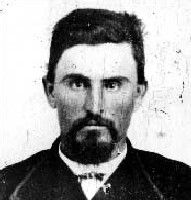
Charles Goodnight when younger.
Before noon Goodnight and his six men galloped in. They had reached his entrenchment that morning, guided by the Indian sign around about it, and had discovered and followed his trail. Goodnight hired a party of Mexicans to take one of their carretas and convey Loving through to Fort Sumner. With the Fort still more than 200 miles away, there was little hope he could survive the journey, but it must be tried. A rude hammock was improvised and slung beneath the canvas cover of the carreta, and, placed within it, Loving was made as comfortable as possible. After a nine-day’ forced march, made chiefly by night, the Mexicans brought their crazy old carreta safely into the post.
While Loving had been gaining strength with rest and food, the heat and the lack of proper care were taking a toll on his wound. Goodnight had returned to the outfits, and, after staying with them a week, he had brought them through as far as the Rio Penasco without further mishap. Then, placing the two herds in charge of the Scott brothers, he himself made a forced ride that brought him into Sumner only one day behind Loving.
Goodnight found his partner’s condition critical. Gangrene had attacked the wound. It was apparent that nothing but amputation of the wounded leg could save him. The medical officer of the post was out with a scouting cavalry detail, and only a hospital steward was available for the operation. To trust the case to this man’s inexperience seemed murder. Therefore, Goodnight decided to send a rider through to Las Vegas, New Mexico, the nearest point where a surgeon could be obtained.
Here arose what seemed insurmountable difficulties. From Fort Sumner to Las Vegas, New Mexico, the distance is 130 miles. Much traveled by freight teams carrying government supplies, the road was infested throughout with hostile Navajo, for whom the freight trains were the richest spoils they could have. Offer what he would, Goodnight could find no one at the Fort bold enough to ride through alone and fetch a surgeon. He finally raised his offer to $1,000 for anyone who would make the trip. It was a great prize, but the danger was greater than the prize. No one responded. To go himself was impossible; their contract must be fulfilled.
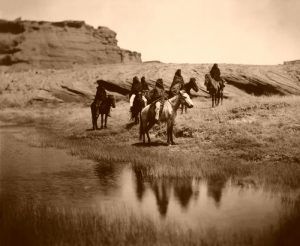
Navajo at Oasis, by Edward S. Curtis, 1904.
At this juncture, a hero appeared. His name was Scot Moore. Moore was the contractor furnishing wood and hay to the post at the time. Coming in from one of his camps and learning of the dilemma, himself a friend of Loving, he instantly went to Goodnight.
“Charlie,” he said, “why in the world did you not send for me before? Oliver shall not die here like a dog if I can save him. I’ve got a young Kentucky saddle mare here, and that’s the fastest thing on the Pecos. I’ll be in Vegas by sun-up tomorrow morning, and I’ll be back here sometime tomorrow night with a doctor if the Navajo don’t get us. Pay? Pay be damned. I’m doin’ it for old Oliver; he’d go for me in a minute. If I’m not back by nine o’clock tomorrow night, Charlie, send another messenger and tell old Oliver that Scot did his best.”
“It’s mighty good of you, Scot,” replied Goodnight, “I never will forget it, nor will Oliver. You know I’d go myself if I could.”
“That’s all right, pardner,” said Scot. “Just come over to my camp a spell and look over some papers I want you to attend to if I don’t show up.”
And they strolled away. Officers and other bystanders shook their heads sadly.
“Devilish pity old Scot had to come in.”
“Might ‘a known nobody could hold him from goin’.”
“He’ll make Vegas all right in a night run if the mare doesn’t give out, but God help him when he starts back with a doctor in a wagon; ain’t one chance in a thousand he’ll get through.”
“Well, if any man on earth can make it, bet your alce Scot will.”
These were some of the comments. Scot Moore was known and loved from Chihuahua to Fort Lyon. One of the biggest-hearted, most amiable, and generous men, he was also known as the coolest and most utterly fearless in a country where few men were cowards.
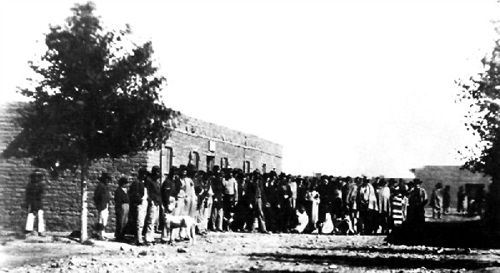
Bosque Redondo Reservation.
At nightfall, the mare well fed and groomed and lightly saddled, Scot mounted, bearing no arms but his two pistols, called a careless “Hasta luego, amigos” to his friends, and trotted off up the road. For two hours, he jogged along easily over the sandy stretches beyond the Bosque Redondo. Then, getting out on firmer ground, the mare well-warmed, he gave her the rein and let her out into a long, low, easy lope that scored the miles off famously. And so he swept on throughout the night, with only brief halts to cool the mare and give her a mouthful of water, through Puerta de Luna, past the Cañon Pintado, up the Rio Gallinas, past sleeping freighters’ camps and Mexican placitas. Twice, he was fired upon by alarmed campers who mistook him for a savage marauder, but luckily, the shots flew wild.
The last ten miles the noble mare nearly gave out, but, a friend’s life the stake he was riding for, Scot’s quirt and spurs lifted her through.
Half an hour after sunrise, before many in the town were out of bed, Scot rode into the plaza of Las Vegas and turned out the doctor, whom he knew.
Dr. D—- was no coward by any means, but it took all Scot’s eloquence and persuasiveness to induce him to consent to hazard a daylight journey through to Sumner, for he well knew its dangers. Scarcely a week passed without news of some fearful massacre or desperate defense. But, stirred by Scot’s own heroism or perhaps tempted by the heavy fee to be earned, he consented.
Having breakfasted and gotten the best team in town hitched to a light buckboard, Scot and the doctor were rolling away into the south on the Sumner Trail before seven o’clock, over long stretches of level grassy mesa and past tall black volcanic buttes.
Driving on without interruption or incident, shortly after noon, they approached the head of the Arroyo de los Enteros, down which the trail descended to the lower levels of the great Pecos Valley. Enteros Cañon is about three miles long, rarely more than 200 yards wide, its sides rocky, precipitous, and heavily timbered, through which wound the wagon trail, exposed at every point to a perfect ambuscade. It was the most dreaded stretch of the Vegas-Sumner road, but Scot and the doctor drew near it without misgiving, for no sign of the savage enemy had they seen.
Just before reaching the head of the cañon, the road wound around a high butte. Bowling rapidly along, Scot half dozing with fatigue, the doctor, unused to the plains, alert and watchful, they suddenly turned the hill and came out upon the immediate head of the cañon, when suddenly the doctor cried, seizing Scot’s arm:
“Good God, Scott, look! For God’s sake, look!”
Cowboy & Old West T-Shirts exclusively from Legends of America
And it was time. There on either hand, to their right and to their left, tied by their lariats to drooping piñon bough, stood 50 or 60 Navajo ponies. The ponies were bridled and saddled. Upon some were tied lances and on others arms. All were dripping with sweat and heaving of flank, their knife-marked ears drooping with fatigue; not more than five minutes could have elapsed since their murderous riders had left them. Apparently, it was an ambush laid for them, and they were already surrounded. Even the cool Scot shook himself in surprise to find that he was still alive.
Overcome with terror, the doctor cried: “Turn, Scot! Turn, for Heaven’s sake! It’s our only chance to pull for Vegas.”
But Scot had been reflecting. With wits sharpened by a thousand perils and trained in scores of desperate encounters, he answered: “Doc, you’re wrong; dead wrong. We’re safe as if we were in Fort Union. If they were lying for us, we’d be dead now. No, they are after bigger game. They have sighted a big freight outfit coming up from the Pecos and are lying for that in the canyon. We can slide through without seeing a buck or hearing a shot. We’ll go right on down, Entoros, old boy.”
“Scot, you’re crazy,” said the doctor. “I will not go a step. Let’s run to Vegas. At any instant, we may be attacked. Why, damn your fool soul, they’ve no doubt got a bead on us this minute.”
With a sharp stroke of his whip, Scot started the team into a smart trot down into the cañon. Then he turned to the doctor and quietly answered: “Doc, you seem to forget that Oliver Loving is dying, and that I promised to fetch you. Reckon you’ll have to go!” And down they went into what seemed the very jaws of death.
But Scot was right. It was a triumph of logic. The Navajo were indeed lying for bigger game.
And so it happened that, having come safely through the cañon, two miles out on the plain, they met a train of eight freight teams traveling toward Vegas. They stopped and warned the freighters, told them what they had seen, and begged them to halt and corral their wagons. But it was no use. The freighters thought themselves strong enough to repel any attack and drove on into the cañon.
None of them came out.
To this day, travelers through Enteros may see pathetic evidence of their foolhardiness in a scattered lot of weather-worn and rusted wheel tires and hub bands.
Before midnight, Scot and the doctor reached Sumner, having changed teams twice at Mexican Placitas. Covering 260 miles in less than 30 hours, Scot Moore had kept his word! Unhappily, however, Oliver Loving had become so weak that he died under the shock of the operation.
Now Scot Moore himself is dead and gone, but the memory of his heroic ride should live as long as noble deeds are sung.
Edgar Beecher Bronson, 1910 – Compiled and edited by Kathy Alexander, updated February 2020.
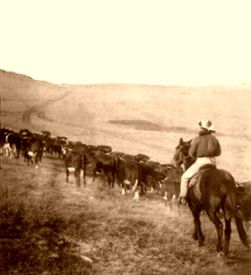
Cattle Trail.
About the Author: Edgar Beecher Bronson was the author of The Red-Blooded Heroes of the Frontier. Loving’s Bend is a chapter of this book, published by A.C. McClurg & Co. in 1910. Bronson worked not only as a reporter and a writer, publishing a number of books and articles, but he was also a cowboy and a rancher. The tale is not 100% verbatim, as grammatical errors and spelling have been corrected. One major change has been made in this tale. The original tale referred to Loving as “Joe.” However, the cattleman is more often known in history as “Oliver,” therefore, it has been changed.
Also See:
Charles Goodnight – Blazing a Cattle Trail