
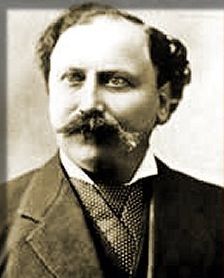
Henry Garfias.
Not known in history as many of his more famous counterparts, Enrique “Henry” Garfias, the first marshal of Phoenix, Arizona, should be better recognized. Many of his feats of bravery far surpass those of many more famous lawmen of the Old West.
Hailing from what is now Anaheim, California, Enrique was born in 1851, the son of a Mexican Army General. At age 20, he headed to Arizona, settling in Wickenburg. Three years later, in 1874, he moved once again to the fledgling town of Phoenix. At that time, Phoenix had about 1,600 residents, and downtown lots were selling for $7 to $11 each. That same year, the city would get its first telegraph line.
Henry took a job as a county deputy sheriff and quickly honed his shooting skills as he dealt with all manner of riffraff on “Whiskey Row,” on the north side of Washington Street. One night in the Capital Saloon, he entered to stop a free-for-all fight that was going on. Pushing his way into the crowd, the 5’9″ deputy, who was slender but well-built, was challenged by a much larger man, who said: “Look who’s here. You start dancing, and you’d better cut some fancy steps ahead of this lead.” The bigger man then moved his hand toward his gun when Henry warned him: “Don’t do it.”
But the foolish man evidently wasn’t aware of Henry’s six-gun skills and started to draw. Before his gun even left his holster, Garfias had drawn and shot him dead.
The town continued to grow quickly, and within a year of Henry’s coming to Phoenix, there were 16 saloons and four dance halls, most of which were located on hell-raising Whiskey Row. Garfias set his mind to taming the lawless town, quickly responding to disturbances, which were everyday affairs, especially on Saturday nights.
The only other “law” in the region, filled with rowdy cowboys and miners, was the military garrison stationed at Fort McDowell. More than 30 miles away, they could hardly help matters that often arose quickly and became lethal within minutes. The Latino lawman’s reputation began to spread as he curtailed the many disturbances one after another.
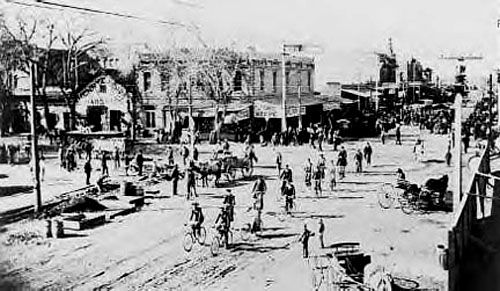
Phoenix, Arizona, the 1880s.
When Phoenix was officially incorporated as a town in 1881, Garfias was appointed as the town marshal. Later, when a formal municipal election was held, he won hands down, becoming the highest elected Mexican American official in the Valley during the 19th century. For the next five years, he would serve as the city’s first marshal and continue to subdue the rowdies of Phoenix.
Another tale reports that when he went to arrest an outlaw named Oviedo, who was better known as the “Saber Slasher,” Garfias was most definitely not looking forward to the arrest, as the men were personal enemies and Oviedo had threatened to kill Garfias on sight. However, he followed through with the warrant and went after the desperado. When he found him, Garfias fearlessly walked toward the dangerous man. Oviedo wasted no time grabbing his shotgun and firing point-blank at the marshal. Again, one of the evil men had underestimated Garfias. By the time the buckshot from Oviedo’s shotgun harmlessly whistled over the marshal’s head, Oviedo had two fatal bullets in his body.
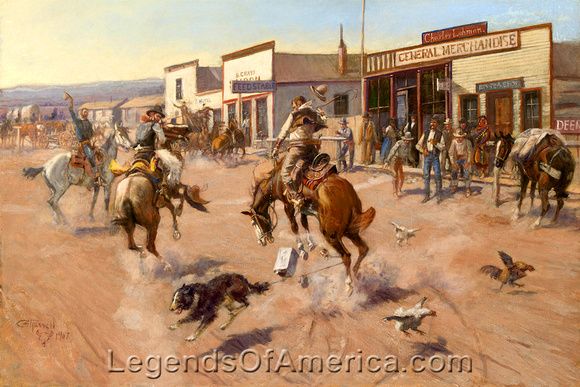
Cowboys & Trailblazers.
On another occasion, several Texas cowboys rode into Phoenix, quickly displaying their habit of shooting up the town. They were not familiar with Marshal Garfias. The minute Henry heard the shots, he was headed towards them, watching as the cowboys headed down Washington Street, occasionally taking shots at doors, signs, and hanging lamps. Demanding they drop their guns and immediately surrender, the cowpunchers paid no heed and opened fire. When the smoke cleared, Garfias was unharmed, but one cowboy was wounded, and one of them was dead. He then rounded up the others and deposited them in the town jail.
Yet another story tells of a time when the marshal was confronted by four rowdy cowboys who began shooting at him from horseback while Garfias was on foot.
This time, too, Garfias prevailed, leaving all four of them lying dead in the dusty street. In the meantime, Henry married Elena Redondo on April 13, 1883, and the two would eventually have a daughter and a son. He also had several other interests besides his lawman duties, which paid him $100 a month and a $3 bonus for every conviction he obtained. The marshal also ran a successful cattle ranch in Castle Springs and established a Spanish newspaper called El Progreso with his brother-in-law.
For 22 years, Garfias would continue to serve in an official capacity, holding not only the position of town marshal but later as an assessor, tax collector, constable, pound master, and street superintendent.
Ironically, Henry would not die in one of his many dangerous confrontations but rather from a fall from a horse. On May 2, 1896, while riding one of his favorite horses, the animal spooked, threw him off, and rolled on him. Though Garfias initially survived the fall, he also suffered from tuberculosis and pain from several old wounds. Seven days later, he died on May 8.
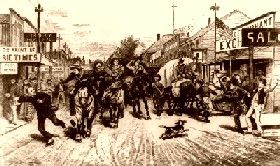
“Painting The Town Red” – A wood engraving by R.F. Zogbaum, in Harper’s Weekly, October 16, 1886.
The newspapers would say of the courageous man: Garfias was “brave and conscientious and never failed in his duty no matter how much danger menaced him,” while the headlines raged: “He was one who knew no fear,” and “Some of his deeds won for him Southwestern renown.”
The Republican also reported, “Arizona has had many brave men, but for cool, determined nerve, coupled with a modest, unassuming manner. Henry Garfias stood at the head.”
The Phoenix Herald praised his bravery and reported, as has been repeatedly stated, that Henry Garfias “had the reputation of never going after a man that did not return with him, dead or alive.”
During his lifetime, Garfias was arguably one of the most honest lawmen and sharpest gunfighters in the American West, on par with more famous names such as Wyatt Earp, Virgil Earp, and Wild Bill Hickok. His deeds were the stuff that legends are made of, but for whatever reason, his contributions have, sadly, been mostly ignored in history.
Another Latino would not lead Phoenix’s police authority for nearly a century until Ruben B. Ortega was appointed police chief on February 25, 1980.
©Kathy Alexander/Legends of America, updated April 2026.
Also See:
Peace Officers of Arizona (J McClintock)
Nabor Pacheco – Pima County Lawman
Arizona – The Grand Canyon State
Lawmen and Gunfighters Photo Gallery
Primary Sources:
Phoenix Police Museum/Rob Settembre
Arizona: The Youngest State, James Harvey McClintock, 1913.