
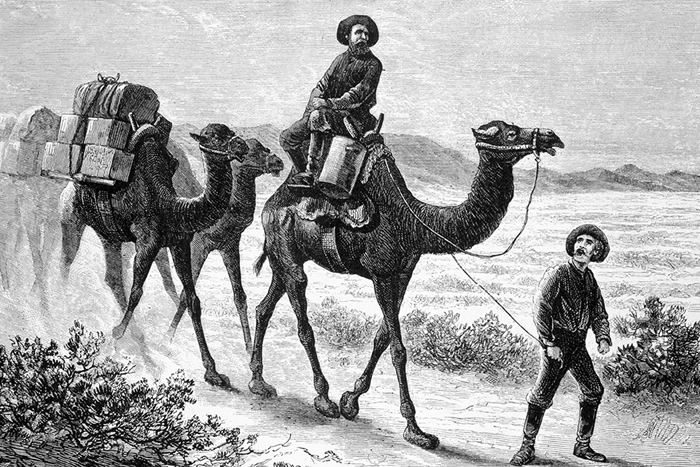
Camels in the Southwest.
In 1848, Henry Wayne, a quartermaster major, suggested to the War Department importing camels for military use in the American Southwest. Two years later, Secretary of War and Mississippi Senator Jefferson Davis tried to persuade the Senate to investigate using camels for the U.S. Army.
During this time period, the Southwest territory of the United States was greatly expanding, and it was thought that camels could carry at least twice the amount of weight as horses or mules. They might also be used to track and pursue Indians, as they could travel without water or rest for much longer than horses. It was also suggested that the camels might carry the mail and that fast camel passenger trains might be developed to run from Missouri River points to the Pacific Coast.
Initially, the Senators voted the idea down, but after California newspapers began promoting it, they finally agreed in 1854 and passed a bill appropriating $30,000 for the camel experiment.
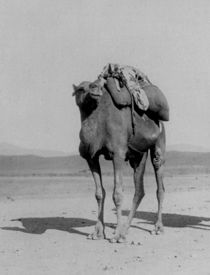
Arabian Camel.
Some 72 camels arrived in the country in early 1857 and were put to work carrying supplies in the southwestern United States. Although the camels proved well suited for travel through the region, their unpleasant disposition, habit of frightening horses, and tendency to wander off at night made them unpopular with soldiers. Still, they were used until the Civil War broke out, when they were sold at auction or abandoned in the desert.
Wild camels continued to be spied roaming in the desert for years afterward, especially in Arizona. Along with these real sights, several legends and tales began regarding these ugly beasts of burden. The most popular is the tale of a camel known as the Red Ghost.
In 1883, a woman was found trampled to death, and on her body and a nearby bush were clumps of reddish fur. Large hoof prints were found in the area, but locals were perplexed. A short time later, a large animal careened into a tent where two miners slept. Though they could not identify the beast, large hoof prints and red hair tufts were left behind again. After more incidents, the locals recognized the large animal as a camel. Soon, people began to report seeing the camel, which one rancher said carried a rider, although the rider appeared to be dead. The following report came from a group of prospectors who saw the camel and, while watching him, spied something falling from its back. As the beast moved on, the prospectors went to see what had fallen and discovered a human skull. For the next several years, numerous others spied the camel, which had been dubbed the “Red Ghost,” carrying its headless rider by this time. However, in 1893, when an Arizona farmer found the red camel grazing in his garden, he shot and killed the beast. By this time, the large camel had shaken free of its dead rider but still bore the saddle and leather straps with which the corpse had been attached.
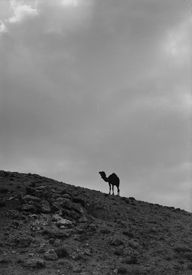
Camel in the desert, about 1900.
There was much speculation as to who the mysterious dead rider the camel had carried for several years might have been. One tale alleges that the rider was a young soldier afraid of camels and therefore had difficulty learning to ride them. To teach him, his fellow soldiers tied him to the top of the beast, determined he would overcome his fear. They then hit the camel on the rump, and the beast ran. Though the soldiers pursued the camel and his rider, the red beast easily outpaced them and escaped into the desert. Neither the camel nor his helpless rider was ever seen again.
Though the abandoned beasts of the Camel Corps roamed for decades, they soon disappeared altogether. In 1907, a prospector reported seeing two wild camels in Nevada, and other reports came in sporadically. However, in April 1934, the Oakland Tribune reported: “The Last American Camel Is Dead.” The camel, dubbed “Topsy,” was last seen trekking across the Arizona desert into California. When she reached Los Angeles, she was taken to Griffith Park to live. However, sometime later, she developed paralysis, so the zoo attendants were forced to put her down.
Seemingly, all the “real” army camels have long passed. However, legends continue to abound of people sighting a giant red camel carrying a headless rider in the deserts of Arizona. “Red Ghost” may be living up to his name.
Yet another legend of a ghostly camel also persists. This camel belonged to a prospector named Jake, who bought three camels from the Army at a public auction. Though his camels were every bit as ornery as the soldiers had described them, he spent much time caring for them and had nothing but praise for his beasts of burden.
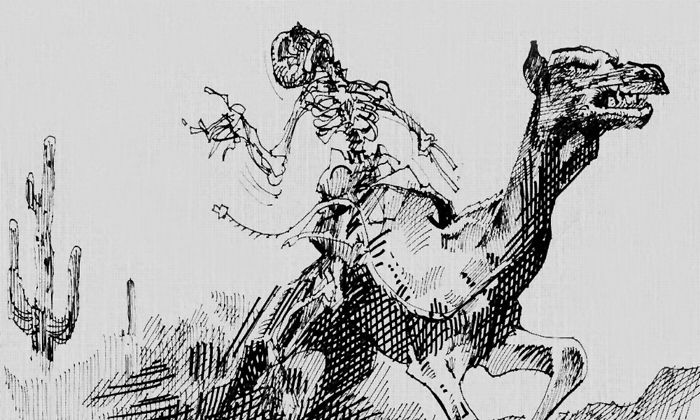
Ghost Camel, courtesy True West Magazine.
After Jake hit pay dirt, he led his gold-laden camels into town to sell his ore. Afterward, he headed to the local saloon to celebrate. Unfortunately, a man named Paul Adams was in the crowd and listened intently to Jake’s story of his gold find. Jake didn’t go directly to his claim when he left to return to his mine, knowing that he might be followed. Though he was careful and took a circuitous route, a man named Paul Adams followed him. When Jake encamped for the night, Adams, thinking that he was at the mine’s location, murdered him. Trying to protect his owner, one of the camels attacked Adams and, for his efforts, was shot by a scoundrel, but not before he had viciously bitten him.
Adams then began to search in earnest for Jake’s mine until one night the ghost of Jake, riding upon the dead camel, approached his camp and chased the scoundrel into town, straight to the sheriff’s office. Frightened beyond belief, Paul Adams then made a full confession.
Whether Jake and his loyal camel continue to roam the desert is unknown.
©Kathy Alexander/Legends of America, updated October 2026.
Also See:
Camel Caravans of the American Deserts
Legends, Ghosts, Myths & Mysteries
Monsters & Strange Creatures of America
See Sources.