
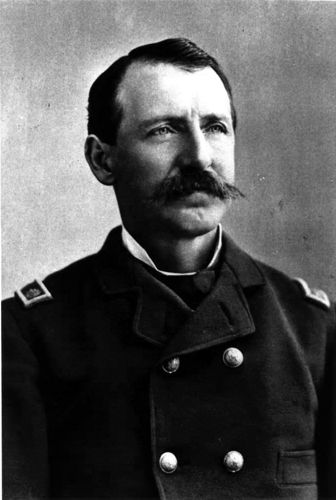
Colonel Albert Jennings Fountain.
Soldier, lawyer, and politician, Albert Jennings Fountain’s disappearance in the desert of southern New Mexico has puzzled lawmen and historians for more than a century.
Born in Staten Island, New York, on October 23, 1838, to Solomon Jennings, a sea captain, and Catherine de la Fontaine Jennings, Albert grew up and attended Columbia College before traveling the world as a tutor. He then settled in California, where he worked at a newspaper before studying law in San Francisco.
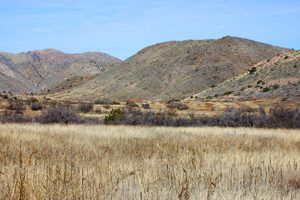
Apache Pass, Fort Bowie, Arizona.
Though the reasons are unknown, it was at this time that he began to go by the name of “Albert Jennings Fountain,” an Anglicized version of his mother’s family name. In August 1861, he enlisted in the Union Army and was commissioned as an officer in the California Column. He participated in the Union conquest of the Confederate Territory of Arizona and fought at the Battle of Apache Pass.
While still serving in the army, he married Mariana Perez in October 1862, and the two would eventually have nine children. He obtained the rank of captain when he was discharged at the end of the Civil War. He and his family then settled in El Paso, Texas, where he worked for the United States Property Commission, which investigated and disposed of former Confederate property. Later, he worked as a Customs Collector, was appointed an election judge, and was the Assessor and Collector of Internal Revenue for the Western District of Texas.
With this background, it is not surprising that he aspired to politics and, in 1869, won a seat in the Texas Senate. Fountain’s radical Republican views angered many Texas Democrats. During the El Paso Salt War, he got into a shootout with a man named B. Frank Williams, on December 7, 1870, was wounded three times and killed.
In 1875, Fountain moved his family to his wife’s home in Mesilla, New Mexico, where he practiced law. Southern New Mexico, at that time, was still subject to frequent Indian raids. In 1878, he became a captain in the first militia company in southeast New Mexico, fighting in the campaigns against Chief Victorio and Geronimo. Continuing to serve in the militia, Fountain would reach the rank of colonel, a title that he was called for the rest of his life.
In 1881, he was appointed to defend Billy the Kid in his charge of murder.
In 1885, Fountain moved to Las Cruces and began prosecuting Federal land frauds. In 1888, he was elected to the New Mexico legislature and eventually became the speaker of the house. Afterward, he became a special prosecutor for livestock associations and, in 1894, convicted 20 men for cattle rustling. His roles as a politician and an attorney, however, acquired him numerous enemies.
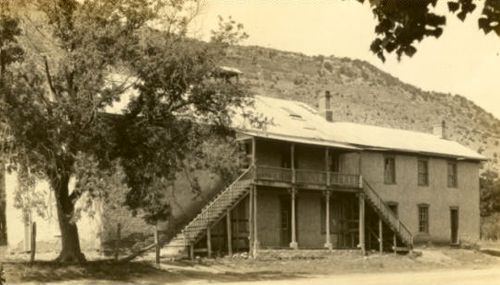
Lincoln County, New Mexico Courthouse, 1930.
On February 1, 1896, after Fountain had attended a court term in Lincoln County, New Mexico, he and his eight-year-old son Henry disappeared near White Sands on their way home. When Mrs. Fountain reported the two missing, a search party was sent for them the following day. On the Tularosa-Las Cruces road, about 45 miles from his home, the buckboard and team were found, along with Fountain’s papers, several empty cartridge casings, and two pools of blood. Missing were Fountain and his son, as well as Albert’s Winchester rifle.
After an investigation, it was thought that a noted New Mexico gunman and rancher named Oliver M. Lee, along with two of his employees named Jim Gililland and William “Billy” McNew, had perpetrated the crime. Eventually, all three were tried for the crime but were acquitted, and the case remained open, with the Fountain bodies having never been found.
Some historians also believe that the famed Sheriff Pat Garrett was assassinated while heavily investigating the Fountain murder. He might have been getting close to answering “who done it.”
©Kathy Alexander/Legends of America, updated March 2026.
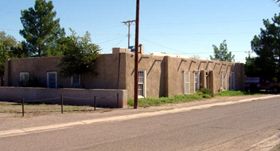
Colonel Fountain’s home, photo by Corey Recko.