

Fort Washita, Oklahoma Entrance.
General Zachary Taylor established Fort Washita, Oklahoma, in 1842 to protect the Choctaw and Chickasaw Nations from Plains Indians. At the time, it was the southwesternmost fort in the United States.
After being forced to move from their homelands in the southeastern United States to Indian Territory, the Choctaw and Chickasaw settled in southern Oklahoma; however, this land was traditionally the hunting grounds of several Plains tribes, including the Comanche, Wichita, Caddo, and Kiowa. These indigenous tribes were not happy with the newcomers and occasionally threatened them.
Initially, log barracks housed the officers and soldiers, but more permanent stone buildings were constructed in 1849. Over several years, they also built more stone buildings, including a hospital and surgeon’s quarters, as well as additional wooden structures, including stables and corrals for the cavalry.
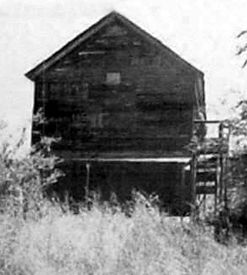
Rugglesville, Oklahoma building
The troops garrisoned at the fort protected the “Civilized” Indians and provided quarters for the Indian Agency for the two tribes. Families and slaves soon followed the soldiers to the frontier fort. Though officers’ families stayed in assigned quarters, enlisted men were allotted only ½ of a bed in a barracks. If they had families, their wives and children lived in a small settlement just west of the fort.
First, it was called Rugglesville for Major Daniel Ruggles, who commanded the fort after the Mexican-American War. This community was not a good place for families. It was filled with saloons, gambling halls, and bordellos. The frontier community would eventually support a general store, a post office, restaurants, and hotels. Colonel William Harney built a billiards hall, bowling alley, and tavern on the post in 1844. The town was later called Hatsboro but was gone by the turn of the century.
When the Mexican-American War broke out in 1846, activity at the fort increased as it became a staging point for the conflict. The number of troops garrisoned at the post increased from an average of 150 to almost 2,000 during this time.
After the war, gold was discovered in California in 1849, prompting thousands of people to head West in search of their fortunes. Many of these emigrants chose the more southern route to California to avoid the cold winters, the snow, and cholera outbreaks that plagued the northern routes. However, the southern route was not without peril, as it was subject to attacks from the Plains Indians. Due to the danger, many emigrating parties rendezvoused at Fort Washita before making the long journey.
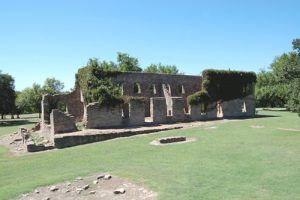
Fort Washita East barracks.
In 1850, General Matthew Arbuckle, commander at Fort Smith, Arkansas, ordered the establishment of a fort West of Fort Washita to protect California emigrants. This fort became Fort Arbuckle and was commanded by General William G. Belknap. However, when Belknap fell ill in the fall of 1851 and was being transferred to Fort Gibson, Oklahoma, to see his family, he died along the way on November 10, 1851, and was interred at Fort Washita.
By 1858, an East barracks, hospital, and surgeon’s quarters were built of native stone, along with several wooden structures. A corral and stables on the hillside Southwest of the fort supported cavalry operations, which comprised most of the forces assigned to Fort Washita until the 1850s. Afterward, the post served as a United States Army Field Artillery School, at which time several artillery units were assigned to the fort in addition to infantry and cavalry.
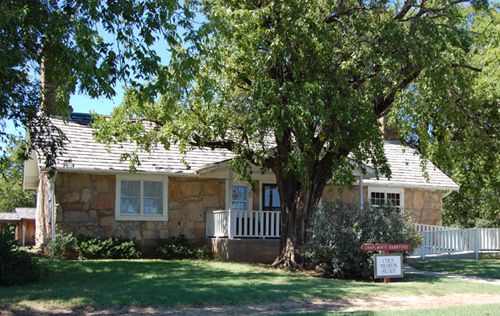
Fort Washita Chaplain’s Quarters –
Visitor’s Center.
Fort Washita’s importance as a military post waned as the frontier moved westward, the Chickasaw and Choctaw Indians grew more settled, and incursions by the Plains Indians lessened. As a result, the fort closed briefly in February 1858 but reopened in December of the same year because Comanche raids increased.
When the Civil War broke out, Union forces abandoned the fort in April 1861, and Confederate troops immediately took it over. Although no battles occurred at the post, it became an essential Confederate supply depot and served as the headquarters of Brigadier General Douglas Cooper for most of the war. The fort stayed in Confederate hands until the end of the war, at which time the southern forces burned it, and it was never reoccupied.
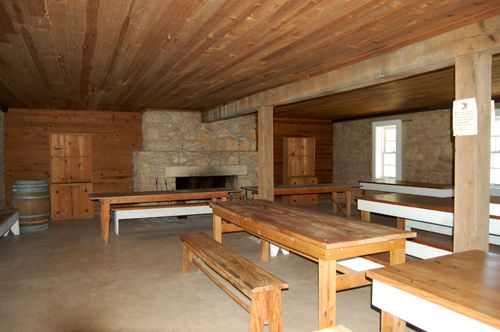
Interior of Fort Washita Barracks.
In 1870, the War Department transferred the fort to the Department of the Interior, and its buildings remained unused and deteriorating for the next two decades. In 1897, the communal lands of the Chickasaw Nation, including Fort Washita, were divided up, and allotments were given to individual Chickasaw citizens.
The former military land was given over to the Colbert family, a prominent Chickasaw family. Charles Colbert turned the West barracks into a home, and the remaining buildings served as living quarters and agricultural buildings for the next 60 years. The Colberts also used the cemetery as a family cemetery and allotted some land to area families for their use. The old West barracks continued to serve as the Colberts’ home until it burned down in 1917.
In 1962, the Oklahoma Historical Society acquired the site and painstakingly restored, rebuilt, and preserved many buildings and ruins. In 1965, the historic fort was designated as a National Historic Landmark.
Sadly, on September 25, 2010, a fire destroyed the reconstructed south barracks. Three teens were arrested for setting the fire and were sentenced.
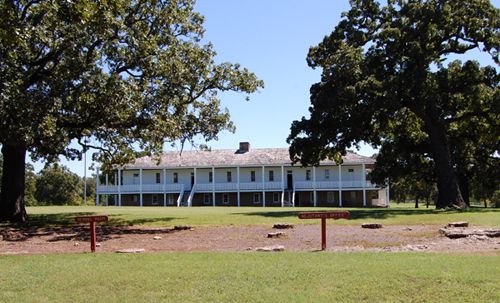
South barracks at Fort Washita before the fire.
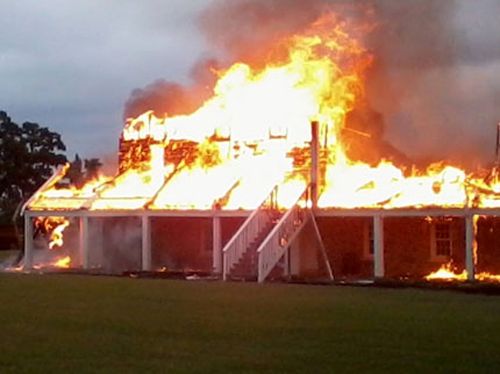
South barracks blazing, photo courtesy of KXII Channel 12 News.
In 2016, the Chickasaw Nation partnered with the Oklahoma Historical Society to assume responsibility for managing Fort Washita. Today, visitors to Fort Washita can tour restored structures, watch Civil War reenactments, and take part in the yearly Fur Trade Era Rendezvous to experience life before and during the Civil War. Other events throughout the year include storytelling, outdoor movies, and special seasonal and holiday events that the whole family can enjoy. In addition to the many buildings and foundations, the post cemetery still exists, along with the Colbert Cemetery, a Chickasaw burial ground, and a Confederate Cemetery.
Fort Washita is located some 15 miles northwest of Durant, Oklahoma, at 3348 State Road 199.
Contact Information:
Fort Washita
3348 State Rd. 199
Star Route 213
Durant, Oklahoma 74701-9443
580-924-6502
©Kathy Alexander/Legends of America, updated September 2026.
See Sources.