Legends of America

Follow the links to the various pages of Legends of America

The Old West Legends of America Outhouse Madness Ghostly Legends Outlaws Old West Saloons Rocky Mountain General Store Legends Photo Store The Book Store Make your travel reservations here! Route 66 Native Americans The Old States - Back East


Legends Of America's Facebook PageLegends Of America's Twitter Page

Legends Home

Site Map

What's New!!


Content Categories:

American History

Destinations-States

Ghost Towns

Ghostly Legends

Historic People

Native Americans

Old West

Route 66

Travel Center

Treasure Tales

   Search Our Sites

Custom Search

Google

About Us

Advertising

Article/Photo Use

Copyright Information

Blog

Forum

Guestbook

Links

Newsletter

Privacy Policy

Writing Credits


We welcome corrections

and feedback!

Contact Us


Legends Of America's

Rocky Mountain General Store


Old West Mercantile

Route 66 Emporium

TeePee Trading Post

Book Shelf

History Tech
Postcard Rack

Wall Art

and Much More!


  Legends Of America's Rocky Mountain General Store - Cart View


Legends' Photo Prints

Legends Of America's Photo Print Shop
 

Ghost Town Prints

Native American Prints

Old West Prints

Route 66 Prints

and Much More!!
 

Legends Of America's Photo Print Shop - Cart View


Mississippi History, Travel Destinations, and LegendsMISSISSIPPI LEGENDS

Civil War Battles of Mississippi


Custom products including posters, bumper stickers, calendars, apparel, and more.


  Bookmark and Share

<< Previous 1 2 3 4 Next >>


The second state to declare secession from the
Union, on January 9, 1861, Mississippi joined with six other states the next month to form the Confederate States of America. Long a hotbed of secession and states' rights, Mississippi proclaimed: "Our position is thoroughly identified with the institution of slavery--the greatest material interest of the world." With South Carolina, Mississippi was one of only two states in the Union in 1860 where the majority of the population were slaves.


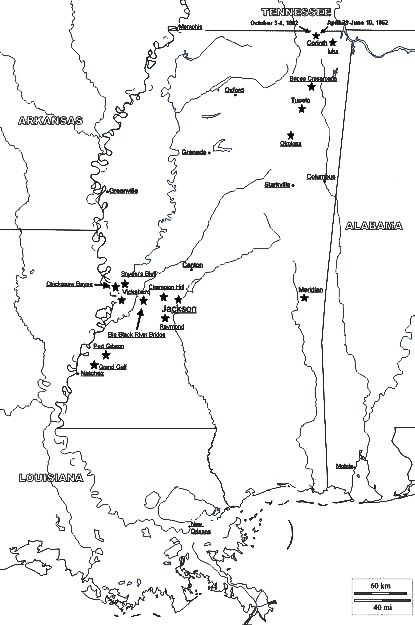
Its location on the Mississippi River made it strategically important to both the Union and the Confederacy, resulting in dozens of battles as troops repeatedly clashed near Mississippi's key towns and cities, such as Corinth, Jackson, Natchez, and Vicksburg.


Although there were small pockets of citizens who remained sympathetic to the Union, the vast majority of Mississippians embraced the Confederate cause, and thousands flocked to the military.


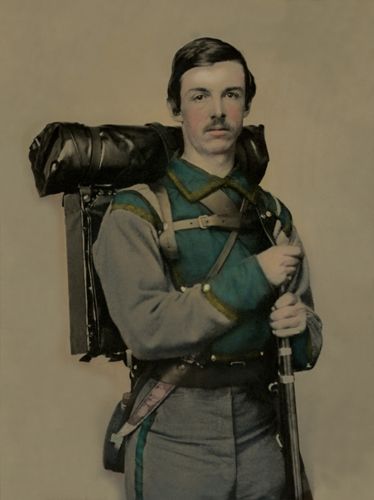
Unidentified Confederate soldier

Unidentified Confederate soldier, by Charles Rees, 1861.

This image available for photographic prints and downloads HERE!


About 80,000 white men from Mississippi fought in the Confederate Army and some 500 white Mississippians fought for the Union. Soldiers from the Magnolia State fought in every major theater of the war, although most were concentrated in the Western Theater.


As the war progressed, a considerable number of freed or escaped slaves joined the United States Colored Troops and similar black regiments, including more than 17,000 black Mississippi soldiers fighting for the Union.


Mississippi Battles:


Cumberland and Tennessee Rivers Campaign (February - June, 1862) - Also called the "Mississippi River Campaign" and the "Fort Henry and Fort Donelson Campaign," this force by the Union began on February 6, 1862 as a strategy to allow the North invasion routes by land and by water, as well as cutting of supplies to Confederate Forces. General Ulysses S. Grant moved his troops swiftly down the Tennessee River toward Fort Henry on river transports on February 2nd and coordinating with  United States Navy Flag Officer Andrew H. Foote, the campaign ended with the Seige of Corinth, Mississippi in June, 1862.


Ruse of the Whistles at Corinth, MississippiSiege of Corinth (April 29-May 30, 1862) - Also called the First Battle of Corinth, this was the fourth and last conflict of the Cumberland and Tennessee Rivers Campaign. After the Fort Henry, Fort Donelson, and Shiloh battles in Tennessee, Union troops continued south to  Corinth, Mississippi. Under the command of Major General Henry W. Halleck -- the Army of the Tennessee, the Army of the Ohio, and the Army of the Mississippi -- advanced on the vital rail center of Corinth. Cautious due to the staggering losses at Shiloh, Halleck approached very slowly, fortifying his troops after each advance. By May 25, 1862, after moving five miles in three weeks, he and his troops were finally in a  position to lay siege to the town. However, Confederate General P.G.T. Beauregard, aware of the impending attack, made other plans. As the Union forces maneuvered for position, the Confederate Army moved out during the night of May 29, 1862, though they pretended to be preparing for an attack. When trains arrived, the troops cheered as though reinforcements were arriving. Instead, the Confederate soldiers were loading up the cars with the sick and wounded, along with artillery and supplies. The troops also set up dummy Quaker Guns along the defensive earthworks, kept camp fires burning, and their buglers and drummers played on as the Rebel troops slipped away. When Union patrols entered Corinth the next morning, they found the Confederate troops gone. With the Union having consolidated their position, this ended the Cumberland and Tennessee Rivers Campaign.
 

Iuka and Corinth Operations (September-October, 1862) - During the late summer of 1862, Confederate forces attempted a three-pronged strategic advance into the North. The only coordinated Confederate attempt to carry the conflict to the enemy ended in disaster. The offensive strategy included  Antietam, Maryland; Kentucky;  and the northern Mississippi campaign, referred to as the Iuka and Corinth Operations. This third campaign into Mississippi led to the devastating and little-studied defeats at Iuka and Corinth, Mississippi -- defeats that would open the way for Grant's attack on Vicksburg, Mississippi. The last battle of the Iuka and Corinth Campaign took place Hatchie's Bridge in Tennessee.


Iuka, Mississippi

Iuka, Mississippi, scene of the battle of September 19-20, 1862, from

 a sketch by an officer of General Buell’s army.


Battle of Iuka (September 19, 1862) - Taking place in Tishomingo County, Mississippi, Confederate Major General Sterling Price’s Army of the West's main column marched into Iuka, Mississippi, on September 14. Price’s superior, General Braxton Bragg, the commander of the Confederate Army of the Mississippi, who was leading an offensive deep into Kentucky, ordered him to prevent Union Major General William S. Rosecrans’ Army of the Mississippi's troops from moving into middle Tennessee and reinforcing Union Brigadier General James Negley’s division of the Army of the Ohio, which was garrisoning Nashville. Price had about 14,000 men, and he was informed that, if necessary, he could request assistance from Major General Earl Van Dorn, commanding the District of the Mississippi, headquartered at Holly Springs.


Union Major General Ulysses S. Grant, commanding the Army of the Tennessee, feared that Price intended to go north to join General Braxton Bragg against Major General Don Carlos Buell’s Army of the Ohio. Grant devised a plan for his left wing commander, Major General E.O.C. Ord, and his men to advance on Iuka from the west; while Rosecrans’ forces were to march from the southwest, arrive at Iuka on the 18th, and make a coordinated attack the next day. Ord arrived on time and skirmishing ensued between his reconnaissance patrol and Confederate pickets, about six miles from Iuka, before nightfall. Rosecrans informed Grant that he would not arrive at Iuka on the 18th but, would begin his march at 4:30 am, the next morning. On the 19th, Ord sent Price a message demanding that he surrender, but Price refused. At the same time, Price received dispatches from Van Dorn suggesting that their two armies rendezvous, as soon as possible, at Rienzi for attacks on the Federal forces in the area. Price informed Van Dorn that the military situation had changed so he could not evacuate Iuka immediately. He did, however, issue orders for his men to prepare for a march the next day, to rendezvous with Van Dorn.


Rosecrans’ army marched early on the 19th, but, instead of using two roads as directed, he followed the Jacinto (Bay Springs) Road. After considering the amount of time that Rosecrans required to reach Iuka, Grant determined that he probably would not arrive on the 19th, so he ordered Ord to await the sound of fighting between Rosecrans and Price before engaging the Confederates. As Rosecrans advanced, his men fought actions with Confederate troops at points along the way. About 4:00 pm, just after ascending a hill, the Union column halted because the Confederates were well-placed below in a ravine, filled with timber and underbrush. The Confederates launched attacks up the hill, capturing a six-gun Ohio battery, while the Federals counterattacked from the ridge. Fighting, which Price later stated he had “never seen surpassed,” continued until after dark; the Union troops camped for the night behind the ridge. Price had redeployed troops from Ord’s front to fight against Rosecrans’ troops. Ord did nothing, later proclaiming that he never heard any fighting and, therefore, never engaged the enemy; Grant also remarked that he had heard no sounds of battle. Following the fighting on the 19th, Price determined to reengage the enemy the next day, but his subordinates convinced him, instead, to march to join Van Dorn, as earlier planned. At the same time, Rosecrans redeployed his men for fighting the next day. Price’s army evacuated via the Fulton Road, protecting its rear with a heavy rearguard and hooked up with Van Dorn five days later at Ripley. Although Rosecrans was supposed to traverse Fulton Road and cover it, he stated that he had not guarded the road because he feared dividing his force; Grant later approved this decision. Rosecrans’ army occupied Iuka and then mounted a pursuit. However, the Confederate rearguard and overgrown terrain prevented the Union pursuit from accomplishing much. The Federals should have destroyed or captured Price’s army, but instead, the Rebels joined Van Dorn and assaulted Corinth in October. Resulting in an official Union victory, estimated casualties were Union 782 and Confederate 700. This battled caused General Ulysses S. Grant to have concerns about William S. Rosecrans’  abilities and leadership.


Continued Next Page

<< Previous 1 2 3 4 Next >>

From the Rocky Mountain General Store

Postcard-O-Mania - Literally, thousands of postcards from across the U.S. See Route 66, the Old West, Native Americans, and all the states.


    Route 66 Postcard    


                                                              Copyright © 2003-2012, www.Legends of America.com