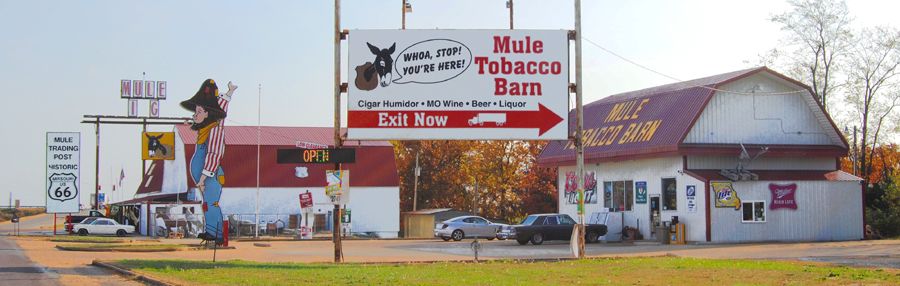
Mule Trading Post on Route 66 in Rolla, Missouri, by Kathy Alexander.
Rolla, Missouri, the county seat of Phelps County, is located about midway between St. Louis and Springfield along I-44.
The area’s first settlers were farmers who arrived in the early 19th Century. They settled along the riverbanks and worked as farmers and miners. Although the town wouldn’t begin for several more years, John Webber built the first house in 1844.

St. Louis & San Francisco Railroad.
The following year, the Frisco Branch of the Southwest Railroad began to survey the land for the westward-pushing railroad. Lieutenant James Abert led the survey and later became the first professor of Civil Engineering at the Missouri School of Mines.
When the railroad began construction, a small settlement started to form in 1855 when the railroad erected an office and several warehouses. Anticipating the railroad’s arrival, nearly 600 people moved to the area within six months. In 1857, Rolla was made the county seat of Phelps County, and the following year, the city was officially laid out. The town was named after one of the original settlers, formerly of North Carolina, who favored the name “Raleigh” after his hometown. Other settlers agreed on the name on the condition that it wasn’t spelled that “funny” way, and they settled on “Rolla.”
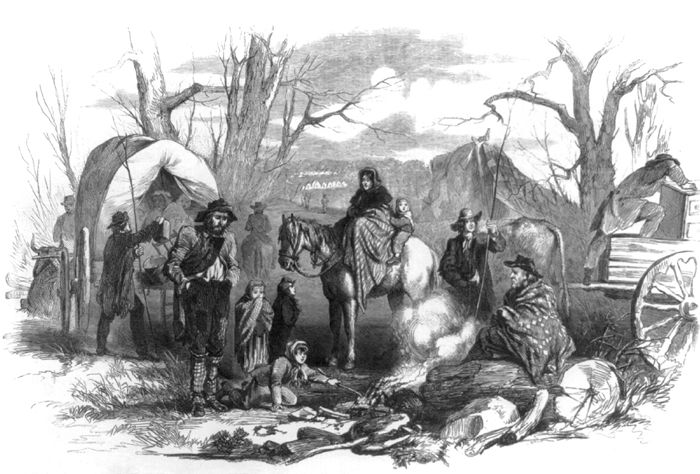
Civil War refugees take shelter in the Union camps in Rolla, Missouri by Frank Leslie’s Illustrated Newspaper, 1862.
On December 22, 1860, the first train arrived in Rolla, making the city the road’s terminus. The outbreak of the Civil War halted the line’s westward expansion. Many area residents had Confederate sympathies during this time, and Union forces took Rolla in June 1861. During their occupation, Union forces built two minor forts— Fort Wyman and Fort Dette — and Camps Glover and Davies. Soon, as many as 20,000 Union troops were stationed nearby, the town became an important transportation hub as supplies were shipped from the East and loaded onto wagons headed West.
The Missouri School of Mines and Metallurgy was founded in 1870 due to Rolla’s location and mineral riches. Today, the school offers degrees in 12 engineering and science fields, including mining and metallurgy.
When Route 66 came through, it replaced Route 14, a difficult gravel road to travel in anything but good weather. Work began on the concrete slab in 1928, and from Rolla to Lebanon, it was the last piece to be paved in Missouri because of its difficulty. The completion sparked a huge celebration. Rolla further improved its image by paving city streets connected to the highway. Rolla quickly became a vacation playground as tourist cabins, motels, trading posts, and fishing camps sprang up.
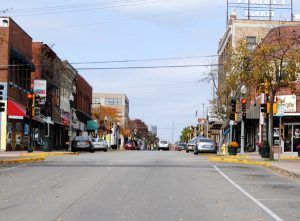
Rolla, Missouri.
Today, Rolla is home to about 20,400 people and remains a haven for outdoor adventurers because of its proximity to the Current and Jacks Fork Rivers, Ozark forests, caves, springs, and bluffs. The town also offers a rich view of its heritage through its historic buildings and vintage peeks of old Route 66.
At the corner of Third and Rolla Streets stands the John A. Dillon Log House, built in 1857 and used as the first Phelps County Courthouse. Today, the building houses the Phelps County Museum. In 1859, Phelps County began to build another Courthouse just across the street, which served as a hospital and supply storage during the Civil War.
For views of Route 66, be sure to check out the Mule Trading Post just as you enter the East side of town. On the West end is the Totem Pole Trading Post, opened in 1933, offering gas and novelties to cross-country travelers. At the corner of Route 66 and Martin Springs Drive, the vintage store sells antiques to new adventurers on the Mother Road.
For a different kind of stop, visit Rolla Stonehenge, a partial reconstruction of the ancient megalith built by students at the University of Missouri at Rolla.
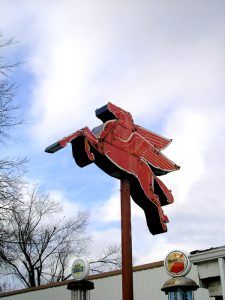
Mobil Pegasus sign at Route 66 Motors in Rolla, Missouri by Kathy Alexander.
Continue westward on a scenic drive through several small settlements and resorts that Interstate I-44 bypassed many years ago. Along this historic stretch, you’ll see the remains of John’s Modern Cabins, built in 1935; the old ghost town of Arlington; the remains of the once-popular Stony Dell Resort; Larry Baggett’s Tribute to the Trail of Tears; and more as you make your way to Devil’s Elbow.
©Kathy Alexander/Legends of America, updated October 2026.
Also See:
Missouri Route 66 Photo Gallery
Sources: