|
Legends Home
Site
Map
What's New!!

American History
Ghost Towns
Ghostly Legends
Historic People
Native Americans
The Old West
Photo
Galleries
Roadside
Attractions
Rocky Mtn Store
Route 66
Travel
Destinations
Treasure Tales
Legends Blog
Free E-Newsletter
Facebook
Fanpage
Twittering

Contact Us
Please report
broken links, missing pictures, or other problems online by clicking
HERE or send us an
email. Thanks!
| |
|
|
|
Ghost Stretch Beyond
Springfield |
|

|
|
<<
Previous
1 2 3
Next >>
|
|
Paris
Springs Junction - Revival on the Mother Road
Just a few more miles down the road you
will come upon Paris Springs Junction. Though current maps, as well as
the
Missouri Highway Department, identify this little burg as Paris
Springs, that is not correct. Paris Springs was actually located
one-half mile north of this junction. The small settlement that would
become Paris Springs was first settled in 1850s and called Chalybeate
Springs, for the iron-rich healing waters flowing from Clover Creek.
Later, when the company of Cherry & Johnson utilized
Clover Creek to run a mill that ground flour and cornmeal at the site,
the town's name changed to Johnson Mills. O.P. Johnson also built a
sawmill and wool mill, and a chair factory was operated by E.L. Davis.
Other businesses also included a blacksmith, shoemaker, a wagon-maker,
and an attorney.
|

Gay Parita in the 1930's.
This image available for
photographic prints
and downloads
HERE! |
|
The town's name changed once again in 1872 when Eli
Paris opened a hotel to cater to the many people flocking to the town
to partake of its healing mineral waters.
Named for the hotel operator, it became Paris Springs and not only
provided a dip in its rich springs but also produced bottled waters.
When Route 66 barreled through in the 1920's, it
bypassed Paris Springs by ½ mile. Before long, a few businesses were
set up to the south to take advantage of the many travelers along
Route 66. This small cluster of buildings soon took on the name of
Paris Springs Junction.
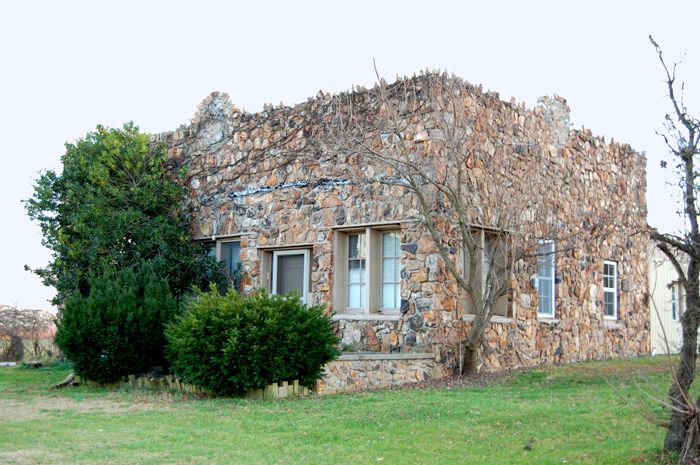
A dome shaped cobblestone garage was one of the first
buildings to be built at the junction in 1926. Four years later a
Sinclair station was built next to the garage. Owned by Gay and Fred
Mason, the couple also added a cafe and three cabins to their little
enterprise, which they called Gay Parita, after Mrs. Mason. Taking
advantage of the busiest road in America, the masons did a brisk
business fixing flat tires, and selling gasoline, sodas and sandwiches
for the next 25 years. When Gay Mason died in 1953, Fred continued to
operate the business, but when tragedy struck again, burning down the
Sinclair station in 1955, Fred retired to his home behind the burned
out station. He died in 1960.
Shortly thereafter, Route 66 was decommissioned and the
junction was bypassed by I-44. For the next several decades, the property sat silent,
utilized only as a residence. However, this small burg gained new life when the Gay
Parita property was purchased by Gary and Lena Turner. Working with
his son, Steve, Gary rebuilt the old Sinclair Station, which today
sits shining and new, beckoning to a new generation of Route 66
travelers. While the "new" station is not an exact replica of its
predecessor, its facade is in character for the 1930's era. The
"station" doesn't sell anything --no gas, no sundries, no gimmicks or
tourist memorabilia -- just memories and enthusiasm spilling from one
of Route 66' biggest fans - Gary Turner. Gay Parita's new proprietor
spends his days welcoming roadies from all over the world, sharing
Route 66 history, and promoting the road.
|
|
|
|

Gary turner spends his days entertaining
Route 66 Roadies,
September, 2007, Kathy Weiser.
This image available for
photographic prints
and downloads
HERE!
|

Gary and his son built this "1930's era" Sinclair station in 2006,
September, 2007, Kathy Weiser.
This image available for
photographic prints
and downloads
HERE!
|
|

The Paris Springs Junction Store once sported a cafe
and
gas station. Today, it serves as a residence,
September, 2007, Kathy Weiser.
This image available for
photographic prints
and downloads
HERE!
|

Gay Parita Garage, September, 2007, Kathy Weiser.
This image available for
photographic prints
and downloads
HERE!
|
|
The restored station, old garage, and a
meeting with Gary Turner, himself, is a "must stop" for any Route 66
enthusiast.
Several other buildings also continue to stand in Paris
Junction, including the 1929 Paris Springs Junction Store, that once
sported a cafe and station, as well as Dot Mason's Log Cabin Station,
which later served as as an auto sales building, and a 1944 slab stone
garage.
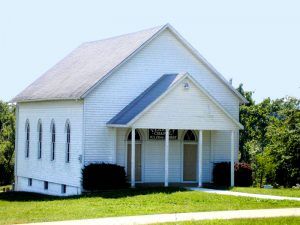
As to the original Paris Springs, ½ mile north of the junction, the only
remaining building is a small church.
Spencer -
Quiet Now
Past Paris Springs Junction, old
Route 66 takes a jog off of State Road 96 onto
County Road N on its way to Spencer. This very old piece of concrete
pavement first
crosses a 1923 triple pony-struss
bridge over Turnback Creek, before meandering on to traverse the 1926
one-lane steel truss Johnson Creek Bridge. Just beyond are the few remains
of Spencer,
Missouri.
This tiny little settlement, that was never
much more than a "spot in the road," was first founded in the late 1870s
when a post office was established. Later a store and a church were built
to cater to the small agricultural population of the area. However, by
1912, it was already a
ghost town when the road to Spencer became
impassable and most people moved on. When Route 66 made its way through
town, the community saw a small resurgence, with a grocery store, a Tydol
station and a garage, a dry goods store and a barbershop. These businesses
all died when Route 66 was bypassed by I-44.
Up until recently, the "entire town"
was
but one row of vacant buildings. Though they were in good condition, they
sat silent and lonely on this old stretch of the road. However, this
historic site has been purchased by Francis and Marie Lynn Ryan of Salina,
Kansas.
The Ryans obtained the property from Kent Casey, who's grandfather,
Sydney Casey, first acquired the land in 1925. Sydney Casey built the
buildings and ran the businesses at the time the
Mother Road
was blazed through the area. For the first few years, the gas station was
a Tydol station but later it changed to Phillips 66, to which the Ryans
have restored it to today.
Today, the gas station and garage have been
restored to their former glory, welcoming a new generation of Route 66 travelers.
The gas pumps, signs, and other memorabilia are from the Ryan's personal
collection. Helping with this project are locals, Quentin and Cathy
Stockham, who have placed the vintage police car in the front of the
buildings. Though tiny Spencer was never large enough for a police
department, it adds yet, another touch of great nostalgia to this historic
site.
More plans are in the works to restore all of
the buildings, bringing yet more character to the forgotten little town of
Spencer.
Be sure to add little Spencer to your
"must-see" list along your journey.
Continued Next
Page
|
|

Steel truss bridge over Johnson Creek,
Spencer,
Missouri,
Kathy Weiser, September, 2007.
This image available for
photographic prints
and downloads
HERE!
|

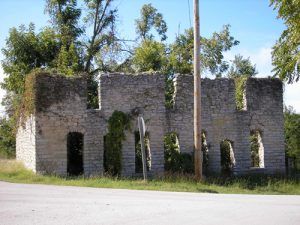
All that was left of Spencer two years ago, Kathy Weiser, September, 2007. This image available for
photographic prints
and downloads
HERE!
|
|

Spencer's row of buildings is being restored
today, photo courtesy Quentin and Cathy Stockham, August, 2009.
|

The gas station and garage have been
beautifully restored today, photo courtesy Quentin & Cathy Stockham,
August, 2009.
|
|
<<
Previous
1 2 3
Next >>
|
|

|
|
From the Rocky Mountain General Store
The
Route 66 Map Series
- Created by
Mother Road Experts Jerry McClanahan and Jim Ross, the
Route 66 Map Series, consisting of a separate fold-out map for each
Route 66
state, provides an easy-to-follow through route and clear, simple
directions to keep you on the right track as you take the historic journey
down America's legendary highway. Each map is generously illustrated with
original nostalgia art by McClanahan, and text by Ross includes the
history of the road, tips on finding abandoned segments, and information
pertaining to each state. These eight maps are an absolute must for
every Route 66
cruiser.
|
| |
|