
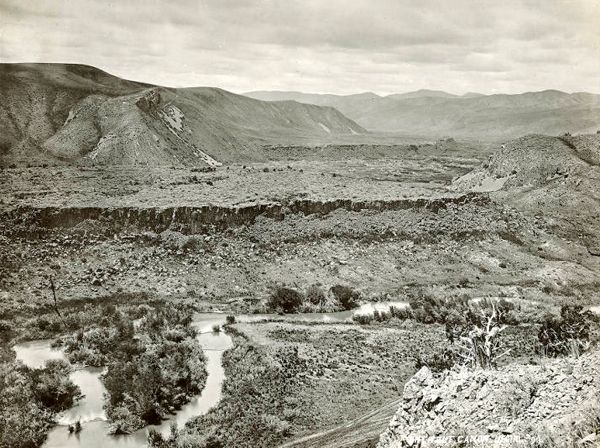
Portneuf Canyon, Idaho.
Before the railroad barreled through Idaho Territory, freight and stage lines provided transportation for trade goods and gold along routes from Montana to Utah.
In 1864, Ben Holladay expanded his stage line through Idaho, and though it provided a much-needed service, the paths were fraught with danger. Portneuf Road, which runs from Virginia City, Montana, to Pocatello, Idaho, often carried gold from the rich Montana mines and soon became a target for thieves hiding in the forested areas along the trail. Such was the case on July 26, 1865.
Carefully planned, four outlaws met in a saloon in Boise City, Idaho, in May 1865. Leading the “gang” was Brockie Jack, who had recently broken out of jail in Oregon and had been hiding on a nearby ranch. The next prominent member of the group was Big Dave Updyke, who had been elected Ada County Sheriff just a few months previously. Parading as a decent citizen, he was known to consort with felons and was closely watched by the Payette Vigilance Committee. The third member was a man named Willy Whittmore, who was known for his quick temper and deadly aim. The fourth man was a little-known player named Fred Williams.
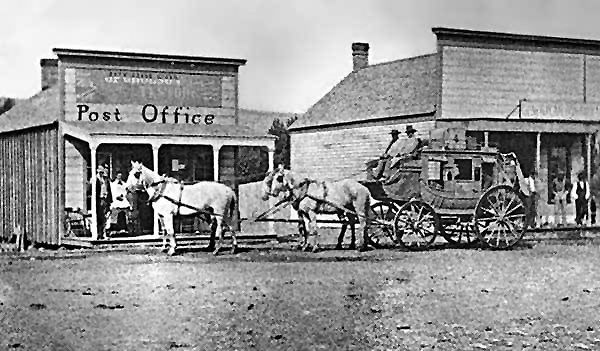
Stagecoach in Boise City, Idaho.
On May 31, 1865, the four outlaws left Boise City and headed toward the Portneuf Stage Route in eastern Idaho, more than 200 miles away. Making camp at Ross Fork Creek near Fort Hall, the men worked out the details of the hold-up. Fred Williams was sent to Virginia City, Montana, to gain information about the gold shipments. Once he was sure the stage line would carry the precious cargo, he was to purchase a ticket and ride along as a passenger.
In the meantime, the other three bandits traveled south along the stage road, looking for the perfect place for the hold-up. A few miles south of present-day Pocatello, the trio found a narrow, heavily timbered, rocky canyon filled with brush. Satisfied that the location provided everything needed, the bandits began investigating the robbery’s details. They soon gathered several large boulders to block the stage road, hiding them out of sight until needed. Additionally, they decided that Willy Whittmore, armed with a new Henry repeating rifle, would shoot the lead horses if the driver found a way around the roadblock.
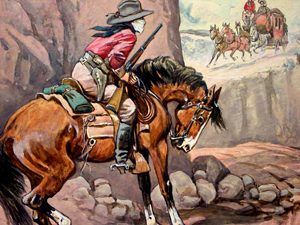
Stagecoach Robber.
With the details worked out, the three bandits returned to Ross Fork Creek to wait for their accomplice, Fred Williams. It would be nearly two weeks before they received any word. On July 21, 1865, the stagecoach left Virginia City with a seasoned driver, Charlie Parks, and seven passengers, including one calling himself Fred Williams. Crossing the Ruby Mountains, the stage spent its first night at the Corral Station near present-day Dillon, Montana. For the next three days, the stagecoach traveled along the route where the Union Pacific Railroad would later be built to Pocatello.
On the fourth evening of their journey, the stagecoach stopped at the Sodhouse Station to rest overnight. After the passengers had completed their evening meal, Williams excused himself and headed toward the Ross Fork Camp. The other outlaws were ecstatic to hear the news that two large, strongboxes laden with gold were being transported on the stage. After a celebratory drink or two of whiskey, Williams headed back. No one had even noticed he was gone.
On July 26, 1865, the coach set out once again. Around midday, it reached the stream near where the three outlaws were hidden in the brush. Slowing down to cross the water, the coach traveled through, went up the bank, and stopped. Across the road were the boulders the bandits had placed to stop the coach. Suddenly, the outlaws appeared from their hiding places with guns raised.

Stagecoach with a guard sitting on top, protecting whatever wealth it might have been carrying.
From the coach, one of the passengers, a professional gambler named Sam Martin, poked his head out of the side door with a revolver in his hand. Aiming at Whittmore, he pulled the trigger and shot off Whittmore’s left index finger.
Enraged, Whittmore shouted, “It’s a trap!” and began to empty his rifle into the side of the stagecoach. In a desperate attempt to escape, Charlie Parks tried to break through the brush, but Brockie Jack shot both lead horses, and the stage stopped dead in its tracks.
Hit by some of the buckshot, the injured Parks scrambled down from the coach and made a mad dash toward the woods. In the meantime, Fred Williams, the outlaw accomplice, and James B. Brown, a Virginia City saloon keeper, were also able to escape into the nearby timbers.
Finally, Brockie Jack grabbed the rifle from Whittmore’s hands, and the sounds of gunfire ceased. Cautiously, Jack approached the stagecoach while Whittmore and Updyke covered him. “Come out of there with your hands up,” he called, but was met only by silence. He opened the stage door and shouted, “My God, they’re all dead.”
Inside were the five broken bodies of Sam Martin, the professional gambler who had shot Whittmore; Mr. and Mrs. Andy Ditmar, a Mormon couple who had been visiting relatives in Bannock, Montana; Jess Harper, an ex-Confederate soldier who was on his way to visit his parents in Sacramento, California; and a man named L. F. Carpenter, who was headed for San Francisco to catch a steamship to New Orleans. All were dead except Carpenter, who was injured and faked his death to survive.
As the bandits began to loot the stagecoach and its dead passengers, accomplice Fred Williams staggered from the woods with a broken arm from one of Whittmore’s deadly bullets. The three other outlaws barely noticed as they were too busy with their frenzied plundering. Whittmore and Brockie Jack soon hauled the two heavy strongboxes from the stage and cracked the large iron locks with an ax. Inside were 15 heavy gold bars and two large pouches filled with gold dust and nuggets. Two more pounds of gold dust and nuggets were found in the passenger compartment. Pleased with their stolen cache, the four outlaws packed up and rode out of the canyon.
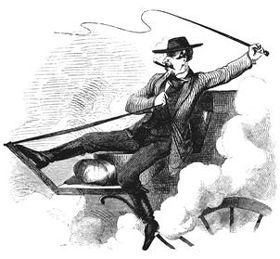
Stagecoach Driver.
After they were out of sight, Charlie Parks, the stage driver, and James B. Brown, the Virginia City saloon keeper, cautiously emerged from the timbers. Brown pulled the still-breathing Carpenter from beneath the dead bodies, making him and the injured Parks as comfortable as possible inside the coach. He then cut the stage loose from the two dead horses and drove it to Miller Ranch Station.
As the survivors told their stories, Parks recognized Brockie Jack and David Updyke, while James Brown positively identified Fred Williams and Willy Whittmore. In an attempt to reclaim its $86,000 loss, the insurance company immediately offered a $10,000 reward for information leading to the recovery of the gold and the capture of the robbers. In the meantime, the ever-active vigilance committee issued orders to hang the criminals once they were captured.
Willy Whittmore, the hot-tempered gunman who had killed all the passengers, was the first to be caught. While on a drinking binge in Arizona, he resisted arrest when lawmen tried to take him in and was subsequently shot. Just a week later, Fred Williams was captured in Colorado and hanged by the local vigilance committee. Both men were nearly penniless when they were killed.
David Updyke was a different story. Having been duly elected as Ada County Sheriff in March 1865, the vigilantes were more cautious and waited until the opportune time to punish him for his suspected wrongdoings. On September 28, 1865, the Payette River Vigilance Committee arrested him for defrauding the revenue and for failing to arrest a hard-case outlaw, West Jenkins.
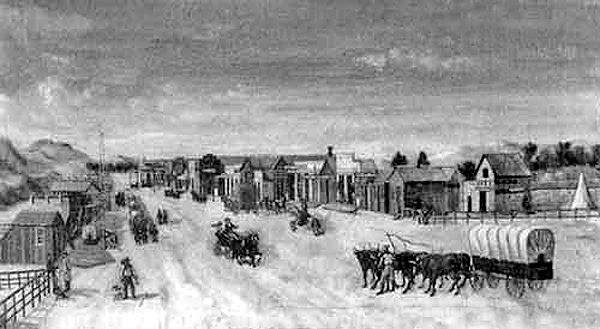
Boise City, Idaho, 1864.
However, Updyke made bail, and, knowing the Vigilance Committee’s reputation, he immediately left town, fleeing to Boise City, where he had more influence. However, the citizens there were also fed up with the criminal elements and began forming groups to clean up the county. By the following spring, Updyke feared for his safety, and accompanied by another outlaw named John Dixon, the two departed Boise on the Rocky Bar Road on April 12, 1866. Unaware that a vigilante party was following them, the two overnighted at an abandoned cabin some thirty miles out of town.
During the night, the vigilantes captured the unsuspecting pair and led them ten miles farther down the road to Sirup Creek. The following day, as the vigilantes prepared to hang the men, they questioned Updyke about the whereabouts of the stolen cache. The crooked sheriff only glared at them in contempt, refusing to respond. The vigilantes then hanged both men under a shed between two vacant cabins. Updyke had only $50.00 on his person at the time of his death.
On April 14, the bodies were found with a note pinned to Updyke’s chest accusing him of being “an aider of murderers and thieves.” The next day, an anonymous note appeared in Boise explaining the committee’s actions.
“Dave Updyke: Accessory after the fact to the Portneuf stage robbery, accessory, and accomplice to the robbery of the stage near Boise City in 1864, chief conspirator in burning property on the overland stage line, guilty of aiding and assisting escape of West Jenkins, and the murderer of others while sheriff, and threatening the lives and property of an already outraged and long-suffering community.”
As to the last outlaw — Brockie Jack, he seemingly disappeared into oblivion.
There is no record of the gold bars ever being sold. This, coupled with the weight of the bars and the destitute state of the three men killed, has led to much speculation that the gold was buried near the robbery site. The gold, valued at $86,000 at the time of the theft, would now be worth about $1.6 million. The robbery site was in the canyons around the Portneuf River, a few miles south of present-day Pocatello, Idaho.
©Kathy Alexander/Legends of America, updated November 2025.
Also See:
Outlaws, Gunfighters, Lawmen & More
See Sources.