
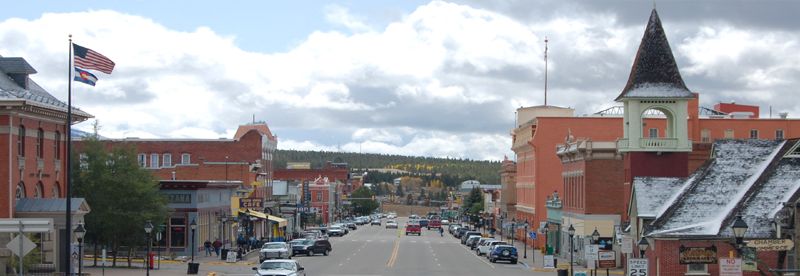
Harrison Avenue, Leadville, Colorado, by Kathy Alexander.
“There has been but one Leadville. Never will there be another.”
This 1916 quote from Olden Times in Colorado aptly describes this grand, glorious city of the past, which continues to awe visitors with its magical appeal.
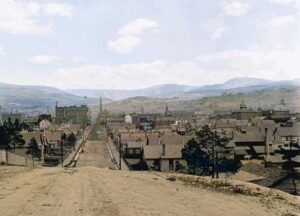
Leadville, Colorado, by William Henry Jackson, 1901.
Leadville, Colorado, often called “The Two Mile High City” and “Cloud City,” was the highest incorporated city in the United States at 10,430 feet. However, that title has now been replaced by Alma, Colorado (the highest incorporated municipality). Located at the foot of two of Colorado’s highest peaks – Mt. Elbert and Mt. Massive- Leadville is one of America’s last remaining authentic mining towns.
Self-described as quaint and absolutely original, Leadville is a National Historic Landmark District. The small city comprises 70 square blocks of Victorian architecture. It is adjoined by the 20-square-mile Leadville mining district, where many old mines and cabins dot the landscape.
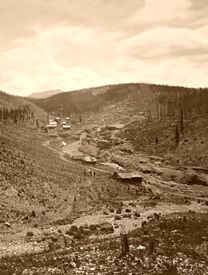
Oro City, near Leadville, William Henry Jackson.
The area’s population began in 1859, when gold was discovered in California Gulch. In 1860, Horace and Augusta Tabor arrived in the Gulch, where Horace tried his luck at placer mining, and Augusta became the camp provisioner, acting as cook, laundress, banker, and postmistress. By 1861, over 5,000 prospectors were swarming the area, and the settlement of Oro City was established. The Tabors followed the miners for several years, moving from one camp to another, but finally returned to Oro City in 1868 and reopened their store.
The placer deposits quickly played out, and although the Printer Boy Mine opened in 1868, Oro City was almost deserted by the 1870s. Most miners quickly left to follow gold discoveries in Buckskin Joe, Payne’s Bar (now Idaho Springs), and other mining camps on the eastern slopes of the Continental Divide.
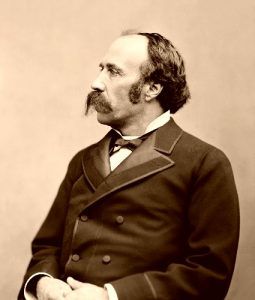
Horace Tabor.
However, in 1875, metallurgist Alvinius Woods and his partner, William Stevens, discovered that the local sands, which had made sluicing gold so difficult, were composed of carbonate of lead with extremely high silver content. They kept their secret for a while and quietly began buying up many of the abandoned gold claims in the area.
Nevertheless, when Woods sold his interest in the partnership for $40,000, word spread, leading to a second boom in the area. Thousands of prospectors again flooded the gulch, which eventually led to the founding of Leadville. In January 1878, Leadville was incorporated, and by 1879, its population had reached 18,000. In the summer of 1878, Horace Tabor struck it rich after grubstaking two miners on a small claim. Quickly, he became the alleged Silver King of Leadville.
In 1879, Horace Tabor built the Tabor Opera House, which was a legend in its own time. Quickly replacing the smaller theatres and showhouses, it became the social Mecca of the community. On its opening night on November 20, 1879, the premier had to compete with one with even greater appeal – a double lynching where two claim jumpers were taken from the county jail by the local vigilante organization and outfitted with hemp neckties. Their bodies were left hanging from the rafters projecting from the roof of the jail as a lesson to “thieves, bunco-steerers, footpads and chronic bondsmen for the same” in the world of a note pinned to one of the victims. While its opening night was only about half full, it was quickly the most popular spot in town.
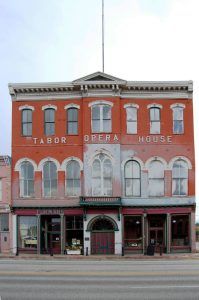
Tabor Opera House in Leadville, Colorado, by Kathy Alexander.
Violence and prosperity coexisted in Leadville in 1879. The local newspaper observed at the time: “Leadville never sleeps. The theaters close at three in the morning. The dance houses and liquor shops are never shut. The highwayman patrols the street in quest of drunken prey. The policeman treads his beat to and fro. The music at the beer halls is playing at a low volume. A mail coach has just arrived. A merry party is opposite the public school. A sick man is groaning in the agonies of death. Carbonate Hill, with her scores of briefly blazing fires, is Argus-eyed. Three shots are heard down below the old courthouse. A fight has broken out in a State Street casino. A woman screams. The sky is cloudless. Amman stands dreaming in front of the Windsor, looking at the stars – he is away from home.”
The journal continued, “A barouche holding two men and two women comes rushing up Chestnut Street. Another shot is heard down near the city jail. A big forest fire lights up the mountains at the head of Iowa Gulch. ‘Give you the price of a bed, did you say?’ ‘Yes, I’ve not seen a bed for a week. Believe me, kind sir, I’m sick and in need of a friend. Help me, stranger, and as true as I live I’ll repay your kindness.’ The clock on the Grand Hotel points to one. Shots are heard from Carbonate Hill. The roar of revelry is increasing. The streets are full of drunken carousers taking in the town.”
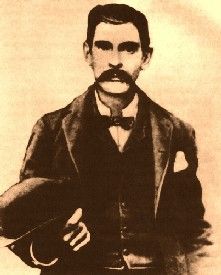
Doc Holliday.
By 1881, 14 smelters and reduction plants operated in the Leadville district. Some of the biggest mines were the Tabor Matchless Mine, Morning Star, Iron Silver, Catalpa, Chrysolite, and Little Pittsburgh (Tabor also had an interest in several of these mines). Silver production peaked at over $11,000,000 in 1880, then leveled out at about $10,000,000 for several years before declining. During this period, many great fortunes were made and lost in the mining district. Horace Tabor became one of the wealthiest men in the world, but would eventually die a pauper.
Around 1883, Doc Holliday made Leadville his headquarters, where he stayed most of the time until his death. Although the two-high-mile-high mining camp did nothing for his tuberculosis, he left only when he scented an opportunity on the plains below.
On the afternoon of August 19, 1884, Doc got into an altercation with Billy Allen. Doc was in Hyman’s Saloon, and as Allen entered, Doc, having known Allen was looking for trouble, leveled his pistol, sailing a bullet over Allen’s head, barely missing him. Allen turned, intending to flee, but tripped over the threshold and, pitching forward, landed on his hands and knees. Reaching over the tobacco counter, Doc fired again, hitting Allen in the right arm. Holliday would have shot him again, but the bartender rushed up from behind and clamped down on his gun hand. In a news report only days later, the Leadville Daily Democrat stated, in part, the following: “The public sentiment, which has nothing to do with the law, is largely in favor of Holliday. The manlier class of the community not only appreciates this but has little criticism to make as to his actions in connection with his trouble with Allen.”
Holliday faced a lengthy legal process, his popularity notwithstanding, but on March 28, 1885, a jury found him not guilty of the shooting or attempted murder. The courthouse in Leadville today still shows the arrests of the infamous gunfighter and gambler Doc Holliday in its jail records.
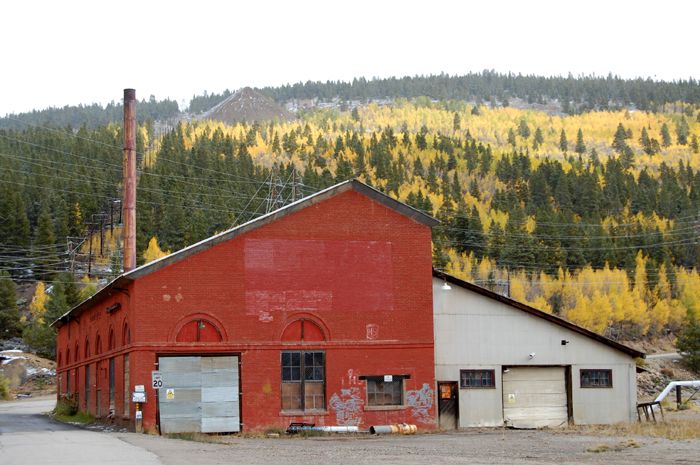
Yak Power Plant in Leadville, Colorado, by Kathy Alexander.
In the spring of 1887, Holliday bought himself a one-way ticket to Glenwood Springs, the spa that claimed so many cures, and died there before the year was out.
By 1893, the estimated population reached almost 60,000. At its peak, Leadville was on the verge of becoming a ghost town again when, in 1893, the United States adopted the gold standard, which led to a severe depression in the area and the closure of most silver mines. All smelters closed except one, which became the Great Arkansas Valley Smelter, the largest in Colorado, and continued operating until the 1960s. By 1896, the area mines had produced more than 200 million dollars in ore.
As the local economy declined after the Silver Panic, significant gold deposits were discovered in the eastern portion of the district. This led to the third boom in Leadville’s history. The discovery of rich gold deposits reinvigorated the Leadville district.
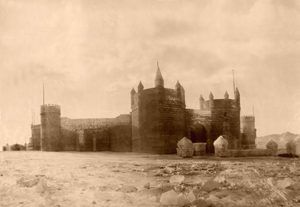
Ice Palace, Leadville, Colorado, by William Henry Jackson.
The Ibex Mining Company became a district leader, acquiring many older silver workings and reopening them. The lead and zinc ores pulled from the mines contained significant amounts of manganese and bismuth in addition to gold. This broader production base allowed the district to maintain a reasonable level of prosperity until the Great Depression, when low world metal prices, rising production costs, and limited capital gradually closed most operations.
Leadville, past its heyday and struggling, attempted to attract visitors by building a mammoth ice castle to draw sightseers, create jobs, and rescue the town’s flagging economy.
Leadville erected the biggest ice structure ever built in the United States in 1895, covering 58,000 square feet. The Crystal Palace, as it was called, was completed in December 1985 and opened on January 1, 1896.
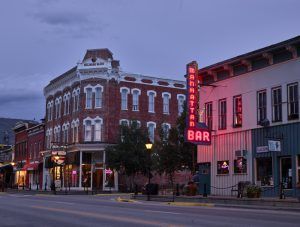
Leadville, Colorado at Dusk by Carol Highsmith.
The palatial building included an ice skating rink, a merry-go-round, a toboggan run, and several social enterprises, including gambling, restaurants, and dance rooms. Unfortunately, Leadville had a very early thaw in March, which shut down the most magnificent ice palace in history.
Though Leadville welcomed more than 250,000 visitors to the Crystal Palace, it was not enough to revive the community, and investors did not fare well.
During the early 20th Century, a vast deposit of molybdenum was discovered in Climax, 14 miles northeast of Leadville. This metal is used to produce modern high-strength steel alloys. The Climax Molybdenum Company created what would become one of the world’s largest open-pit mines to extract ore from Bartlett Mountain. By the 1940s, the mine produced over $13,000,000 annually.
One of America’s last remaining authentic mining towns, Leadville has a wealth of historical attractions, including the federally chartered National Mining Hall of Fame Museum, the Healy House & Dexter Cabin State Museum, and the Tabor Opera House.
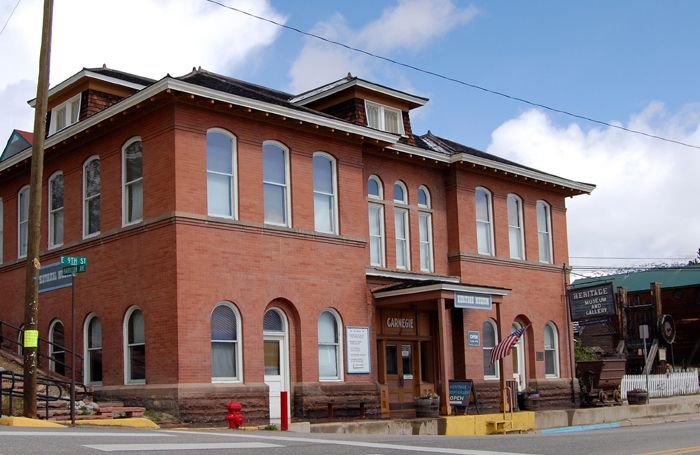
Heritage Museum in Leadville, Colorado, by Kathy Alexander.
A “must-stop” for ghost towners and explorers is the Leadville Chamber of Commerce, where you can pick up a free map called “The Route of the Silver Kings.” This informational guide tells you about the mines surrounding Leadville and shows you the way. Most of the roads are easily accessible with any vehicle. It is well worth the trip!
Recreational opportunities are plentiful in the vast mountains, streams, and lakes. And, at altitudes that seldom drop below 9,000 feet, the Leadville area boasts exceptional scenery, crisp mountain air, and pleasant summer temperatures.
Horseback riding, rock-hounding, climbing Colorado’s highest peaks, camping, hunting, fishing, mountain biking, exceptional cross-country skiing, and a variety of other outdoor activities abound.
Contact Information:
Visit Leadville
460 Harrison Ave
Leadville, CO 80461
719-486-3900
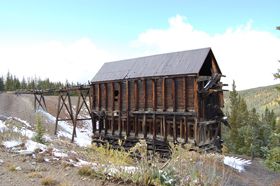
Ibex Mine Ore bin on the Route of the Silver Kings outside Leadville, Colorado, Kathy Alexander.
©Kathy Alexander/Legends of America, updated October 2026.
Also See:
Colorado Ghost Towns & Mining Camps
See Sources.