
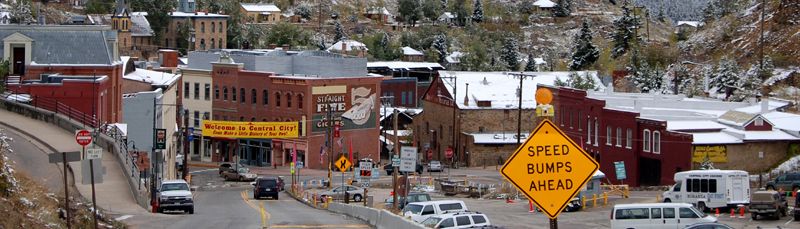
Central City, Colorado by Kathy Alexander.
“By the first of June 1859, Gregory Gulch from North Clear Creek to the confluence of Eureka, Nevada, and Spring Gulches was literally crowded with human beings huddled together in tents, wagons, log cabins, dugouts, houses made of brush, and of every conceivable material that promised shelter.”
— Daily Central Register, June 1859.
Central City, Colorado, the county seat of Gilpin County, is a historic mining town founded in 1859 during the Pike’s Peak Gold Rush.
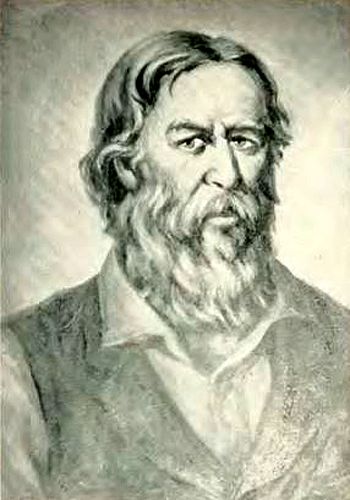
John H. Gregory, Colorado Miner.
On May 6, 1859, John H. Gregory followed Clear Creek upstream, looking for gold. As he pulled a low tree branch out of the way and began to pan the creek, he discovered what was later called “The Gregory Lode.” Located in a gulch between what later became Central City and Black Hawk, he staked the first of many mining claims in the vicinity. Immediately, prospectors flocked to the region, and within two months, the population grew to 10,000 people seeking their fortunes. The Clear Creek Mining District was so rich with ore it became known as the “Richest Square Mile on Earth.” A stone monument at the eastern end of Central City commemorates Gregory’s discovery.
An article in the Daily Central City Register described the living conditions at the time as thus: “By the first of June 1859, Gregory Gulch from North Clear Creek to the confluence of Eureka, Nevada, and Spring Gulches was literally crowded with human beings huddled together in tents, wagons, log cabins, dugouts, houses made of brush, and of every conceivable material that promised shelter.”
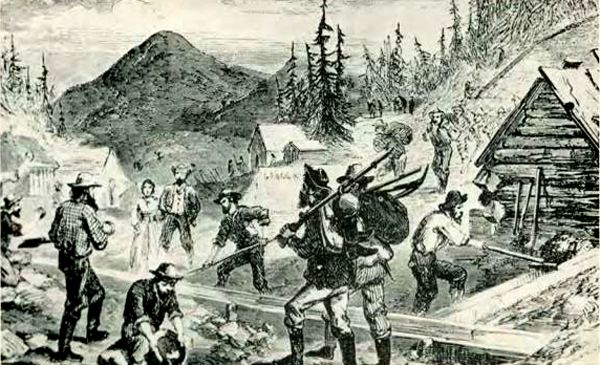
Gregory Gulch, Colorado, 1859.
Other gold deposits were found in surrounding gulches and several mining camps sprouted up, including Springfield, Bortonsburg, Missouri City, Nevadaville, Dog Town, Eureka, Russell Gulch, Lake Gulch, Black Hawk Point, Chase’s Gulch, and Enterprise City. By the middle of July 1859, between 20,000 and 30,000 people were living in and around Gregory Gulch.
There are two popular stories about how Central City was named. The first involved William N. Byers, founder of the Rocky Mountain News, who pitched his tent squarely in the center of the mining district in June 1859. Supposedly, he suggested that a town be laid out in that vicinity, and since it was about halfway between Nevada, Nevadaville, and Mountain City, it should be called “Central City.” The second is of a miner’s supply store in the area known as the “Central City Store.” Either way, Central City was born.

Central City, Colorado, in the 1860s.
The Rocky Mountain Gold Reporter and Mountain City Herald were the first newspapers published in the mountains. In its first issue, dated August 13, 1859, it contained the following article regarding Mountain City:
“Although not three months old, it already contains some 300 buildings substantially erected, with a population of between 2,800 and 3,000, nearly all of whom are miners. Yet the arts and trades are well represented; we have about 25 stores, 2 jewelry shops, 3 tailor shops, blacksmiths, shoemakers, painters, etc.”
In late September, the first snow began to fall, and most of the miners returned to lower elevations; however, a census taken just the next month revealed that nearly 2,300 men were still in the gulch area.
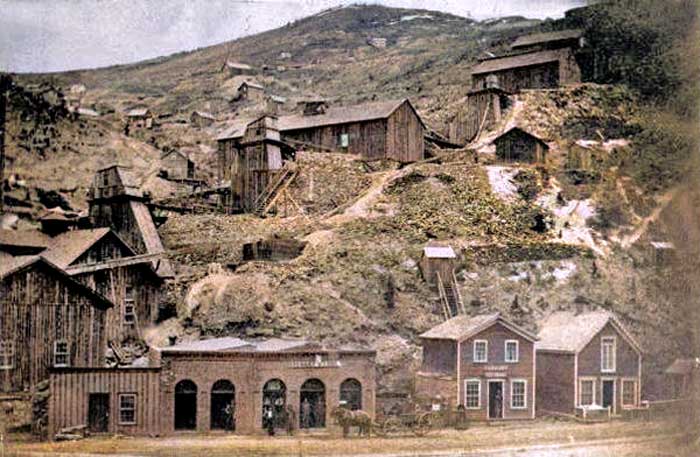
Gregory Gulch, Colorado by W.H. Reed, 1865.
By the end of the year, The Rocky Mountain News estimated that “From a million and a half to two million dollars in dust has been taken out, which has found its way to all parts of the Atlantic States and Territories…”
During the winter of 1859-60, many new gold discoveries were made throughout the mountains and by February, miners were beginning to return. During that month, there was “a report of the discovery of a six-pound nugget near Gregory’s.” The discoverer was offered $16 per ounce for it but refused to sell.
Also, in February 1860, the first steam engine was assembled in Mountain City. It was used to produce shingles and was ready to crush quartz when the mines began delivering ore. This engine cost $1,500 when purchased at the foundry in Chicago, Illinois, in late 1859. In March 1860, it was sold at Mountain City for $15,000.
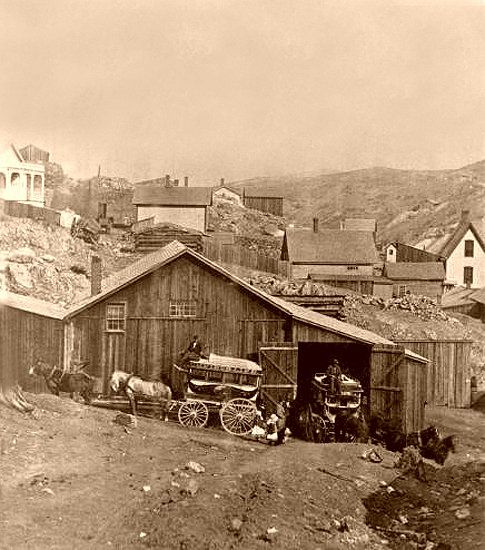
Central City, Colorado Transportation.
On April 25, 1860, the Rocky Mountain News reported, “The emigration is coming in at the rate of over one hundred men each day, and constantly increasing.” Just a little over a month later, they reported that the emigrants were coming in at the rate of a thousand a day.
In June 1860, the Western Stage Company began running daily stagecoaches from Denver to Mountain City – the ride taking seven to eight hours. Only one year earlier, it had been a three or four-day journey. During the summer, the population around Gregory’s Diggings began to stabilize. In 1860, the United States Census listed Central City at 598, Mountain City at 840, and Nevada City at 879. About 5,000 people were in the immediate area and 34,000 in the mining region.
By August 1860, the easy pickings were over, and mining for gold became more difficult. As the depth of the mines increased, extracting gold from the ore became more complex. Due to the primitive technology, as little as 1/3 of the assayed amount of the ore was recovered. Other problems contributed to an economic slowdown in the area, including the Civil War and frequent Indian attacks on wagon trains crossing the Plains. The miners were becoming a rowdy bunch, and in 1861, Central City recorded 217 fistfights, 97 revolver fights, 11 Bowie knife fights, and 1 dogfight. Amazingly, no one was killed.
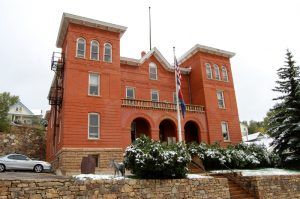
The Gilpin County Courthouse in Central City, Colorado, by Kathy Alexander.
Central City became the county seat when Gilpin County was organized in 1861. The Territorial legislature granted a city charter to the City of Central in March 1864. This was 12 years before Colorado achieved statehood in 1876.
In 1865, Nathaniel P. Hill, a professor at Brown University, began studying the problem of extracting gold from the sulfide ore. He developed a smelting process that removed most of the ore’s impurities, producing a concentrate of copper, gold, or silver. The concentrate then had to be separated and refined.
In 1867, Hill began operating the Boston & Colorado Smelting Company in Black Hawk, and mines began shipping ore to the smelter for processing. The concentrate of copper, gold, and silver was then shipped to Swansea, Wales (over 7,000 miles away), where the metals were separated and refined.
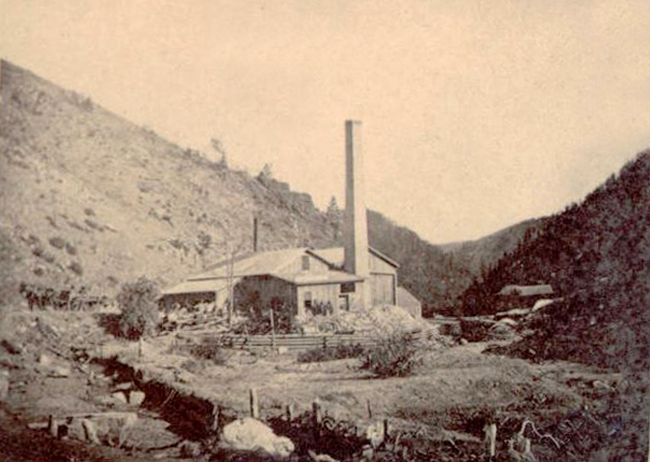
Clear Creek Canyon Smelter near Blackhawk by Albert S. McKinney, about 1870.
As a result of this smelting and concentrating process, the district was “booming” again by early 1868. This “boom” resulted in extensive construction in Central City during the summer of 1868. The Daily Miner’s Register of June 16, 1868, noted that: “No less than eleven brick storehouses will be put up on Main Street this summer. Hurrah for Central City.” Two of those brick storehouses, built that year, survived the 1874 fire and are still standing. They are the north half of the “Roworth Block” on Main Street and the “Seavey Block” on Spring Street.
In 1870, the population of Central City, Black Hawk, and Nevadaville was about 4,000 – the same as Denver. The 70’s saw many significant events in the City of Central. The city had become the most important city in the territory, and by 1871, the settlement boasted 13 blacksmiths, five boarding houses, ten butchers, one dentist, four drugstores, 12 grocery stores, 18 lawyers, seven physicians, 11 shoemakers, and five tailors.
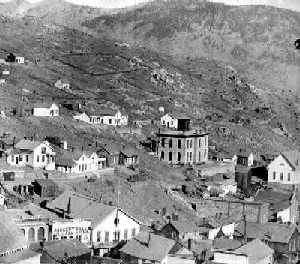
Central City, Colorado, 1870.
In 1871, a Republican Convention was held in Central City that almost turned into a disaster when the second floor of Washington Hall collapsed, depositing 200 men into the Recorder’s office on the first floor. Amazingly, no one was seriously injured.
In 1872, the Teller House Hotel was built and was said to be the finest hotel west of the Mississippi River.
In 1873, President Ulysses S. Grant visited his friend, Henry Teller (who later became the first senator from Colorado and later Secretary of the Interior under President Chester Arthur), and his new hotel. To impress the president, mine owners decided to lay 26 ingots of solid silver to make a path to the entrance to the Teller House so President Grant would not have to dirty his boots when he stepped from his carriage. However, legend has it that Grant became angry when he saw the silver bars and walked up the boardwalk instead. At that time, Congress was debating whether gold or silver should back the dollar, and Grant refused to show favoritism.
Before 1873, most buildings were constructed of wood. In January 1873, a fire destroyed 16 buildings on Lawrence Street, below Raynolds’ Court, before it was brought under control. Finally, aware of the potential danger from fire, the city began to prepare for such occurrences. An 1873 resolution of the City Council prohibited any new construction of wood buildings in the business district. However, their efforts were a little too late.
On May 21, 1874, a fire started in Dostal Alley, behind Main Street. The fire destroyed about 150 buildings in the downtown area. The fireproof Teller House and Register Block on Eureka Street stopped the fire in that direction.
The Continental Fireproof and Raynolds’ Court on Lawrence Street blocked the fire to the East. Toward the South, the fire burned as far as the Seavey Building on Spring Street.
The fireproof Roworth Block was the only building on Main Street that survived the fire. The losses were estimated to be about $500,000. Fire insurance policies paid $114,533 toward the loss. The town was rebuilt, this time of brick and stone; most of these still stand today.
As a result of the fire’s destruction of the business district, the city was able to widen and straighten the streets. The community also planned for a more substantial city than the one that burned. Rebuilding began immediately. The first brick building (Morse Block) was completed just nine days after the fire. This rebuilding of the city resulted in the downtown business district that exists today.
In 1877, Elizabeth Bonduel McCourt Harvey, later to become known as Baby Doe Tabor, moved to Central City with her first husband, Harvey Doe. It was in Central City that she gained the name “Baby Doe”, a nickname given to her by the area miners, who longingly looked upon her beauty. Baby Doe soon found that Harvey was a poor provider, being both lazy and a procrastinator. Their three-year marriage began to seriously falter when Harvey drifted from camp to camp. Baby Doe stayed in Central City until 1880, when she moved to Leadville and met the legendary Horace Tabor.
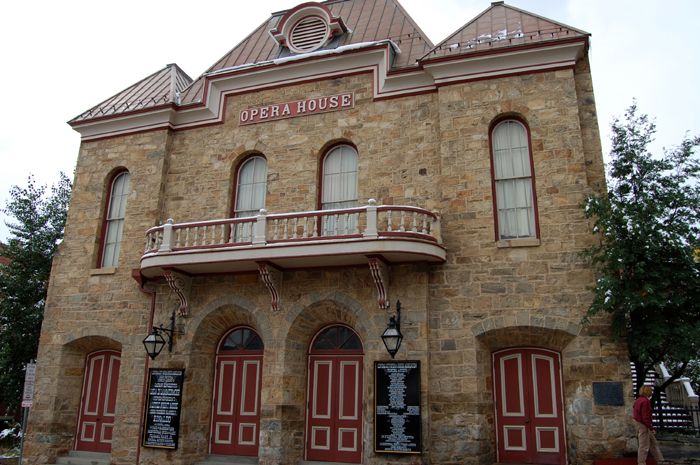
The Central City Opera House, 2009, by Kathy Alexander.
The grand opening of the Opera House in 1878 marked the start of a tradition of community theater, ranging from opera to vaudeville. Buffalo Bill Cody performed there as well at P.T. Barnum’s circus. At about the same time, population shifts began to occur, with many entrepreneurs and businesses moving to Denver or Leadville.
During this time, there was an area of town known by the locals as the Red Light District, a place where children were told to avoid. The area was at the end of Central City’s Pine Street, past the Catholic Church, and below the Methodist Church perched upon the hill. Madam Wright was operating a “crib” in the vicinity, and the newspaper believed she should relocate her business to a less conspicuous location.
In 1880, it was reported by the Census that four women resided at the address and were listed as “housekeepers.” The 1900 Census showed a widow running a boarding house with two female boarders living there. However, by 1910, the Census showed the two girls who were “boarding” with Lou Bunch as being prostitutes. Lou Bunch was the last operating madam in town.
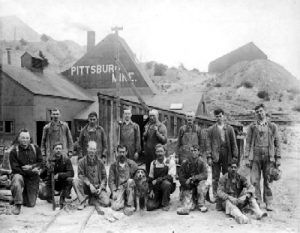
Pittsburg Mine, Central City, Colorado, 1890.
Nevertheless, Madam Lou Bunch and her girls became renowned for providing much-needed nursing care to miners sick and dying during an epidemic. This generous behavior has left Madam Lou Bunch and her Shady Ladies immortalized in history books and in the annual tribute to their good deeds. Every third Saturday in June, the city of Central City honors Madam Lou Bunch and the town’s entire heritage, drawing visitors to the unique gambling town in the mountains of Gilpin County.
By 1880, Central City, with a population of 2,547, began a period of relative stability that lasted about twenty years. However, Colorado was also growing, and the Little Kingdom of Gilpin was no longer as influential as it had been. From the early 1880s until the early 1900s, Central City was merely a good mining town. Central’s “boom” days were over.
The first evidence of Central City’s decline was in 1881 when the Tabor Grand Opera House opened in Denver. This immediately displaced the Opera House in Central City as the state’s leading showhouse.
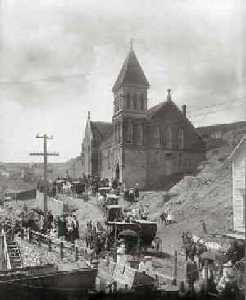
Sleepy Hollow Funeral, Central City, Colorado, 1895
Central City was also the unfortunate victim of flooding — one major flood hit the settlement in 1893 and another in 1895. If mining itself wasn’t dangerous enough, the flood of 1895 took the lives of 14 miners who drowned in the Sleepy Hollow and Americus Mines.
In 1896, violence returned to Central City when Samuel Covington entered Judge Seright’s office to pay a $61 debt. Covington had his revolver aimed at Seright’s chest, and Judge Seright knocked the gun to the side as it discharged through the floor into Goldman’s card room (Golden Rose). Covington again drew his gun on Seright and demanded a receipt.
As Marshall Kelleher opened the office door, Covington turned and fired at Kelleher, striking him in the chest. Covington ran downstairs only to meet Dick Williams coming up.
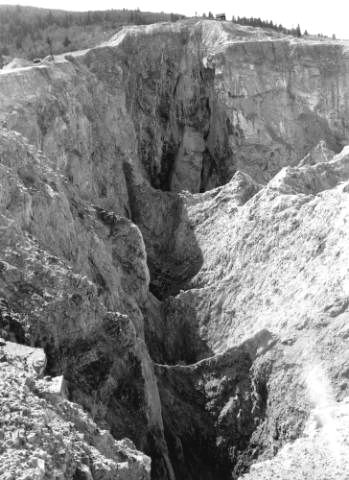
Glory Hole in Central City, Colorado, about 1930.
Williams had borrowed a revolver and ran to the scene to provide help. Williams was struck in the breast at point-blank range just as he fired a shot, which struck the ceiling behind him. Covington then ran back up Main Street with two revolvers, drawing on the crowd following him.
Henry Lehman confiscated a Winchester and hopped on Sherman Harvey’s wagon in pursuit of Covington. Covington was blazing away on Nevada Street when Lehman aimed and fired as he leaped from the wagon, striking Covington. A mob gathered around shouting, “Hang him”, but he died before a doctor could arrive. Marshall Kelleher recovered from his wound. Dick Williams died several days later. His funeral was the largest in the county, so his service was held at the Opera House.
In the early 1900s, gold production again declined as the mines became so deep that it became too expensive. Secondly, inflation during World War I caused the price of other commodities to rise while the value of gold stayed constant at about $20.00 per ounce. By 1920, the value of gold had shifted to at least a 10-to-1 ratio in favor of other commodities. As a result, most mines in the area suspended operations, and many businesses closed. This caused the population of Central City to drop from 3,114 in 1900 to 553 in 1920.
During this time, many frame houses in Central City, Black Hawk, and Nevadaville were torn down and the lumber taken to other parts of the state for construction of new residences. Many other houses were abandoned to the elements, tax rolls, and vandals.

Central City, Colorado, circa 1899. Photo by Harry H. Lake.
Lamenting this condition, the following appeared in The Weekly Register-Call on May 31, 1918:
“Iron junk is passing through this city every day for the railroad yards in Black Hawk, where the stuff is shipped to Denver. The same can be said of lumber from old houses which have been purchased by wrecking parties of Golden and Denver, in this city and Nevada City. Mr. Hawley’s old house on Nevada street, opposite the ballpark, is the latest building to be torn down, and there are many more in this city to follow.”
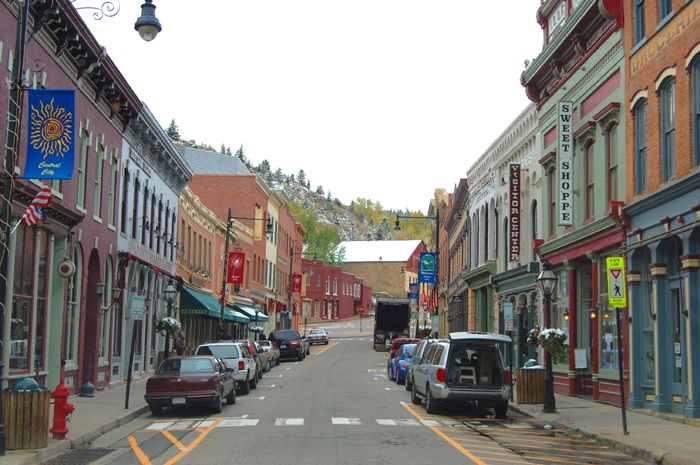
A Central City, Colorado Street today by Kathy Alexander.
During the 1930s, there was some recovery in mining due to an increase in gold from $20 to $35 per ounce and the cheap labor provided by out-of-work men after the depression.
In 1932, the Central City Opera House Association began producing summer festivals, which stimulated interest in the city. Many people began buying old residences for summer and weekend retreats, which brought a small economic revival to the area.
At the beginning of World War II, the government prohibited the commercial mining of gold in order to direct labor into the war effort. This act sent gold mining into a tailspin from which it has never recovered. After the war, some mines occasionally reopened, sputtered for a while, and reminded everyone of Central’s former grandeur. Then, like old soldiers, they would fade away. There are still vast quantities of gold ore beneath the surface of Central City and the surrounding area. However, in most cases, it is not economically feasible to produce it.
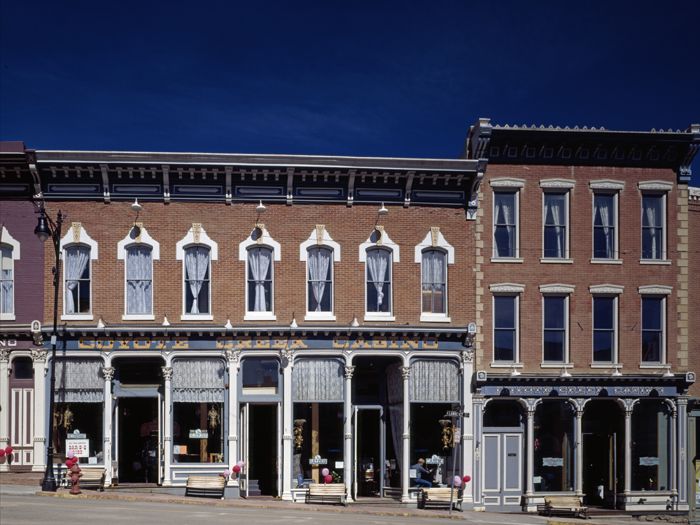
A casino in Central City, Colorado, by Carol Highsmith.
By the mid-1980s, many citizens recognized that other attractions were diverting tourists from Central City. Major ski resorts began enticing tourists to their areas during the summer and fall. Economic downturns, especially the energy bust of the early 1980s, contributed to the decline in tourism. Central City recognized that it lacked the tax base to adequately maintain its infrastructure, and new sources of revenue had to be found.
In 1989, a group of citizens formed Central City Preservation Incorporated and began working toward the legalization of limited gambling to attract tourists back to Central City. In 1991, a statewide referendum legalized low-stakes gambling but limited it to three famous gold rush towns: Cripple Creek to the south, and tiny Blackhawk and Central City. Many casinos quickly sprang up in both Central City and Black Hawk, but the majority of the emphasis was on Black Hawk. Many of the casinos in Central City have already closed, and Central City is once again seeking ways to boost its economy.
Central City’s appearance today is very similar to how it looked over 100 years ago. After the fire of 1874, the business district was constructed to last, with only buildings of brick and stone being built. There would be no more wooden buildings with their ever-present potential for destruction by fire.
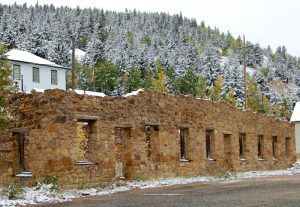
Central City, Colorado Ruins by Kathy Alexander.
On Eureka Street, from the Courthouse to Main Street, only one building that existed in 1874 remains today. That was the white wood Presbyterian Church, which stood between the Teller House and the Opera House. Even Henry Teller’s Law Office, built about 1860, still survives. On Lawrence Street, from Main Street East to Raynolds’ Court, most of the existing buildings were erected in the 1870s. On Main Street, only the buildings on the Southside of the Gold Coin were built after 1900. The Roworth Block even survived the 1874 fire and dates to the 1860s.
Outside of Central City lie four cemeteries with hundreds of ornate stone markers and intricate grillwork, with headstones dating back to the 1860s.
Just outside of town, remnants from the mining days are abundant. One mine is on a hill just above the Central City Cemetery. According to geologists and experienced miners, there are over 17,000 mining claims in the southern end of Gilpin County. For safety reasons, most of the mines have been ‘capped’ with concrete slabs or filled in.
Central City is on Highway 160, about 35 miles west of Denver.
Central City is also said to be haunted by several restless spirits. Click HERE to read about the hauntings.
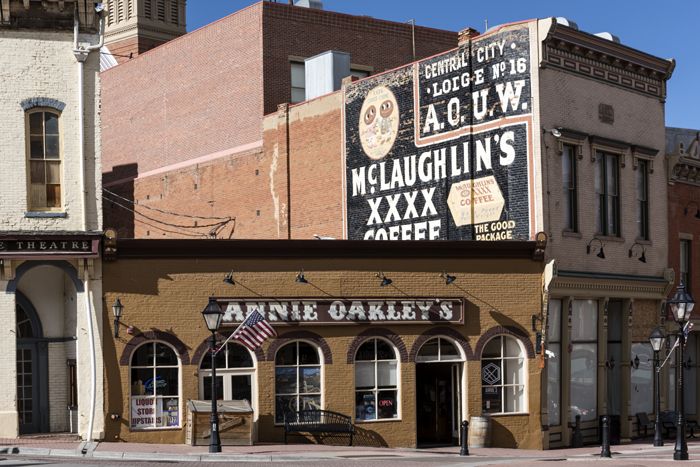
Annie Oakley’s Emporium in Central City, Colorado, by Carol Highsmith.
© Kathy Alexander/Legends of America, updated March 2026.
Also See:
Colorado Ghost Towns & Mining Camps
Colorado Ghost Town Photo Galleries
The Richest Square Mile is Haunted!
See Sources.