
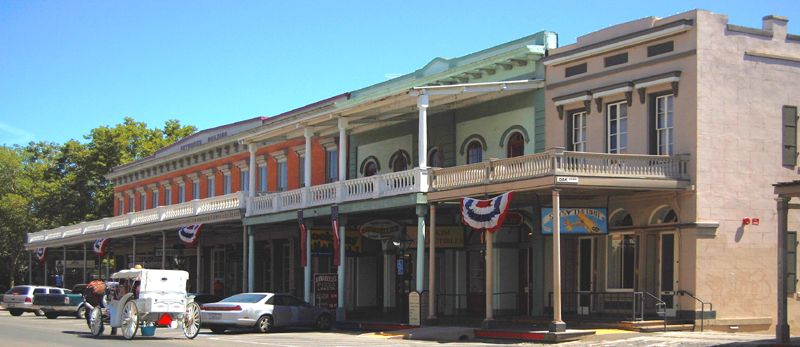
Old Town Sacramento, California, by Kathy Alexander.
Before John A. Sutter arrived in the Sacramento Valley of California, the Native Americans of the area had been inhabiting the land for at least 10,000 years. Dominated by the Nisenan and Maidu tribes, dwelling in huts built of willow saplings, their idyllic existence would soon end as trappers and traders came to the area.
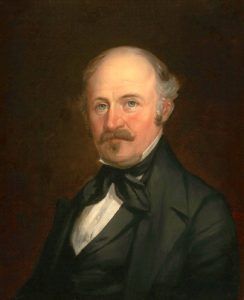
John Sutter.
John Sutter arrived on August 13, 1839, at the confluence of the American and Sacramento Rivers with a Mexican land grant of 50,000 acres. The following year, he and his party established Sutter’s Fort, a massive adobe structure with 18-foot-high and three-foot-thick walls.
Representing Mexico, Sutter called his colony New Helvetia, a Swiss-inspired name, and was the political authority and dispenser of justice in the new settlement. Soon, the colony began to grow as more and more pioneers headed west. Unfortunately, these many trappers and traders spelled a death knell for the Native Americans as the new residents bore diseases and ailments to which the Indians had developed no immunity.
Samuel Brannan established the first store in the area near the Sacramento River, taking advantage of the convenient waterfront location, and another settlement sprang up called Sacramento.
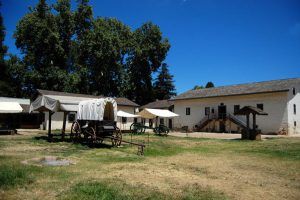
Fort Sutter in Sacramento, California, today by Kathy Alexander.
Within a few short years, John Sutter had become a grand success, owning a ten-acre orchard and a herd of 13,000 cattle. Fort Sutter became a regular stop for the increasing number of immigrants coming through the valley. In 1847, Sutter hired James Marshall to build a sawmill to continue expanding his empire. However, in January of the following year, Marshall discovered gold. Sutter pledged secrecy to all his employees, but within a few months, the word was out, and the gold rush was on. Sacramento boomed, becoming a prime trading center for the many miners flooding the area.
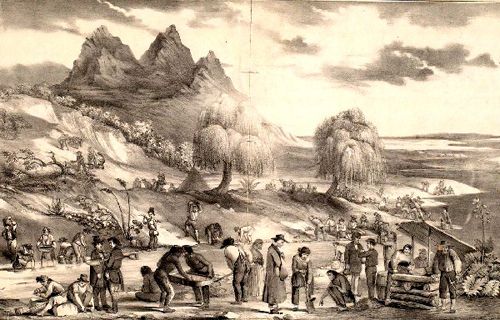
Sacramento Mining District in the 1850s.
John Sutter, Jr. arrived in 1848 to help his father manage his holdings. Much to his father’s chagrin, John, Jr. soon partnered with Samuel Brannon in laying out the City of Sacramento rather than New Helvetia, two miles to the south. Eventually, this led to the estrangement of father and son, and John, Jr. departed for Mexico. However, the town of Sacramento continued with its plans, becoming the first incorporated city in California in 1849.
To make matters worse, Sutter’s workmen soon abandoned him to seek their fortunes in the gold fields. His land became filled with squatters who destroyed crops and butchered his herds.
John Sutter, too, got caught up in the gold fever, filing multiple claims that he would later lose to the United States after the United States took the land from Mexico. By 1852, Sutter’s colony of New Helvetia had been destroyed, and Sutter was bankrupt. He spent the rest of his life seeking compensation for his losses from the state and federal governments and died disappointed on a trip to Washington, D.C., in 1880.
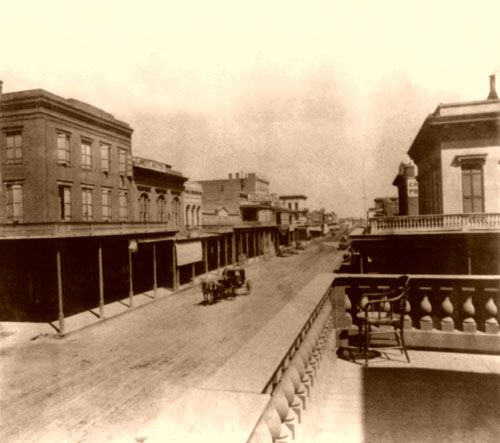
Sacramento, California, 1866.
In 1850, Sacramento experienced its first devastating flood. Two years later, it was virtually wiped out by the high waters. Though an ambitious proposal was made to raise the city above the floodwaters, nothing came of it. However, the city survived and became the California capital in 1854. Finally, when another flood devastated the city in 1862, wagonloads of dirt were hauled in, and the street level was raised by thousands of cubic yards to prevent another disaster.
As the gold rush began to decline, Sacramento became the center for the developing commercial agriculture industry. When modernization came to the city in the 21st century, the commercial district gradually moved east, and the area of Old Sacramento became a virtual slum. However, in the mid-1960s, the city began to redevelop and refurbish the area.
Today’s 28 acres, encompassing the location, have more historic buildings concentrated in one area than any other in the West. Moreover, it has become a National Landmark, with a portion designated as a California State Historic Park.
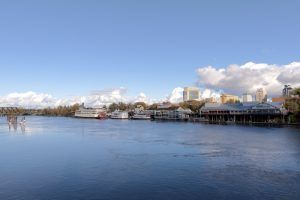
Sacramento River and Old Town by Carol Highsmith.
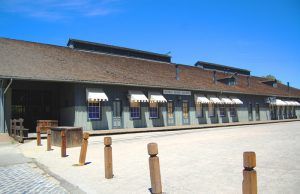
Railroad Depot in Old Town Sacramento, California by Kathy Alexander.
Today, with its wood-plank sidewalks and picturesque three-story buildings, Old Sacramento caters to more than five million visitors annually. The National Registered landmark provides a Public Market, two museums, excursion cruises along the waterfront, a hotel, numerous restaurants, and boutique-like shops.
Old Sacramento is located downtown and is easily accessible via all freeways. Take Interstate 5 to the J Street exit from any direction and follow the signs. Abundant covered parking at reasonable rates is available; enter at 3rd and J Streets. Also, a limited number of metered 90-minute on-street parking spaces are available.
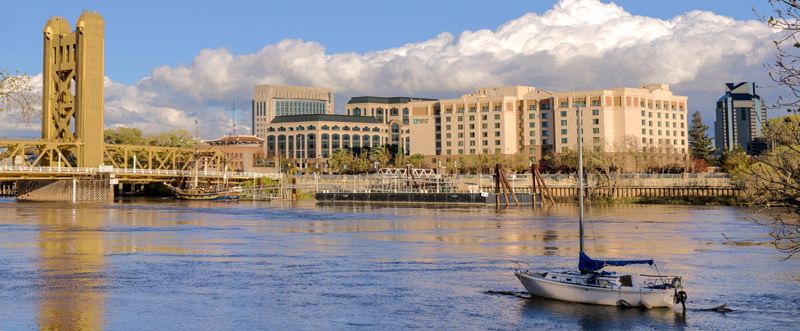
Sacramento, California skyline today, by Carol Highsmith.
©Kathy Alexander/Legends of America, updated March 2026.
Also See:
History of Wine Country in the Sierra Foothills
John A. Sutter – Boom & Bust in California
See Sources.