
By Benjamin Bicais.

Napa Valley, California Vineyard.
You can’t study the history of wine country in the Sierra Foothills and the Delta of California without understanding the broader economic forces that have shaped the region since the mid-19th Century.
Before the Gold Rush, Stockton and Sacramento were natural deepwater ports; afterward, mining left the riverbeds filled with debris. These cities are still deepwater ports, but only because a path through the Delta is dredged.
The early economy revolved around transporting goods to and from these regional centers. However, the population was relatively small and did not support a significant wine industry.
The Independent Miner: Impact on Wine Country
On January 24, 1848, James Marshall discovered gold in the American River. When news got out, a flood of young men raced to the region to seek their fortunes.

Gold Panning.
For a few years, miners searched streams throughout the Sierra Foothills for surface placer. During these early years of the Gold Rush, the romanticized notion of the self-sufficient miner emerged. The mythological independent miner remains part of California’s identity today.
These miners had a constant thirst for alcohol. This demand helped give rise to the Sierra Foothills Wine Country. In 1856, Swiss immigrant Adam Uhlinger planted grapes in the Shenandoah Valley. These were the original vineyards in the Sierra Foothills, located in Amador County.
The wine industry boomed in the following years to meet miners’ demand for alcohol. Despite the inhospitable soils, rugged entrepreneurs kept seeking new locations to grow grapes and make wine.
Early vineyards were also planted North of Uhlinger’s original vines in the more elevated El Dorado County. In 1860, Fossati-Lombardo was the first winery established in the newly incorporated town of El Dorado.
At the height of the Gold Rush, over 100 wineries operated in the Sierra Foothills. All evidence points to Zinfandel as the primary varietal then. Wines were extremely rustic, naturally very alcoholic, and often fortified.
Industrial Mining: Impact on Wine Country

Industrial Mining.
After the surface placer was discovered and mined, large-scale operations took over. The idea of independent miners striking their fortunes is essentially a misnomer. It was true for the first few years, but, as with any significant business opportunity in a free-market society, capital was rapidly pooled to profit from it. The Pacific Stock Exchange became the epicenter for pooling the capital needed to undertake these massive operations.
Entire rivers were diverted with wooden flumes to scour dry riverbeds for gold. The scale of these operations was monumental.
The mining industry also began to dig deep into the earth through hydraulic mining. Hydraulic mining involved blasting away mountainsides with pressurized water. This tactic had immediate and long-lasting implications for the region’s wine country, environment, and economy.
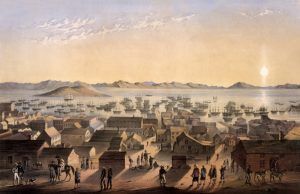
San Francisco, California, by Frank Marry, about 1850.
To this day, man-made canyons hundreds of feet deep in the Sierra Foothills remain from this process. Debris washed downstream to the Delta, causing massive flooding and devastation. They also formed a silt base, which is partly responsible for the region’s current productivity. However, the immediate economic benefits were felt in the emerging metropolis of San Francisco.
San Francisco’s industrial and real estate fortunes were tied not only to the gold of the Sierra Foothills but also to the frenzy of gold fever. A handful of wealthy San Franciscans owned factories South of Market Street that produced the machinery needed for hydraulicking. They also owned much of the real estate North of Market Street. They completed their highly profitable cycle by using newspapers and magazines to advertise the potential for vast riches to anyone who moved to the area.
Large numbers of people moved to San Francisco and the surrounding areas to claim their piece of the windfall. The population increase skyrocketed land values and provided a large, cheap labor force to extract more gold. The burgeoning San Francisco skyline was a direct result of the inverted skyscrapers of the Sierra Foothills mines.
The gold from these mines literally financed this urban prosperity. It was unbelievably lucrative for a select few. The immediate collateral effects devastated farmland (including wine country) in the Delta. Flooding was so common that the region became a shallow extension of the San Francisco Bay for much of the year. Ships could barely navigate the mud-choked waters of the once-pristine Bay.
Environmental Implications and the End of Hydraulicking

Hydraulicking.
Forests were cut down with alarming efficiency to build flumes to divert rivers. Because almost all the trees surrounding the rivers and creeks in the Sierra Foothills were cut down, the banks were not adequately supported. This contributed to regular downstream inundations. In one terrible year, the newly elected mayor of Sacramento had to travel by boat to his inauguration.
Most of the trees in the Tahoe area today are less than 150 years old. Old-growth forests were decimated during the Gold Rush.
Huge amounts of debris from constant hydraulic use filled riverbeds and caused flooding in the Delta farmlands, worsening each year. Viticultural production in Lodi suffered during these years.
This boom cycle continued until January 7, 1884, when Ninth Circuit Judge Lorenzo Sawyer outlawed hydraulicking. He declared that hydraulics’ impact on the natural environment was undeniable. Political pressure from agricultural interests in the Delta and the Central Valley also played a role. However, the most powerful objection to hydraulics came from the U.S. Navy. They could barely reach Mare Island Naval Base through the clogged waterways.
The Bust, Prohibition, and Post-Prohibition Years
One of the defining periods in California’s history had ended, and the economic repercussions were massive. Fiddletown illustrates the mining bust’s impact. Once a vibrant trading center, the population dwindled significantly after Judge Sawyer’s ruling.
Because wine country in the Sierra Foothills was isolated from the rest of the state, planted vineyards in the region largely avoided the devastation caused by the Phylloxera Louse at the end of the 19th Century. As a result, some ancient vines still survive in the foothills today.
However, this isolation, coupled with the disintegration of the local wine market (no more miners), severely impacted the wine industry. When Prohibition became law, only the Fossati-Lombardo Winery retained its bond to produce wine for local churches. The wine industry in the Sierra Foothills fell even further into oblivion in the decades after Prohibition’s repeal. Even Fossati-Lombardo Winery was forced to shut its doors.
The Delta weathered these years more successfully. In the years after the Gold Rush, many Lodi growers began forming wine-producing co-ops to adapt to changing times. These arrangements were largely successful for several decades.
After Prohibition was enacted, Lodi Wine Country continued to produce grapes for home winemakers through the Volstead Act. Heads of households were legally allowed to make a limited amount of wine for personal consumption. Lodi’s proximity to major shipping routes made the business quite profitable.
The Flame Tokay and Zinfandel varietals were shipped all over the country, often East of the Rocky Mountains. Cesare Mondavi (Robert and Peter’s father) came to Lodi from Northern Italy in the 1920s. He began his career in the wine industry by shipping grapes to the East Coast during Prohibition.
The Renaissance Wine Country in the Delta and Sierra Foothills
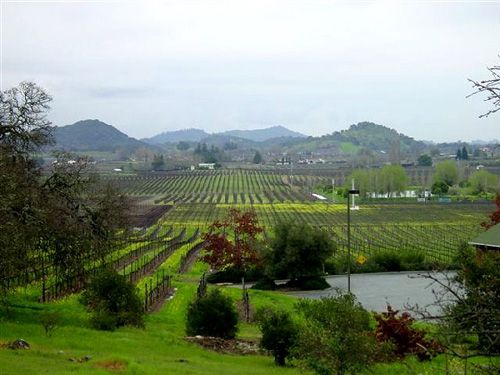
Napa Valley, California
By the 1950s, seven major Lodi co-ops encompassed more than 600 independent growers. However, problems with this business model began to arise. Major wine production and distribution corporations eventually bought all the co-ops except East-Side. This laid the groundwork for big business’s current dominance in Lodi Wine Country. The region has only partly emerged from the jug wine era. Lodi is instrumental in producing grapes for White Zinfandel. That being said, there are many high-quality, limited-quantity wines from the AVA.
Wine production in Clarksburg began in 1968 when Warren and Chris Bogle planted 20 acres of vineyards in the region. The AVA’s wine industry has grown considerably since then and currently has a reputation for producing some of the best Chenin Blanc in the United States.
Greg Boeger bought the old Fossati-Lombardo Winery in 1973 and established the first Post-Prohibition Winery in the Sierra Foothills. Since then, the region has steadily grown and has recently planted a significant amount of Rhône and Cal-Italian varietals. Zinfandel remains the region’s specialty.
The Sierra Foothills and Delta have played a significant role in shaping modern California. Although these regions are often thought of as peripheral, they are primarily responsible for the population and financial foundation on which the Golden State rests today.

Sierra Foothills, California, courtesy of Wikipedia.
By Benjamin Bicais, March 2005, updated November 2026.
Benjamin Bicais lives in Napa Valley. Article provided by: Go Articles
Also See: