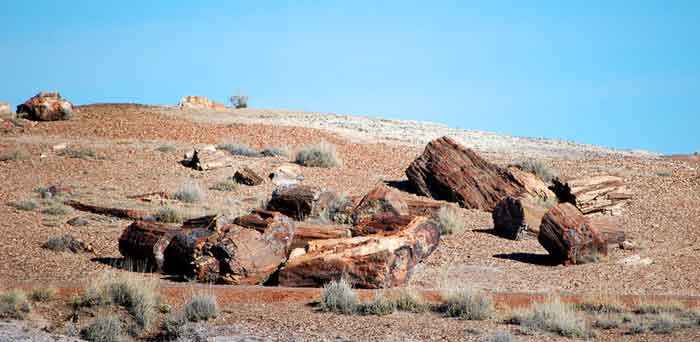
Logs at the Petrified Forest National Park along Route 66 in Arizona. Photo by Kathy Alexander.
The Petrified Forest National Park is between Navajo and Holbrook in northeast Arizona, along I-40 and old Route 66. The park is a surprising land of scenic wonders and fascinating science featuring one of the world’s largest and most colorful concentrations of petrified wood, the multi-hued badlands of the Chinle Formation known as the Painted Desert, historic structures, archeological sites, and displays of 225 million-year-old fossils.
History & Information
The park consists of two large areas connected by a north-south corridor. The northern area encompasses part of the multi-hued badlands known as the Painted Desert. The southern area includes colorful terrain and several concentrations of petrified wood. Several American Indian petroglyph sites are also found in the southern area.

Petroglyphs in the Petrified Forest of Arizona by the National Park Service.
The natural world of Petrified Forest is far more complex than it seems on the surface. Located near the southern edge of the Colorado Plateau, the park is part of an incredible geological region that includes other famous parks, such as the Grand Canyon in Arizona and Zion, Bryce, and Arches National Parks in Utah. Each has its own character, including which layer of the geological story is featured by that park.
Over 200 million years ago, large trees and rich vegetation flourished in northeast Arizona. The region was a tropical wetland with abundant streams and rivers at that time. The waterways would flood during heavy rains, sweeping fallen trees into the sandy floodplains. Later, volcanic lava destroyed the forest, and the remains were embedded in volcanic ash, mud, and water sediment. Trees are transitioned to stone by permineralization, a process of fossilization in which the organic materials are replaced with minerals, such as quartz, making a “cast” of the original organism. Millions of years later, the petrified logs were revealed by erosion.
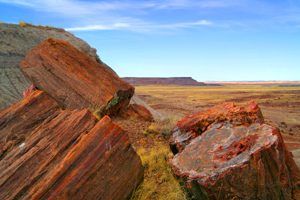
Petrified logs at the Petrified Forest, Arizona, by the National Park Service.
Much of the striking banded coloration of the Chinle Formation badlands that make up the Painted Desert region is due to soil formation during the Late Triassic period. The soil suggests that the climate was dramatically seasonal, with distinct wet and dry seasons. This climate was probably similar to the modern monsoon of the Indian Ocean region.
The colorful mudstones and clays of the Painted Desert badlands are composed of bentonite, a product of altered volcanic ash. The clay minerals in the bentonite absorb water, and their expansion and contraction properties cause rapid erosion. This prevents vegetation from growing on the hillsides.
Other prominent features created by erosion include the numerous mesas and buttes throughout the park. Both have flat tops of more erosion-resistant sandstone over softer clays. Mesas are pretty broad but not very tall, while buttes are taller and narrower.
The Petrified Forest and Painted Desert are also rich in human history, dating back over 13,000 years. More than 600 archeological sites have been found in the park. Folsom-type spear points, the earliest artifacts of Paleo-Indians who lived during the final glacial episodes, have been found, as many more artifacts, petroglyphs, and the remains of pueblos from later inhabitants. – See: People of the Painted Desert & Petrified Forest
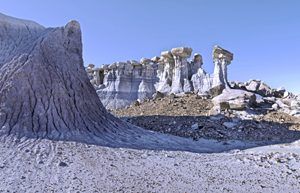
Petrified Forest Hoodoos by the National Park Service.
From the 16th through the 18th centuries, explorers seeking routes between Spanish colonies along the Rio Grande to the southeast and other Spanish colonies on the Pacific coast to the west passed near or through the area known as El Desierto Pintado, the Painted Desert. However, the park’s oldest Spanish inscriptions, left by descendants of the region’s early Spanish colonists, date only to the late 19th century.
The Petrified Forest area was designated a National Monument on December 8, 1906. The Painted Desert was added later, and on December 9, 1962, the whole monument received National Park status. Today, the park covers 93,532.57 acres.
The Painted Desert Inn, built by Herbert Lore in 1924 on a high perch overlooking the Painted Desert, was nicknamed the Stone Tree House. Because of the petrified wood used in its construction, the two-story inn operated as both an inn and a tourist attraction.
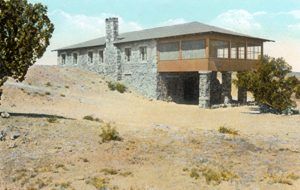
Painted Desert Inn, Arizona, the 1920s.
This isolated oasis was purchased by the Petrified Forest National Monument in 1936, and it began updating the structure. It would later become the park’s headquarters and serve thousands of Route 66 travelers. It closed in 1963 and sat vacant, deteriorating for years. Today, it is fully restored and serves as a museum.
The petrified wood of the Petrified Forest is the “State Fossil” of Arizona. The pieces of permineralized wood are from a family of trees extinct in the Northern Hemisphere today, surviving only in isolated stands in the Southern Hemisphere.
During the Late Triassic period, this desert region was in the tropics and experienced seasonal wet and dry seasons. During seasonal flooding, trees were washed from their original sites and accumulated in sandy river channels, periodically buried by layers of gravelly sand rich in volcanic ash from volcanoes farther west. The volcanic ash was the source of the silica that helped to permineralize the buried logs, replacing wood with silica and coloring it with oxides of iron and manganese.
Landmarks in the park include the Agate House Pueblo, built of petrified wood; the Agate Bridge, a petrified log spanning a wash; the Painted Desert Inn, designated on the National Register of Historic Places, an old segment of Route 66; and the Puerco Pueblo, as well as numerous scenic formations and hiking trails.
Agate Bridge
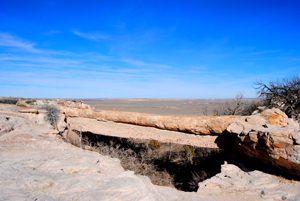
Agate Bridge at the Petrified Forest National Park by Kathy Alexander.
Some 225 million years ago, numerous tall trees washed into the floodplain, where a mix of silt, mud, and volcanic ashes buried the logs. The sediment cut off the oxygen and slowed the logs’ decay. Silica-laden groundwater seeped through the logs, replacing the original wood tissues with silica deposits.
Eventually, the silica crystallized into quartz, and the logs were preserved as petrified wood. Later, centuries of scouring by floodwaters washed out the arroyo beneath this 110-foot-long petrified log, forming a natural bridge. The petrified log, harder than the sandstone around it, resisted erosion and remained suspended as the softer rock beneath it washed away.
Enthusiastic visitors, fascinated by the bridge, helped preserve it by establishing the Petrified Forest National Monument in 1906. Conservationists felt this ages-old natural bridge needed architectural support and, in 1911, erected masonry pillars beneath the log. In 1917, the present concrete span replaced the masonry work.
The current National Park Service philosophy allows the natural forces that create unusual features to continue. If discovered today, Agate Bridge would be left in its natural state.
Agate House
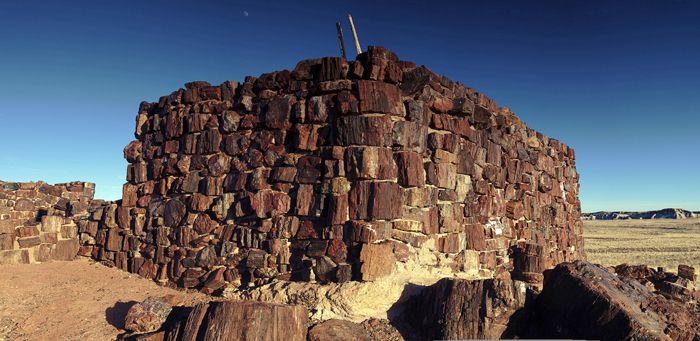
Agate House in the Petrified Forest by the National Park Service.
The ancestors of the modern Pueblo people used petrified wood for various purposes, including projectile points, knives, and scrapers. Agate House demonstrates another innovative use of petrified wood as a building material for masonry structures. The ancestral Pueblo inhabitants constructed this small, eight-room pueblo about 900 years ago near agricultural fields and petrified wood deposits. The structure’s size and the time required to build and maintain it indicate that this was not a temporary residence or field house, but rather a year-round residential structure for a family unit. Others have suggested that this structure served solely ceremonial purposes and was not a residence for a family group. Like most structures from this time, it likely remained in use for less than a generation or thirty years.
The Agate House was estimated to have been constructed and occupied between 900 and 1200 AD. This determination is based on the ceramic assemblage recovered during the excavation, including coiled utility ware and various black-on-white-painted ceramics, with a few examples of black-on-red. Most pottery appears to be associated with ancestral Puebloan people (Anasazi), although some have southern origins, perhaps associated with the Mogollon.
According to the 1933-34 site excavation report, Agate House was constructed using medium to large pieces of petrified wood, presumably carried to the top of the knoll. The walls were originally constructed of petrified wood held in place by mud mortar and chinked with smaller pieces of petrified wood. Due to the small amount of cultural debris in the area, the eight-room pueblo is thought to have been occupied for a brief time. Reconstruction of its rooms occurred after archaeological excavation in 1934.
The Agate House is located on a small hill within the Rainbow Forest. Some questions remain about the accuracy of this reconstruction, but it still enables us to envision the daily lives of the ancestral Puebloans. Agate House was listed on the National Register of Historic Places in 1975.
There is a two-mile round-trip trail from the Rainbow Forest Museum parking area to the Agate House. The first half-mile of this trail is paved and suitable for strollers and various mobility equipment (power and manual). The rest of the trail may be negotiated out to Agate House, but it is narrow and has a very rough surface, which is not suitable for some wheelchairs and other equipment. Upon reaching the Agate House, leave all archeological artifacts for all to enjoy. Also, note that this dwelling is fragile. Do not sit, stand, or lean on the walls.
Painted Desert Inn
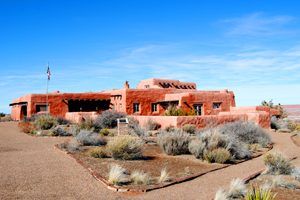
Painted Desert Inn today by Kathy Alexander.
One of the primary landmarks in the Painted Desert is the Painted Desert Inn. Herbert Lore, a local homesteader, began construction of the two-story Inn on a high perch overlooking the Painted Desert in 1920. It was first called the “Stone Tree House” because so much petrified wood was used in its construction. In 1924, he registered it as a business and claimed property under the Homestead Act. For almost twelve years, Lore operated the Inn as a tourist attraction. Visitors could eat meals in the lunchroom, purchase Native American arts and crafts, and enjoy a cool drink in the downstairs taproom. Rooms were available for $2 to $4 per night. Lore also gave 2-hour motor car tours through the Black Forest in the Painted Desert below. It was an isolated oasis in the Painted Desert without electrical connections, so an on-site lighting plant was built to supply electricity. Water was hauled from Adamana, ten miles south on the Puerco River.
The inn was built of wood and native stone in the Pueblo Revival style. Outside, flagstone terraces surrounded by low walls overlooked the desert. The building’s stone walls are over two feet thick and finished with textured earth-toned stucco. Multiple flat roofs with parapets give the inn its varied massing, and Ponderosa Pine logs pierce the walls, adding play between light and shadow.
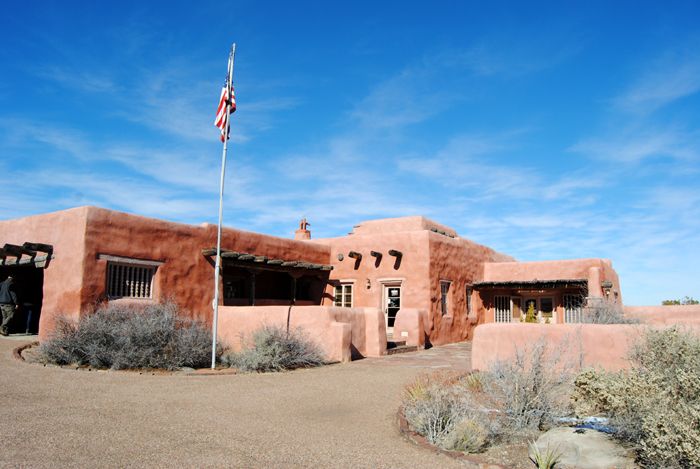
Painted Desert Inn by Kathy Alexander.
In 1932, over 53,000 acres were added to the Petrified Forest National Monument, including much of the Painted Desert, adding scenic value and protecting natural resources. This ultimately helped push legislation to upgrade the national monument to national park status. In 1936, the Petrified Forest National Monument purchased the Painted Desert Inn and other sections of land owned by Herbert Lore. Work quickly began on updating the Inn’s electrical, plumbing, and heating systems. Guest rooms, a new entryway, a dining room, and a shaded porch were added to the original structure, along with stained-glass ceiling panels, hammered-tin chandeliers, and hand-carved furniture.
During the Dust Bowl, thousands of heartland residents fled west along Route 66 in search of a better life. Hollywood documented the era in The Grapes of Wrath, which included scenes at the Painted Desert Inn.
In 1940, the inn opened under the management of the Fred Harvey Company, famous in the Southwest for providing hospitality services to tourists and travelers on the Santa Fe Railroad. For two years, the inn offered Route 66 travelers food, souvenirs, lodging, and local people with event and meeting space. It closed in 1942 as American involvement with World War II shifted resources away from domestic programs.
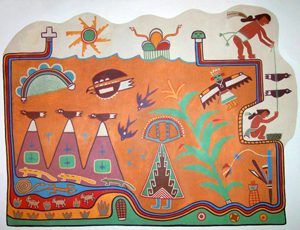
Painted Desert Inn Hopi Symbols by the National Park Service.
In 1947, the Inn reopened, with the legendary Harvey Girls complementing it with their excellent service in the spotless dining room. That same year, the Harvey Company’s noted architect and interior designer, Mary Jane Colter, oversaw the renovation of the facility. Along with overseeing repair work, Colter created a new interior color scheme and made other changes. New plate-glass windows, designed to capitalize on the magnificent surrounding landscape, were an important addition. At Colter’s behest, Hopi artist Fred Kabotie painted murals on the dining room and lunchroom walls reflecting Hopi culture. The Harvey Girls provided legendary service to the public at the Painted Desert Inn. In 1848, the Painted Desert Inn became the park’s northern headquarters.
After World War II, Route 66 became busier as people began to experience “vacations.” For many, the Mother Road included a stop at the Petrified Forest and a bite to eat or curio shopping at the Painted Desert Inn
Over the next decade, the inn declined and suffered from structural damage. In 1963, the inn closed, and a new facility opened to house the park visitor center and the Fred Harvey operations. Already suffering from foundation problems, the building sat abandoned for the next 27 years. Only open for periodic events, the building continued to deteriorate, and it was nearly demolished in 1965 and again in 1975. A public campaign helped save the building, which the National Park Service listed in the National Register of Historic Places in 1976. The Secretary of the Interior recognized the inn’s historic significance by designating it a National Historic Landmark in 1987.
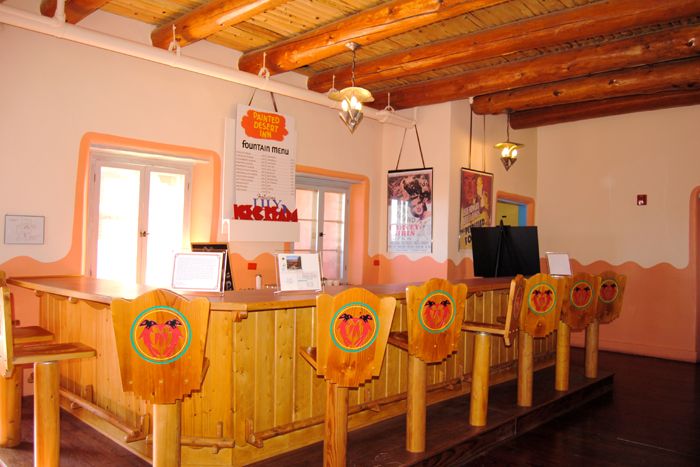
Fountain Cafe at the Painted Desert Inn by Kathy Alexader.
In 2006, the Painted Desert Inn reopened following its restoration. The inn now appears as it would have in 1949. Today, the Painted Desert Inn functions as a museum and bookstore, allowing visitors to again experience the exquisite architectural details and richly colored walls of the Painted Desert Inn. Some highlights include the Trading Post Room, a magnificent architectural space with six hammered-tin, Mexican-style chandeliers, an enormous skylight, and windows overlooking the desert.
The skylight has multiple panes of translucent glass painted in Indian pottery designs. The posts supporting the corbels and vigas are painted in muted colors. The inn still has the original Fred Kabotie murals. A large and stunning mountain lion petroglyph is on display inside the inn. Discovered in the 1930s, the petroglyph is considered one of the finest, most vividly animated, and lifelike depictions of mountain lions in the region.
Puerco Pueblo

Ruins of the Puerco Pueblo at the Petrified Forest National Park along Route 66 in Arizona. Photo by Kathy Weiser-Alexander.
During the Pueblo I Era, most sites were single-family homes. Still, as soils became exhausted, many sites were abandoned by 1250 A.D. in favor of large, multi-room pueblos near more dependable water sources. This was likely the case with the Puerco Pueblo in today’s Petrified Forest National Park. Overlooking the Puerco River, this 100-room pueblo built around 1250 surrounded an open plaza. The rooms had no windows or doors, but each could be entered by climbing a ladder and descending through a hole in the roof. At its peak, as many as 200 people lived in the pueblo. The residents of Puerco Pueblo farmed the dry slopes below the village, growing cotton, corn, squash, and beans while hunters sought game. Artisans created and decorated clay pots.
The pueblo stood one story high, with 2 to 3 rows of connected rooms. Within the plaza were several rectangular ceremonial kivas. The village was a lively center, even after the abandonment of larger Mesa Verde and Chaco Canyon pueblos to the northeast. Over time, however, the persistently dry climate led people to leave their homes around 1380. They were thought to have joined with their ancestors; the people of today are the Hopi or perhaps the Zuni people. Fragments of their buildings, tools, and their petroglyphs on nearby rocks remain to tell us of their existence.
At Puerco Pueblo and many other sites within the park, petroglyphs—images, symbols, or designs—have been scratched, pecked, carved, or incised on rock surfaces. Most of the petroglyphs in Petrified Forest National Park are thought to be between 650 and 2,000 years old.
The pueblo is near the middle of the park. A trail to the pueblo is just a short 0.3-mile loop from the Puerco Pueblo parking area. Petroglyphs can be viewed along the south end of the trail. Do not climb on the boulders or walls or touch the petroglyphs. This trail is paved and has no stairs, making it suitable for strollers and mobility equipment.
Old Route 66
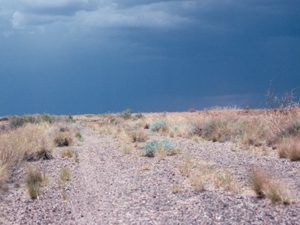
Route 66 in the Petrified Forest by the National Park Service.
Route 66 paralleled the railroad in Arizona, generally following the Beale Road and National Old Trails Road.
In the Petrified Forest National Park, old Route 66 bisected the main park highway. Signs directed travelers either north to the Painted Desert Inn and overlook or south to the main petrified wood deposits. In the late 1950s, a new alignment, which later became Interstate 40, bypassed the route. Today, the route is marked only by the remnants of the raised roadbed, weathered telephone poles, and a park exhibit.
Petrified Forest National Park is the only park in the National Park System containing a section of Historic Route 66. From Chicago, Illinois, to Los Angeles, California, this heavily traveled highway stood as a symbol of opportunity, adventure, and exploration for travelers.
A trip from the Midwest to the coast could take about a week. For many, the journey was across miles and cultures and lifestyles, from the modest to the exotic. Of course, getting to your destination was necessary, but the trip itself was a reward. From the neon signs of one-of-a-kind motels to burgers and chicken-fried steaks in the multitude of restaurants, from the filling stations that served as miniature oases to tacky tourist traps, more than 2,200 miles of open road were magical.
After long hours of travel, this was a special place to take a break, a welcome stop to rest, stretch your legs, sip a cold drink, and admire the view. The Painted Desert Inn welcomed all with an air of hospitality and allure.

Old Route 66 through the Petrified Forest and Painted Desert can be seen by following the telephone poles. Photo by Dave Alexander.
Bypassed by a new alignment (now Interstate 40) in the late 1950s, today’s route is marked only by the remnants of the raised roadbed, a lonely line of telephone poles, and a park exhibit marking the old intersection. A tribute to this remarkable American icon.
Gaze down the long road…and listen. You may hear echoes of the past, echoes of Route 66.
Other places within Petrified Forest National Park are listed on the National Register of Historic Places, including the Newspaper Rock Petroglyphs, the Archaeological District, and the Twin Buttes Archaeological District.
The Painted Desert Visitor Center provides information, book sales, exhibits, and restrooms. Timeless Impressions, a free orientation film about the park, is shown every half hour. A restaurant, a gift shop, a gas station, and a convenience store are adjacent to the visitor center. A second museum, the
Rainbow Forest Museum offers exhibits of petrified wood and fossils, displays of prehistoric animals, information, book sales, and restrooms. The orientation film is also shown here every half hour. A gift shop and a seasonal snack bar are located nearby.
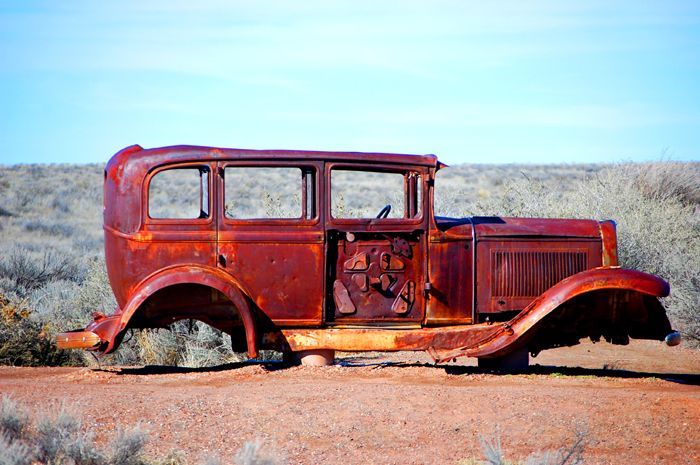
An old car on Route 66 in the Petrified Forest by Dave Alexander.
Travel through the park is limited to private vehicles, bicycles, motorcycles, or commercial tours only. The park road, parking lots, and pull-outs suit large recreation vehicles, including those towing smaller vehicles. Off-road vehicle travel, including mountain bikes, is not allowed within the park. The park does not have campground facilities, and overnight parking is not allowed.
Be aware that theft of petrified wood is punishable by fine. Tourists can purchase petrified wood legally collected from private land at several nearby businesses. (As a side note, you might also want to know about the Curse of the Petrified Forest. Read HERE.)Hiking opportunities are limited. The longest-established trail in the park is only two miles; the others are one mile or less. Backcountry camping and hiking are allowed only with a permit.
More Information:
Petrified Forest National Park
1 Park Road
Petrified Forest, Arizona 86028
928-524-6228
©Kathy Alexander/Legends of America, updated March 2026.
Also See:
Across the Painted Desert on Route 66
The Curse of the Petrified Forest
Sources:
Four Corners SW (dead link)
National Park Service
Wikipedia