

John Adams, by Asher B. Durand.
John Adams was a politician, philosopher, lawyer, and one of our country’s Founding Fathers. Adams served as George Washington’s Vice President for two terms before becoming the United States’ second President.
Described as learned and thoughtful, John Adams was more remarkable as a political philosopher than a politician. “People and nations are forged in the fires of adversity,” he said, doubtless thinking of his own experience and that of the American people.
Adams was born in present-day Quincy, Massachusetts, on October 30, 1735, the eldest of three sons of John Adams, Sr., and Susanna Boylston Adams. His Puritan family was modest, and he was raised with strong values. At just 16, he went to Harvard College in 1751.
Although his father wanted him to become a minister, he taught school for a few years after graduating in 1755.
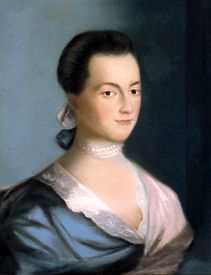
Abigail Adams by Benjamin Blythe, 1766
He then became a lawyer, studied with James Putnam in Worcester, and was admitted to the bar in 1758. In 1764, he married his third cousin, Abigail Smith, and the couple would eventually have five children, including future president John Quincy Adams.
Adams was not as popular a leader as his second cousin, Samuel Adams. Instead, his influence emerged through his work as a constitutional lawyer, his intense analysis of historical examples, his thorough knowledge of the law, and his dedication to the principles of republicanism. Adams often found his inborn contentiousness to constrain his political career.
Early on, he joined the patriot cause, serving as a delegate to the First and Second Continental Congresses, and he led the independence movement. During the Revolutionary War, he served in France and Holland in diplomatic roles and helped negotiate the peace treaty. From 1785 to 1788, he served as minister to the Court of St. James’s, then returned to be elected Vice President under George Washington.
Adams’ two terms as Vice President were frustrating experiences for a man of his vigor, intellect, and vanity. He complained to his wife Abigail, “My country has in its wisdom contrived for me the most insignificant office that ever the invention of man contrived or his imagination conceived.”
When Adams became President in 1797, the war between the French and British was causing great difficulties for the United States on the high seas and intense partisanship among contending factions within the nation. His administration focused on France, where the Directory, the ruling group, had refused to receive the American envoy and had suspended commercial relations.
Adams sent three commissioners to France, but in the spring of 1798, word arrived that the French Foreign Minister Talleyrand and the Directory refused to negotiate unless they first paid a substantial bribe. Adams reported the insult to Congress, and the Senate printed the correspondence, in which the Frenchmen were referred to only as “X, Y, and Z.”
The nation broke out into what Thomas Jefferson called “the XYZ fever,” which Adams’s actions and encouragement intensified. Congress appropriated money to complete three new frigates and to build additional ships and authorized the raising of a provisional army. It also passed the Alien and Sedition Acts, intended to frighten foreign agents out of the country and to stifle the attacks of Republican editors. Though President Adams did not call for a declaration of war, hostilities began at sea anyway. At first, American shipping was almost defenseless against French privateers, but by 1800, armed merchantmen and U.S. warships cleared the sea lanes. Despite several brilliant naval victories, the war fever finally subsided.
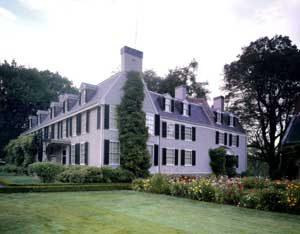
Home of Presidents John Adams and John Quincy Adams in Quincy, Massachusetts, by Carol Highsmith.
When word came to Adams that France also had no stomach for war and would receive an envoy with respect, Adams sent a peace mission to France and, after long negotiations, the “Quasi War” ended. However, sending a peace mission to France brought the full fury of Alexander Hamilton and the Republicans. In the 1800 campaign, the Republicans were united and effective, while the Federalists were badly divided. Ultimately, Thomas Jefferson and his running mate, Aaron Burr, narrowly defeated Adams.
In the closing months of his term, Adams became the first President to occupy the new but unfinished President’s Mansion, beginning November 1, 1800. On his second evening in its damp, unfinished rooms, he wrote his wife, “Before I end my letter, I pray Heaven to bestow the best of Blessings on this House and all that shall hereafter inhabit it. May none but honest and wise Men ever rule under this roof.”
Adams retired to his farm in Quincy, where he penned his elaborate letters to Thomas Jefferson. The two men, long at odds, reconciled their differences and revived their friendship in 1812. Their correspondence lasted the rest of their lives and was later hailed as one of their greatest legacies and a monument of American literature.
Sixteen months before John Adams’s death, his son, John Quincy Adams, became the sixth President of the United States. On July 4, 1826, the 50th anniversary of adopting the Declaration of Independence, Adams died at his home in Quincy. Told that it was the Fourth, he answered clearly, “It is a great day. It is a good day.” His last words, as reported, were: “Thomas Jefferson survives.” But Jefferson had died at Monticello a few hours earlier.
His crypt lies at United First Parish Church (also known as the Church of the Presidents) in Quincy, Massachusetts.
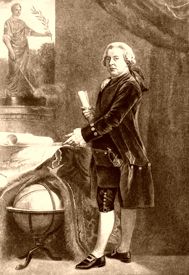
John Adams, by John Singleton Copley
Compiled and edited by Kathy Alexander/Legends of America, updated October 2026.
Also See:
John Quincy Adams – Sixth President of the United States
The Presidential Election of 1800
Presidents of the United States of America
Presidential Trivia, Fun Facts, and Firsts
Primary source: The White House