
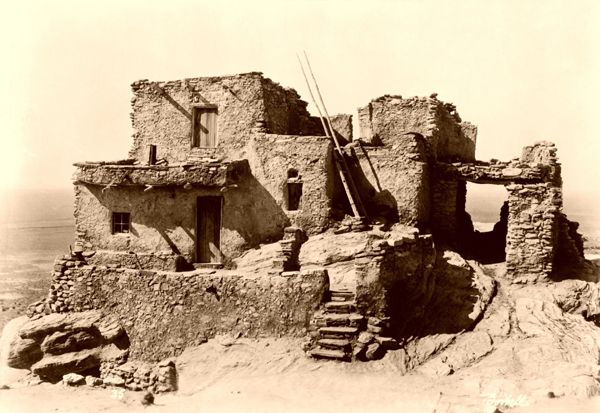
Hopi House in Arizona.
Living primarily on a 1.5 million-acre reservation in northeastern Arizona, the Hopi (meaning “peaceful ones”) have the longest authenticated history of occupation of a single area by any Native American tribe in the United States. Thought to have migrated North out of Mexico around 500 B.C., the Hopi have always lived in the Four Corners area of the United States.
Initially, they were a hunting-and-gathering group divided into numerous small bands that lived in pit houses. However, around the year 700 A.D., the Hopi became an agricultural people, growing blue ears of corn using runoff from the mesas. Many small bands began to come together at this time, and large villages were established atop the mesas, the first being at Antelope Mesa, East of present-day Keams Canyon, Arizona. Masonry walls came into use, and aboveground dwellings replaced pit houses. As the population grew, agriculture became increasingly important.
From 900 to 1100 A.D., many small masonry villages appeared. Over the next 200 years, the climate dried, leading the area’s population to cluster into larger villages such as Oraibi, Awatovi, Wupatki, Betatakin, and the villages in Canyon de Chelly.
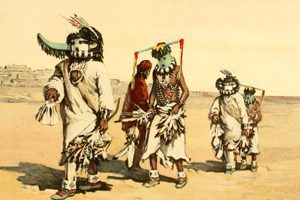
Men dressed in Kachina costumes.
At approximately the same time, the “Kachina Cult” emerged among the Hopi people. Although the origin of kachina art is unknown, evidence of this art form is found today in the Puerco Ruins of Petrified Forest National Park, dating back to approximately 1150 A.D. Additionally, rock art shows evidence of kachina masks and dancers from around 1325 A.D.
Kachinas are the spirits of deities, natural elements, or animals, or the deceased ancestors of the Hopi. Before each kachina ceremony, village men spend days carefully making figures in the likeness of the kachinas represented in that ceremony. During the ceremony, the Giver Kachina passes the figures to the village’s daughters. Following the ceremony, the figures are hung on the walls of the pueblo and are meant to be studied to learn the characteristics of that certain Kachina.
By the 15th Century, masked dancers and carved dolls had become an integral part of various Puebloan tribes in the Southwest. In the next century, the Spanish began documenting bizarre images of the devil hanging in Pueblo homes. These were most likely kachina dolls. The kachina practices and ceremonies continue to this day.
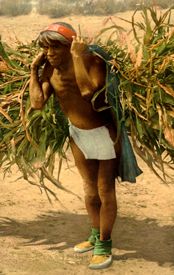
Hopi Indian bringing in the harvest, photo by the Detroit Publishing Company, about 1900.
In the late 1200s, a massive drought forced 36 of 47 villages on the Hopi mesas to be abandoned. Following the drought, the 11 remaining villages grew, and three new villages were established in Northeastern Arizona, about 70 miles from Flagstaff. While the Hopi built their villages on mesas for defense, they also used the surrounding land, dividing it among families and using common areas for agriculture, medicine, and religious practices.
By the 16th Century, the Hopi culture had developed into a highly complex system, characterized by an elaborate ceremonial cycle, intricate social organization, and an advanced agricultural system. They also participated in an extensive trade network that spanned the Southwest and into Mexico.
The Hopi society was matrilineal, with women determining people’s inheritance and social status. When a man marries, children from the relationship belong to his wife’s clan.
The Hopi practice a complete cycle of traditional ceremonies, although not all villages retain the full ceremonial cycle. These ceremonies are observed in each Hopi village according to the lunar calendar. Like other Native American groups, the Hopi have been influenced by Christianity and the missionary work of several Christian denominations. Few have converted to Christianity to the point of abandoning their traditional religious practices.
The Hopi enjoyed a peaceful way of life until the first outsiders arrived in the Hopi territory in 1540. Under the leadership of Don Pedro de Tovar, the Spanish were looking for the legendary Seven Cities of Gold. The Spaniards were not initially received with friendliness. Still, the natives soon overcame their opposition, and the party stayed among the Hopi for several days, learning from them about the existence of the Grand Canyon. Unsuccessful in their search for the precious metal, they returned to Mexico but continued to maintain sporadic contact.
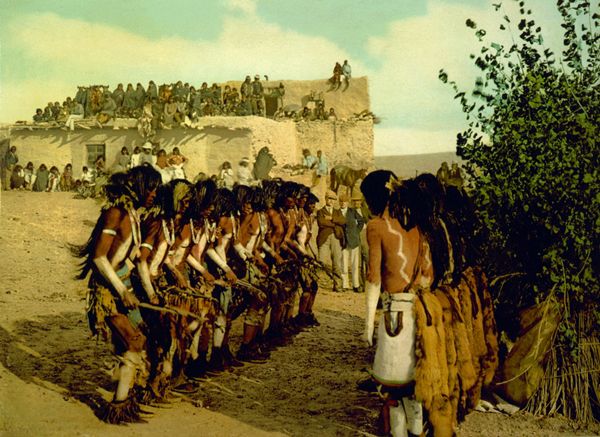
Antelope priests chanting at Kisi Moki snake dance, Hopi, Detroit Photographic, 1902.
In 1592, the Spanish returned and established a mission at Awatovi. For the next nine decades, the priests would attempt to suppress the Hopi religion and convert the tribe to Catholicism.
The Hopi acquired horses, burros, sheep, cattle, and new fruits and vegetables the Spanish introduced into their diet. The Spanish and later Europeans also introduced smallpox, which, over the centuries, periodically reduced the mesas’ populations from thousands to hundreds in devastating epidemics.
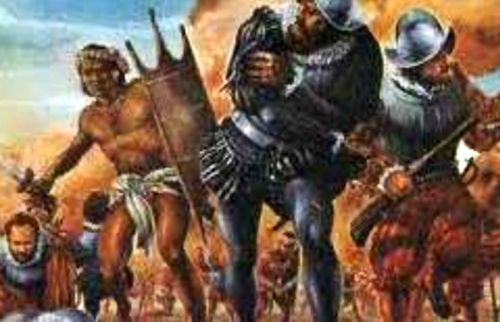
Pueblo Revolt.
In 1680, the Hopi joined the Puebloans of New Mexico in the Pueblo Revolt, which forced the Spanish out of the Southwest. Although the Spanish later reconquered the pueblos, they never firmly reestablished a foothold among the Hopi.
Following the Spanish, the Navajo, also under pressure from Europeans, began moving into Hopi territory in the late 1600s. Scattered throughout the area, they appropriated Hopi rangeland to graze their livestock, farm fields, and water resources, and conducted frequent raids against Hopi villages. The peaceful Hopi were forced to battle for their survival in a long period of fighting that would last until 1824, when Spain recognized Mexico, and the Hopi lands were given to the new Mexican government. Though no longer having to face the Spanish, the Navajo continued to attack the Hopi until they were forced onto reservations in 1864.
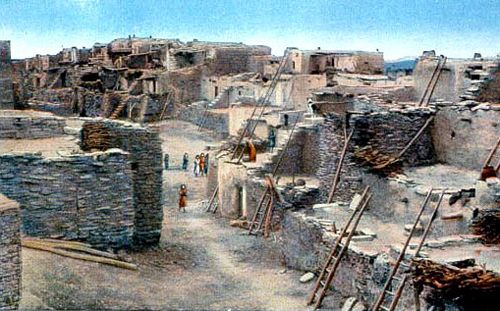
Hopi Pueblo.
In 1848, the United States and Mexico signed the Treaty of Guadalupe Hidalgo, which changed jurisdiction over Hopi lands.
After the area became part of the United States, white settlers began to explore it in greater numbers. In 1870, the U.S. government claimed the Hopi’s lands. Once again, the Hopi were forced to fight to save their lands until, finally, they were forced onto the reservation in Black Mesa in 1882, where most still live today.
Once on the reservation, the U.S. government spent years attempting to eradicate the Hopi culture and religion. Children were made to go to school, men and boys were forced to cut their hair, and efforts to convert the Hopi to Christianity intensified. Ultimately, this resulted in the incarceration of Chief Lomahongyoma and eighteen other Hopi Indians, who were placed in Alcatraz for their resistance to the “forced culture.” From January 3 to August 7, 1895, the group was imprisoned for resisting farming on individual plots away from the mesas and refusing to send their children to government boarding schools.
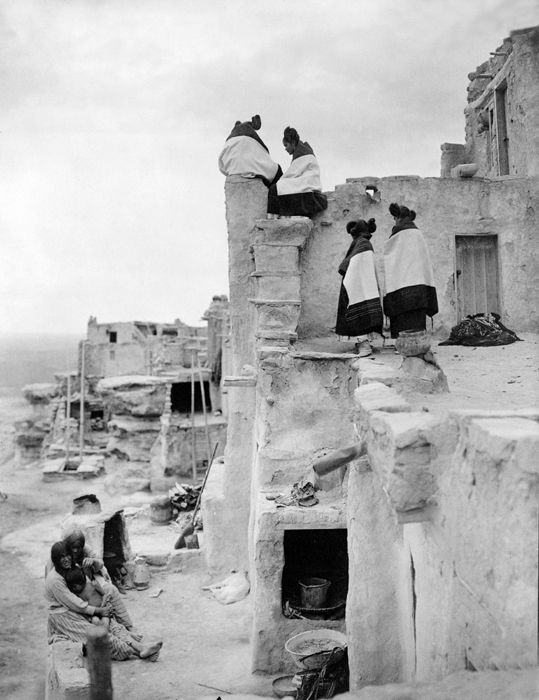
Hopi Pueblo by Edward S. Curtis, 1906.
In 1934, a changing tide of sentiment toward Native Americans led to the Indian Reorganization Act, which codified the U.S. government’s obligations to protect and preserve Native Americans’ rights. Soon after, the Hopi Tribal Council was formed in 1936 to establish a single representative body of the Hopi with which the U.S. Government could do business.
Like other Native American tribes, the Hopi lands were drastically reduced, and their current reservation represents only 9% of their original landholdings. Initially, they occupied almost all of northern Arizona, from California to parts of southern Nevada. The Hopi Reservation, located in Black Mesa, Arizona, is surrounded by the Navajo Reservation and is home to most of the Hopi people today. However, a few Hopi live on the Colorado River Indian Reservation in western Arizona.
Today, the Hopi, more than most Native American peoples, retain and continue to practice their traditional ceremonial culture. They also continue to battle legally with the U.S. government and the Navajo tribe for the return of their native lands. Traditionally, the Hopi are highly skilled micro or subsistence farmers. The Hopi are also part of the broader cash economy; many have mainstream jobs, while others earn a living by creating high-quality Hopi art, notably carving Kachina dolls, crafting earthenware ceramics, and designing and producing fine jewelry, especially sterling silver.
Today, the Hopi Reservation in northeastern Arizona covers about 1.5 million acres and includes several pueblos, most notably Walpi and Old Oraibi. Most villages close their doors to Kachina dances, but some social dances remain open to the public. Photography, sketching, and recordings are prohibited.
©Kathy Alexander/Legends of America, updated October 2025.
Hopi Weaving, 1879.
More Information:
Hopi Cultural Preservation Office
P.O. Box 123
Kyko P.O.vi, Arizona 86039
928-734-2441.
Also See:
Ancient Puebloans of the Southwest
Sources: