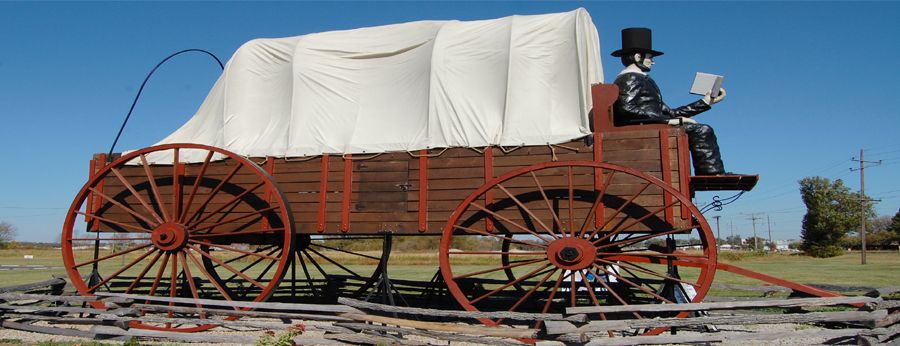
Abraham Lincoln sits in a covered wagon welcoming visitors to his namesake town, by Kathy Alexander.
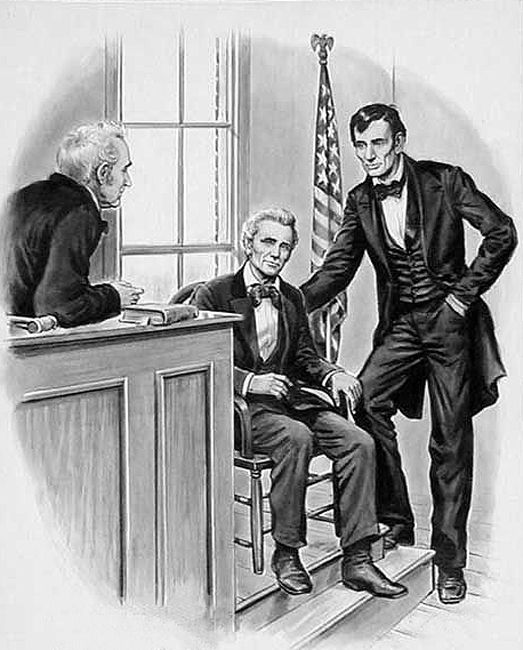
Abraham Lincoln was in court in Illinois in 1841.
Lincoln, Illinois, the county seat of Logan County, is the only town in the United States named for Abraham Lincoln before he became president. Route 66 also runs through the city, which has numerous historic landmarks.
In the 1830s, settlers favored the area for its location, easy access to Kickapoo, Salt, and Sugar Creeks, and abundant wildlife. In 1835, a man named Russell Post established a settlement called Postville, and four years later, it had grown enough to become the Logan County seat in 1839. They built a simple frame courthouse in the Federal style in 1840. When it opened, it housed offices for the sheriff, coroner, recorder, surveyor, county clerk, commissioners, and justice of the peace. Citizens came to the new courthouse to pay taxes, register their deeds, list strayed livestock, and conduct legal business with the circuit court.
Meanwhile, Abraham Lincoln, a self-taught lawyer, passed the bar in 1836, and in 1837 he moved to Springfield, where he became a junior partner with John T. Stuart. Like most lawyers of his day, he traveled the circuit to make a living, as most communities were too small to support resident lawyers. Lincoln most likely handled civil cases in Logan County, but little is known of Lincoln’s legal work because the court records were destroyed in an 1857 fire. What is known is that his work in Logan County bolstered a wildly successful legal career and helped set the stage for later political successes.
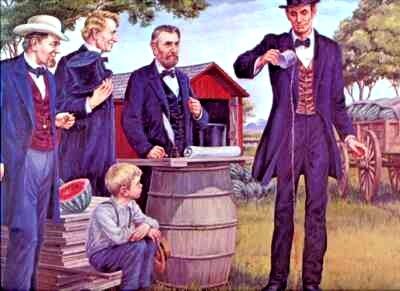
Painting of Abraham Lincoln christening the brand new town of Lincoln, Illinois. The State Bank of Lincoln in Lincoln, Illinois, owns the original artwork.
In 1848, Postville lost the county seat to Mt. Pulaski, 11 miles to the Southeast, and Postville declined. However, when the Chicago and Alton Railroad came through in 1853, the tracks were located about a mile East of Postville. Soon, a new community sprang up near the railroad.
The town’s developers, Robert Latham, Logan County Sheriff, John D. Gillett, a cattleman, and Virgil Hickox, director of the railroad, proudly asked their distinguished attorney, Abraham Lincoln, who also served as the railroad’s attorney, if he would agree to have the town named after him. Though Lincoln agreed, he reportedly cautioned, “You’d better not do that, for I never knew anything named Lincoln that amounted to much.” When the town was officially christened on August 27, 1853, Lincoln had the honor of doing so with watermelon juice.
The first public sale of lots in Lincoln was held on August 29, 1853. Abraham Lincoln rode the train from Springfield, along with numerous prospective buyers. At the sale, new prospective residents bought 90 lots ranging from $40 to $150. The new town of Lincoln thrived, soon encompassing the old site of Postville, and in 1855, Lincoln gained the county seat back from Mt. Pulaski. They built a new courthouse in 1858. Solomon Kahn bought the old Postville Courthouse for $300 and used it briefly as a store, then as a post office. Over the decades, the old courthouse became a private home.
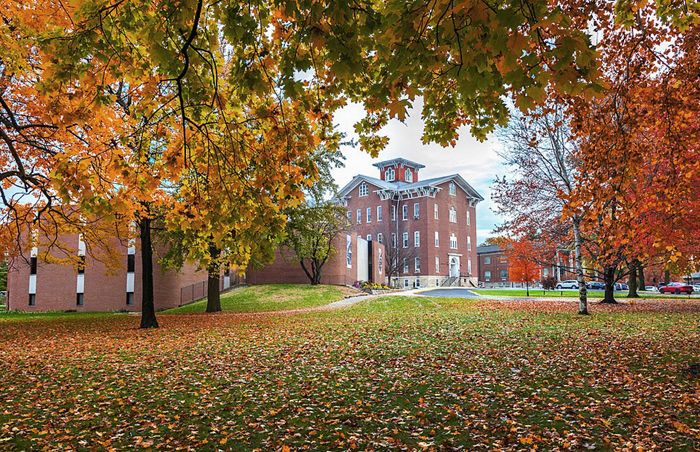
University Hall was the first building constructed at Lincoln University. Today, it still stands at Lincoln College. Photo courtesy of Wikipedia.
Lincoln University, a private four-year liberal arts college, was founded in early 1865. Lincoln University was the first institution named for Abraham Lincoln and the only one during his lifetime. In 1929, it became a community college granting two-year degrees, and its name changed to Lincoln College. It continues to operate today.
In 1877, the Illinois Asylum for Feeble-Minded Children was established in Lincoln. The large Victorian Gothic Revival building on 40 acres became one of the city’s largest employers. Over the years, several buildings were added in the Georgian and Tudor styles. The school became self-reliant, with its power plant, farm, kitchen, bakery, hospital, nursing school, greenhouses, fire department, and jail. At various times, the residents made mattresses, shoes, and brooms. Others worked caring for other residents, maintaining the campus, and working in the laundry. During the Great Depression, many of those housed at the facility were not developmentally disabled but were just poor and committed.
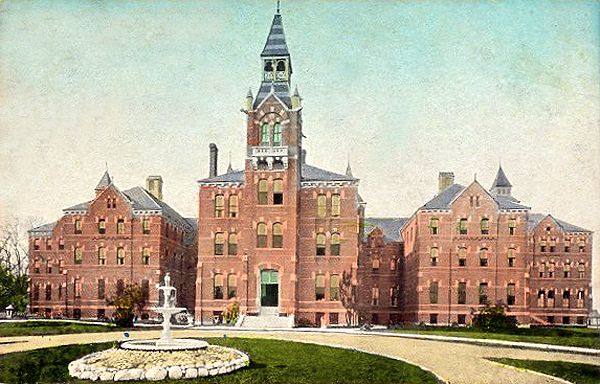
Asylum for Feeble-Minded Children in Lincoln, Illinois.
The institution changed its name to the Lincoln State School in 1954, when it became extremely overcrowded and housed as many as 5,700 residents. In the following years, resident numbers dropped, and by 1971, the facility housed 2,600 residents. The facility was renamed the Lincoln Developmental Center in 1975. In 1978, the farm annex was closed and became home to the Lincoln Correctional Center.
By 2000, the Lincoln Developmental Center housed just 383 residents and had a staff of 698. It was closed in 2002 by Governor George Ryan amidst reports of abuse, neglect, and preventable deaths. He cited four safety-related incidents involving patients as a basis for his determination. Employee and parent groups said the incidents were minor, not typical of this institution, and did not constitute life-threatening conditions. They took their case to court to keep the facility open but lost in September 2002. Since then, the old facilities have remained vacant except for training by the state police and the correctional facility.
Farming was the initial basis of Lincoln’s economy; however, that changed when coal mines began to be built in the area. Before long, numerous new businesses providing hardware, building materials, food, and professional services sprouted in the community.
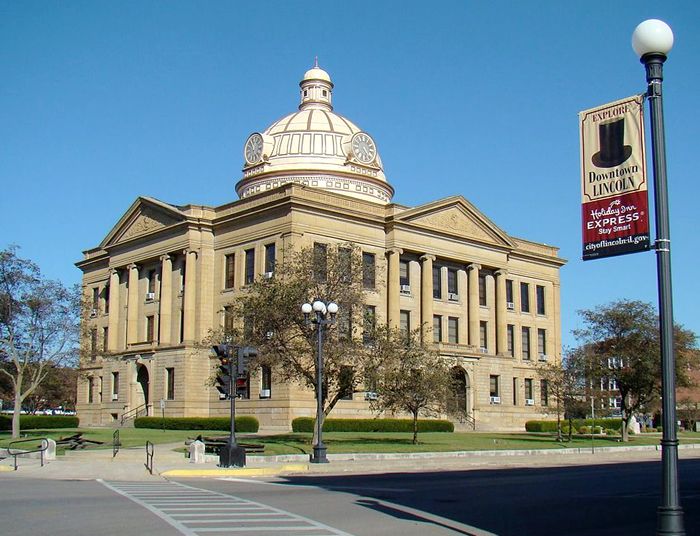
Logan County Courthouse in Lincoln, Illinois, courtesy of Wikipedia.
In 1905, Lincoln built a new three-story domed Logan County Courthouse of stone. By then, the 1858 courthouse had fallen into decay and could not be saved.
The main road in Logan County, originally called the Springfield Stage Road and paralleling the railroad alignment, became State Route 4 in 1918. In 1926, it became Route 66, bringing auto courts, restaurants, and service stations to the community.
In August 1929, automobile magnate Henry Ford purchased the old Postville courthouse and its one-block site for $8,000. Ford planned to dismantle the structure, move the pieces to Michigan, and rebuild it as a Lincoln memorial at his Greenfield Village in Dearborn. By the end of September, the old courthouse had been dismantled, and every stone was gone. The Postville Courthouse was rebuilt in time for the grand opening of Greenfield Village on October 29, 1929, and still stands today in Dearborn, Michigan.
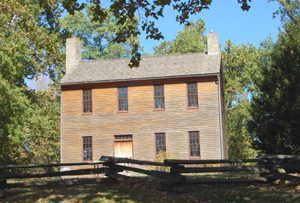
Reconstructed Postville Courthouse, Kathy Alexander.
After dismantling the old courthouse, Henry Ford donated the block to the Logan County Historical Society to be used as a park. However, the block stood empty for two decades. During Lincoln’s centennial in 1953, the city of Lincoln presented the block to the State of Illinois as the first step in creating a Lincoln memorial. The state soon began constructing a replica courthouse on the original site, and in 1956, a local museum collection was installed on the first floor. The second floor was furnished as a mid-19th-century courtroom and offices. Today, the Postville Courthouse State Historic Site is located at 914 Fifth Street.
The century-old Logan County Courthouse sits on the square in downtown Lincoln, surrounded by stores and restaurants that speak of its vintage past. The old courthouse is one of the few historic courthouses in the state still being used for its intended purposes. Check out the number of repainted old advertisements and murals on Lincoln’s downtown buildings.
Lincoln is also home to the Lincoln College Museum, a sizeable collection of Lincoln artifacts and memorabilia located at 300 Keokuk Street.
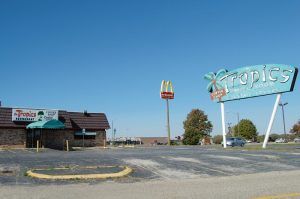
Tropics Restaurant and its iconic sign in Lincoln, Illinois, by Kathy Alexander.
Route 66 runs through the town center, where visitors can glimpse the era. At the corner of Woodlawn and Lincoln Parkway once stood the Tropics restaurant and lounge that opened in 1950. Vince Schwenoha built it, inspired by the palm trees in California, which appeared on the iconic sign he put on the restaurant. Lew and Bev Johnson bought it five years later and ran it for 40+ years. Though the Johnsons made it famous, they also suffered during the decades because of fires in 1965 and 1975 and because Route 66 was replaced with Interstate 55. Afterward, the Tropics closed and reopened several times over the years before closing for good in 2004. The building sat empty and abandoned for years until it was sold in 2014, and the sign was removed. However, it was safely placed in storage. The old structure was torn down in April 2017 to make way for a new McDonald’s restaurant. Though the building is gone, its historic neon sign was saved, restored, and now stands fully lit at its original site. Some of its vintage memorabilia can still be seen in the Mill Museum.
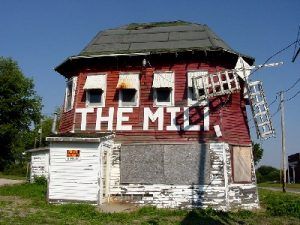
The Old Mill Restaurant opened in 1929 and has served Route 66 travelers for decades, photo by Kathy Alexander.
At 738 Washington, the Mill Museum is housed in what was once called the Old Mill Restaurant, which became famous for its schnitzel shortly after it opened in 1929. Family-owned and operated, it served thousands of Route 66 travelers until 1996, when it closed. Over the years, the building badly deteriorated and, in 2005, was slated for demolition. However, the following year, a “save-the-mill” campaign began, and in 2007, renovations began.
Today, Lincoln is home to some 14,500 residents.
Route 66 travelers can continue their journey down the old highway by traveling through the small towns of Broadwell, Elkhart, and Williamsville.
©Kathy Alexander/Legends of America, updated October 2026.
Also See:
Illinois Route 66 Photo Gallery
See Sources.