
By William H. Ryus in 1913.

Wagons on the trail.
During the coldest time in Winter, in January 1863, nine freight wagons left Santa Fe, New Mexico, on their way East. A few miles before they reached Nine Mile Ridge, they encountered a band of almost famished Cheyenne and Arapaho Indians, who hailed the freight wagons with delight, thinking they could get some coffee and other provisions. In this lonely part of the world, 75 miles from Fort Larned, Kansas, and 175 miles from Fort Lyon, Colorado, without even a settler between, it was uncomfortable for even an Indian to find himself without rations.
Nine Mile Ridge rose high above the Arkansas River road, running close to the river, on top of the ridge.
The Indians followed the wagons several miles, imploring the wagon boss to give them something to eat and drink, which request he steadily refused in no uncertain voice. When the red men knew the wagon boss refused their prayers for subsistence, they had no other way to enforce division than to take it from the wagons.
The leader of the band went around to the head of the oxen and demanded that they corral, stop, and give them some provision. During the corralling of the train, one wagon tipped partly over, and the teamster shot an Indian in his fright. Then the Indians picked up their wounded warrior, placed him on a horse, and left the camp, determined to return and take an Indian’s revenge upon the caravan. The wagon boss went into camp well satisfied—but not long was his satisfaction to last.
After the Indians departed, several teamsters who thought they knew what the Indians wanted reproached their wagon boss for not complying with their request to give them food. His refusal resulted in a mutiny among the teamsters. After the oxen were turned out to graze, the dispute between the teamsters and the wagon boss became so turbulent that, if a few peaceably inclined drivers had not sided with the wagon boss, he would have been lynched.
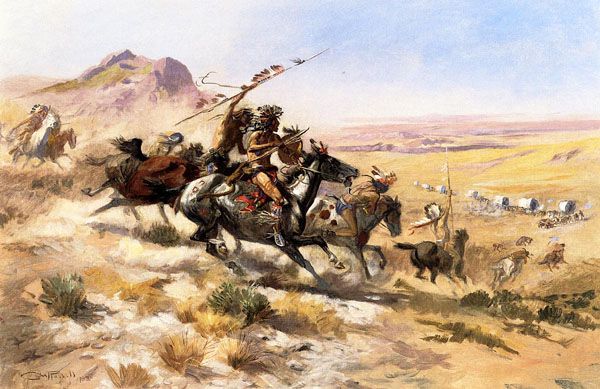
Indian attack on a wagon train by Charles Marion Russell.
Before daylight, the Indians returned and attacked the wagons and killed all the whites but one man who escaped down the bank into the river. He floated down until he was out of hearing of the Indians. When he was almost worn out and half-frozen, he got out of the river, wrung the water from his clothing, and started for Fort Larned, seventy-five miles distant. After leaving the water, he noticed a fire and knew instinctively that the Indians had set fire to their wagons, and he wondered how many, if any, of the company had escaped as he had so far done.
Late in the afternoon of the next day, a troop of soldiers discovered this man several miles from Fort Larned in an almost exhausted condition, dropping down and getting up again. The commanding officer sent out some soldiers and brought him to the fort. I talked with this man, and he told me that if the wagon boss had given the Indians something to eat, entertained them a little, or given them the smallest hospitality, he believed they would all have been saved from that massacre. He said the Indians pleaded with the wagon-boss for food, and he thought if the teamster had not lost his equanimity and made that first luckless shot, the Nine Mile Ridge massacre would never have become a thing of history.
This tragedy created widespread fear and made travel across the plains difficult. The Indians were hostile only because they did not know the minds of the white men and what their attitude toward them would be if they were not always prepared to defend themselves.

Fort Larned, Kansas Parade Ground by Kathy Alexander.
Therefore, the people traveling on the plains in trains assembled themselves for protection, and the people at Fort Larned with their soldiers were very much worked up over the atrocious murders and the destruction of property all along the whole Western frontier. In a time of war, one false step may cause hundreds of deaths. In this case, the commanding officer of the fort took the precaution to send out runners to call the Indians together to the fort to learn, if possible, the cause of this fearful massacre and get their statement concerning their action.
The two Indians who came in verified the ox driver’s statement and declared that if the teamster had not killed their inoffensive warrior, who only asked for something to eat, they would have had no trouble at all.
In defense of the Indian, I will say that the people, in general, were all the time seeking to abuse him. In almost all instances where I have read of Indian troubles, I have noticed that it grew out of the fact that the whites invariably raised the trouble and were always the aggressors. Nevertheless, newspaper reports, and any other report for that matter, laid the blame at the door of the wigwam of the red man of the forest.
I think most of the trouble on the frontier was uncalled for. The white man learned to fear the Indians always when there was no attempt on the part of the Indian to do him harm. Many times, while I was crossing the plains, bands of 30 to 40 Indians or more came to us, catching up with us or passing us by. Had I not understood them and their intentions as well as I did, we would more than likely have had trouble with them or have suffered severe inconvenience.
We never thought of fear when they were going along the road. Many times, I would call them when I was camping for meals to come and get a cup of coffee. They would go back to camp with us. We did not care what their number was; we would always divide our provisions with them. If there were a large number of Indians, and our provisions were scarce, I would tell them so, but also tell them that, notwithstanding that fact, I still had some for them. Then, if they got only a few sips of coffee and a little piece of bread, they were always profoundly grateful and satisfied that we had done our best.
To let them know we were scarce of bread, etc., I would say, “poka te keta pan;” in the Mexican language, that is interpreted as “very little bread.” Bread, in the Mexican or Indian language, is “pan,” and when they understood, they would say “si,” which is interpreted as “yes.” They showed us their appreciation for the little they received, just as though we had given them a whole loaf of bread apiece.
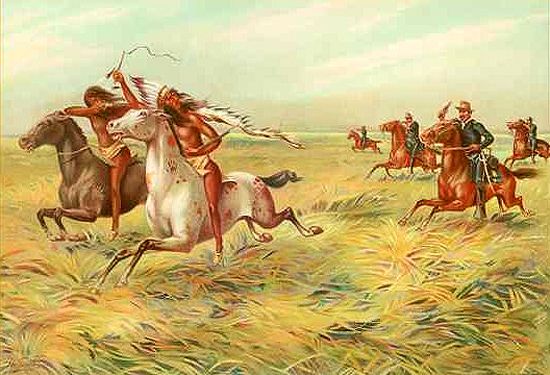
Cavalry and Indians.
If we had only a few cups of coffee and 70 or 80 Indian guests, we would give it to one of the Indians, and he would divide it equally among his number. He would pour the cup so it contained an equal amount of coffee. Then one of the Indians would get up from the ground (they always sit on the ground grouped all about us when they ate with us) and take the cups and hand them around to every fifth man, or such a one as would make it average to every cup of coffee they had. The Indians would break the bread and distribute it equally among each one, according to their respective shares. When they came to drink their coffee, every Indian who had a cup raised it to their lips at once, swallowed the beverage, and then passed the cup to the next one. They did the bread the same way. After finishing their repast, they invariably thanked us profusely in their Indian style for what they had been given. There were times when I had plenty of provisions to give them all they needed or required to satisfy their hunger. My coach was surrounded by hostile intent, yet never departed from it in friendliness. At the same time, I knew they had some significant grievances.
William H. Ryus, 1913. Compiled and edited by Kathy Alexander/Legends of America, updated October 2026.
Also See:
Fighting Comanche on the Santa Fe Trail
Indian Terrors on the Santa Fe Trail
Santa Fe Trail – Highway to the Southwest
About the Article: Excerpted from the book, The Second William Penn – A True Account of Incidents that Happened Along the Old Santa Fe Trail, by William H. Ryus, 1913. W. H. Ryus was better known as “the Second William Penn” by passengers and old settlers along the line of the Old Santa Fe Trail because of his rare and exceptional knowledge of Indian traits and characteristics and his ability to trade and treat with them so tactfully. Ryus was one of the boy drivers of the stage company with U.S. Mail contracts, regularly running along the Santa Fe Trail. During this time, he routinely crossed the plains at a time when the West was still looked upon as “wild and woolly,” and in reality, was fraught with numerous, and oftentimes, murderous dangers.