

A reconstructed blockhouse and stockade similar in appearance to the fort at Pickawillany, courtesy Wikipedia.
Pickawillany was an 18th-century Miami Indian village located on the Great Miami River in the Ohio Valley near the modern city of Piqua, Ohio. It would become the scene of conflict between French & British traders vying for business with the Miami tribe.
Miami Indians had settled the town of Pickawillany five years before the conflict between the English and French forces began. The village was located on a low bluff on the west side of the confluence of the Great Miami River and Loramie Creek, just north of Piqua in Miami County. The town soon became a significant trading center. In its first five years, it was one of the largest Native American communities in eastern North America.
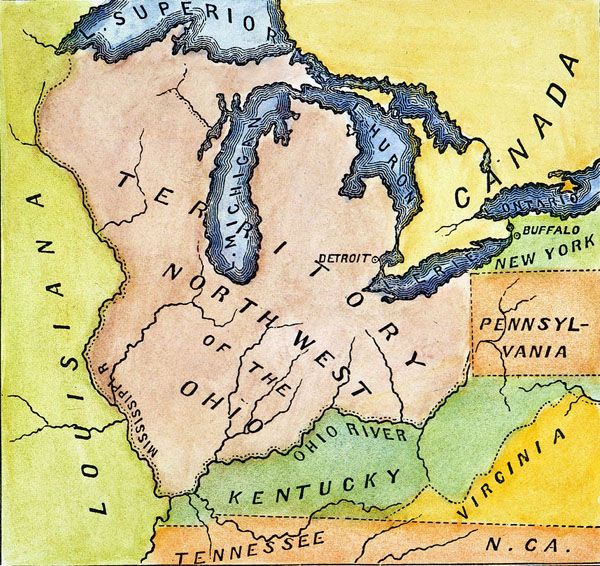
Northwest Territory.
Like many Indian nations in Ohio, the Miami were French allies because the French were the first traders to arrive in the Northwest Territory. They exchanged deer skins, beaver pelts, and other Native American products for French-made goods like firearms, ammunition, gunpowder, and cooking utensils.
As demand for these animal skins mushroomed in Europe, British traders began making inroads and trading with Miami as early as 1740. As the French realized they might lose this valuable resource, they forced the small British trading posts out of Ohio.
Despite this extensive trading arrangement, Miami felt the French traders treated them poorly. Over time, their resentment grew, so they refused to trade with the French. Chief Memeskia invited the British to set up a trading post in Pickawillany. This was a good deal for the British and Miami, but the French were not pleased with the loss of trade and French influence.
In 1749, an English trading post was established alongside the Miami village, selling goods to neighboring tribes. The following year, Fort Pickawillany was constructed to protect the post. That year, the French attempted to convince Chief Memeskia to re-establish trading with them, but Memeskia refused.

Fort Pickawillany, Ohio Raid.
In the winter of 1751-1752, the French decided to use stronger tactics. Charles Michel de Langlade, a 23-year-old Metis independent French Canadian trader seeking to advance his military career, assembled a war party of French-allied Ottawa, Potawatomi, and Ojibwa warriors. Langlade knew that the Governor of New France had been trying to implement a plan to attack and destroy the village but that he had been unable to recruit Indian warriors. Langlade, who was well-connected with the Ottawa and spoke their language fluently, persuaded Ottawa warriors to attack Pickawillany by characterizing the raid as a gesture of friendship towards Onontio, the French governor. Langlade’s plan to attack Pickawillany was carried out without the Canadian government’s knowledge.
In the Spring of 1752, the French sent Langlade and a force of 272 Ottawa warriors to attack the village. On June 7, Langlade and his warriors reached Detroit, Michigan, where about 30 Indians deserted, having heard that there was a smallpox epidemic in Miami.
On the morning of June 21, 1752, the French and their warriors who had sided with them arrived at Pickawillany and attacked the village. In the Battle of Pickawillany, the village and trading post were destroyed, Chief Memeskia and at least one English trader were killed, five British traders were captured, and the English stockade was burned. The Miami later alleged that 30 French soldiers accompanied the Indians but did not take part in the raid.
Pickawillany’s destruction encouraged greater British fortification and military presence at other outposts in the Ohio Valley. It was a precursor to the wider British-French conflict that would become the French and Indian War.
Afterward, the Miami permanently abandoned Pickawillany and moved west to present-day Indiana. A few years later, a band of Shawnee claimed the area and built a village they called Piqua.

Pickawillany Historic Marker.
©Kathy Alexander/Legends of America, August 2024.
Also See:
Frontier Skirmishes between the Pioneers & the Indians
Military Campaigns of the Indian Wars
Sources: