
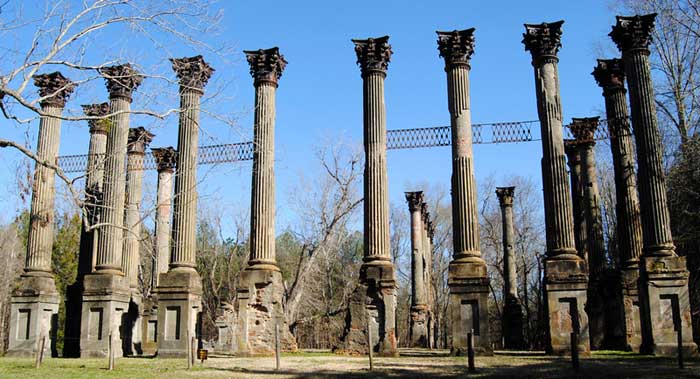
Windsor Ruins near Port Gibson, Mississippi. Photo by Kathy Alexander.
Sitting like a lonely “Stonehenge” about ten miles Southwest of Port Gibson, near the Mississippi River, Windsor Ruins has an interesting history and, perhaps, a few legends.
Once a magnificent plantation mansion, the Windsor was built by Smith Coffee Daniell, II, a wealthy planter with extensive properties in the Mississippi Delta, Arkansas, and Louisiana. Smith Daniel was born in 1826, the son of an Indian fighter turned farmer and wealthy landowner. In 1849, he married his cousin, Catherine Freeland, and the couple had seven children, three of whom survived to adulthood.
In 1859, the couple began building the Greek Revival-style mansion on their 2,600-acre plantation overlooking the Mississippi River in the distance. Built by New England craftsmen and slave labor, the couple spared no expense in architecture, furnishings, and details. The four-story home, which borrowed from Italianate and Gothic architectural styles, would include 25 rooms when completed, each with its own fireplace fronted with marble mantels. The home featured interior bathrooms supplied with water from an attic tank that caught and stored rainwater.
An above-ground basement contained a schoolroom, dairy, supply rooms, a commissary, a doctor’s office, and a kitchen. The main floor featured a broad entrance hallway, the master bedroom, a bath, two parlors, a study, and a library. An ell on the main floor contained a pantry and the dining room, which included a dumbwaiter, from which meals were brought up from the basement. The third floor had an additional bath and nine more bedrooms. The fourth floor contained a ballroom that was never finished, and the elegant structure was topped by a rooftop observatory. With its hipped roof, the observatory was supported by smaller versions of the main Corinthian columns. From here, Smith Daniell could see his entire Mississippi plantation and much of his land across the river in Louisiana. Eight chimneys broke the roofline.

Windsor Column Capital by Dave Alexander.
The mansion’s exterior featured 29 fluted columns with attached iron balustrades which enclosed the galleries on the upper levels. Slaves formed and fired the bricks for the 45-foot columns in a kiln on the Windsor grounds. Expert masons then covered the columns with mortar and plaster. The wrought iron stairway was manufactured in St. Louis, Missouri, shipped down the Mississippi River to Bruinsburg, and hauled 14 miles overland to Windsor.
The skilled carpenters, brought in from New England, completed the woodwork, moldings, and other elegant interior details, and the home was furnished with the finest pieces from as far away as New York and Europe. Designed and furnished to reflect the height of Southern life at the time, Mark Twain, who visited during his riverboat piloting days, compared the Windsor mansion to a college because of its size. Later, he wrote of its elegance in his book Life on the Mississippi.
Completed in 1861, the home was one of the largest in Mississippi, costing some $175,000 for the building and furnishings. After waiting patiently for two years and overseeing many details, Smith Coffee Daniell, II, would not live to enjoy his new home. Just a few weeks after it was completed, he passed away at the age of 34. That same year, the Civil War erupted, and Windsor, like so many other plantations in the South, found itself in the midst of it.
Smith Daniell’s family would remain at Windsor after his death and would not immediately see Civil War soldiers upon their lawn, but this would change during General Ulysses S. Grant’s Campaign of Vicksburg. As Union ships moved along the Mississippi River and troops forged through the region, Confederate soldiers often used the rooftop observatory to watch Union movements on the river and use signal equipment to alert their comrades to Yankee advances.

Plantation Party
What the Rebels were unaware of, however, was that Union troops were also watching them in preparation for the advance on Vicksburg. Years later, Smith Coffee Daniell, IV would tell a story he had heard from his great-grandmother, Catherine Daniell, of the night Union troops showed up at the mansion uninvited. Though the South was in the midst of the Civil War, the widow Catherine still tried to make things pleasant and comfortable for her friends and family. On one occasion, she invited several neighbors to a covered-dish dinner. She also invited several Confederate officers. When she was ready for her guests, she sent a signal to her neighbors and the Confederate officers. She didn’t know that the Union troops also picked up the signal.
As her guests enjoyed the party, Catherine was surprised by some latecomers. A servant opened the door to the men and welcomed them in. These men, however, were not neighbors — but they were soldiers — Union soldiers who had interpreted the signal, dressed in civilian clothing, and come to capture the Rebels. One of the officers would later write in a letter to his family:
“So we entered, and there in the parlor of the house was quite a party, singing and laughing and having a fine time generally. Among them were three Confederates dressed in their gray uniforms. I walked in, went up to the one who seemed to be in command, touched him on the shoulder, and asked, ‘Are you a Confederate officer?’ He promptly replied, ‘Yes, I am.’ At this, the singing stopped, and the ladies present came around and insisted that we Yankees were not gentlemen and that we should not spoil their evening by arresting and taking prisoners these three Confederates. The ladies grew very boisterous and attacked us with their fists and fingernails, and refused to allow the arrest.”
The lieutenant and his detail came in from the rear, and we took the three rebels prisoner, marched them down to the river edge from Windsor to where our yawls had been left, loaded them, and went back up the river to Grand Gulf, where the gunboat was tied up. We arrived late at night. We then took them to Vicksburg where they were placed in prison.”
Afterward, Union soldiers were placed at the Windsor Plantation as permanent guards, and the observatory was used again, this time by Federal troops. On April 29, 1863, Union General Ulysses S. Grant tried to cross the Mississippi River from Louisiana at Grand Gulf, about ten miles northeast of the Windsor Mansion. However, he was unsuccessful and changed tactics. He then moved his men downriver to Bruinsburg Landing the next day. After some 17,000 Union soldiers were ashore, the inland march began, with thousands of troops passing right by the Windsor mansion.

Advance On Port Gibson
When the Battle of Port Gibson was fought on May 1, many wounded were brought back to Windsor, where a temporary hospital was established in the basement. During this occupation, a Union soldier was shot and killed in the home’s front doorway. The details of the shooting remain unknown. Upon hearing of this, General Grant sent troops to burn the mansion. However, Catherine begged them not to, reminding them that she had nursed many Union soldiers after the Battle of Port Gibson and that she and her family would have nowhere to go. Her home was spared, but the barn was burned anyway, as a lesson to the family and neighbors of the consequences of killing a Federal soldier.
Unlike many of its counterparts, the mansion survived the war, but its lavish heyday was over, as, like the rest of the South, the plantation was devastated by the economy. Over the years, the family lost many holdings as the land was sold. However, the family would remain on the grounds but again suffer a tragedy some 25 years later. On February 17, 1890, the sky over the Mississippi River loomed heavy with smoke. When neighbors rushed to see what caused it, they found the four-story Windsor mansion blazing with flames. Catherine Daniell stood helplessly beneath an Oak tree at a safe distance, watching the grand house and all its contents being reduced to ashes.

Windsor Ruins by Dave Alexander.
That very day, the family was preparing for a dinner party. They had left briefly to pick up the mail, only to return to find the house ablaze. An investigation uncovered that a worker hired to repair the observatory had carelessly tossed a cigarette into a pile of sawdust. Within minutes, the mansion was burning out of control from the top down. Though family and friends did their best to control the flames, it was too late. Other than a few pieces of china, nothing was saved. A local newspaper reported on February 21, 1890:
“The palatial dwelling on Windsor plantation, near Bethel Church in the southwestern part of the county, burned to the ground last Monday. The fire was discovered about noon, but it could not be checked, and in a few hours, this splendid country site was in ruins. Most of the contents were also destroyed. These included not only a great deal of elegant furniture but many costly heirlooms and much other household property of value, such as jewelry, silver plate, a large library, etc. Mr. Smith Daniell erected this residence, probably the most magnificent in the state, shortly before the war. It was a brick structure comprising 25 rooms and, we believe, was completed in 1859. The building cost $140,000, and the furniture an additional $35,000, bringing the total cost to $175,000. We regret to learn that neither the building nor its contents were insured.”
Catherine Daniell then moved to a nearby plantation called Retreat, where she lived for the remainder of her life.
Through the decades, thousands have driven a winding road from Port Gibson, Mississippi, to see the stately columns that remain of Windsor, one of the most magnificent homes in the antebellum South. How it looked before it was destroyed by fire in 1890 was a mystery (and possibly part of its attraction) until a drawing discovered 130 years later in the diary of a Civil War officer showed the Claiborne County home in its heyday. The diary and drawing belonged to Lieutenant Henry Otis Dwight, a Union officer who served with the 20th Ohio Infantry during the Civil War, and were discovered in the Ohio State Archives in Columbus, Ohio.

Windsor Sketch by Henry Otis Dwight, a Union Officer who saw the mansion.
Though other artists have sketched pictures of the house, they were done from oral descriptions. Dwight’s drawing is the first found that was done by someone who saw the home. The sketch bears the words, “May 1, 1863. Residence Near Bruinsburg Miss.”, in what is believed to be Dwight’s own handwriting.
The only remnants today are 23 haunting columns, portions of the balustrade, a few pieces of china, and a set of wrought-iron stairs. The flight of stairs and part of the balustrade are now used at Alcorn State University’s chapel down the road. The numerous outbuildings have long since disappeared, and over the decades, the nearly 3,000 acres of cotton fields that slaves and sharecroppers tended have been replaced with hundreds of trees, heavy brush, and soil lost to erosion.
The property remained in the family until 1974, when descendants of Smith Coffee Daniell donated it to the state of Mississippi for historic preservation. Hollywood also made the pilgrimage to these enigmatic ruins in two films—Raintree County in 1957 and Ghosts of Mississippi in 1996.
It comes as no surprise that these silent, standing obelisks have long inspired numerous legends. Like so many other places of the antebellum South, legends and tales abound about the ruins. Visitors to the ruins of this once-elegant mansion often agree. Standing among these massive columns, imagining the mansion’s size, appreciating the detail in the elegant columns, and knowing both the family’s luxurious life and the turmoil they endured, vivid images almost come to life.
One of the ghosts that is said to linger here still is the Union soldier who was killed in the mansion’s doorway during the Civil War. According to visitor reports, his faded image has been seen walking up the old iron staircase that no longer exists. Others have reported hearing laughter and music coming from this once-magnificent mansion, as if an elegant soirée is still underway. Another ghostly figure of a man has also been seen walking the grounds. Dressed in period clothing, might this be Smith Coffee Daniel II himself—who never got to enjoy his beautiful home? Some visitors have reported that his image appears so real that they have approached this spirit to talk to him. However, as they got closer, the man fades away.
Paranormal investigators who have visited this historic property agree with the visitors. These “ghost hunters” have reported seeing the same spirits and have captured the sounds of revelry coming from a plantation party on EVP (Electronic Voice Phenomena). Others have also said they have been poked by unseen hands and heard disembodied voices.
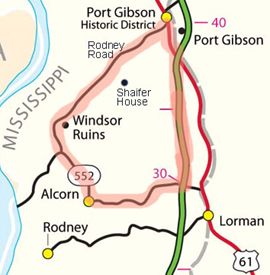
Port Gibson Historic District Map.
The Windsor Ruins are located on the Windsor Loop off the Natchez Trace, between Natchez and Vicksburg, Mississippi. They are located 12 miles from Port Gibson on Mississippi Highway 552.
Also nearby are the ghost town of Rodney, Mississippi, the Shaifer House, the Bethel Presbyterian Church, founded in 1826, and other historic sites.
©Kathy Alexander/Legends of America, updated November 2026.
Also See:
Rodney – From Prominence to Ghost Town
Mississippi – The Magnolia State
The Mississippi River and Expansion of America
In 2025, Legend’s reader Jack Clark shared a YouTube video in which he used the Union Soldiers’ 1863 drawing to reconstruct the mansion in 3-dimensional form.