
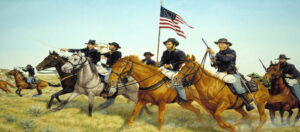
Battle of Prairie Dog Creek in Phillips County, Kansas, by Ralph Heinz.
The Battle of Prairie Dog Creek, Kansas, occurred in Phillips County in the summer of 1867.
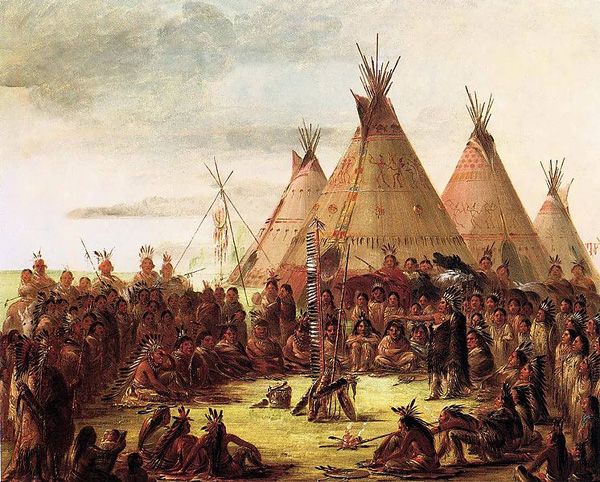
Plains Tribes by George Catlin.
After the Civil War, settlers rushed to the rich and relatively empty lands of the Great Plains. By mid-1867, the Plains tribes, recognizing the threat to their traditional way of life, regularly attacked settlers, railroad workers, and travelers, particularly along the Smoky Hill, Saline, and Solomon Rivers.
With veteran Sioux warriors, Cheyenne Dog Soldiers under Chief Roman Nose, and Kiowa warriors under Chief Satanta, the Indians attacked with a vengeance.
When the state’s frightened citizens demanded military assistance, the War Department authorized volunteer militia units to be placed on active duty during the emergency. On July 15, 1867, four companies of the 18th Kansas Volunteer Cavalry, under the command of Captain Horace L. Moore, were mustered into Federal service to protect settlers from attack. The volunteers departed on July 18 for a month of intensive campaigning before returning to Fort Hays. They then joined forces with the 10th U.S. Cavalry, known as the “Buffalo Soldiers,” forming a combined force of more than 250 men led by Captain George A. Armes of the 10th and Captain Moore of the 18th.
Armes led his men down Prairie Dog Creek in present-day Phillips County while Moore scouted upstream. While separated, Armes’ group was attacked on August 21, 1867, by about 300 Kiowa and Cheyenne under the leadership of Chiefs Satanta and Roman Nose. As Armes’ troops bravely fought off the attack, the men of the 18th Kansas, hearing the noise of battle, began to make their way to assist.
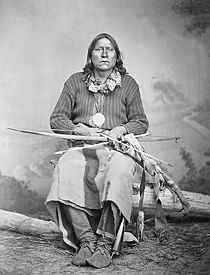
Chief Satanta of the Kiowa tribe.
Outnumbered five to one, the U.S. troops dismounted and found refuge in a ravine. During the afternoon, they were subjected to a dozen assaults but managed to hold off the warriors due to the superior firepower of their Spencer repeating rifles.
Once joined by the 18th Kansas, Captain Armes gathered the troops and, moving toward Prairie Dog Creek, charged the Indians, who broke and scattered. The cavalry suffered three men dead and 36 wounded; the Indians, 50 dead and 150 wounded. This battle ended the U.S. offensive operations on the Kansas frontier for the year, and in the fall, treaties were signed with the tribes of the Southern Plains.
Today, the 18th Kansas Volunteer Cavalry continues its efforts as the Kansas Army and Air National Guard.
The battle site is located in northwest Phillips County, Kansas, between Long Island and Almena, Kansas, south of Highway 383.
©Kathy Alexander/Legends of America, updated January 2026.
Also See:
Indian Wars, Battles & Massacres
Indian Wars of the Frontier West
Sources: