
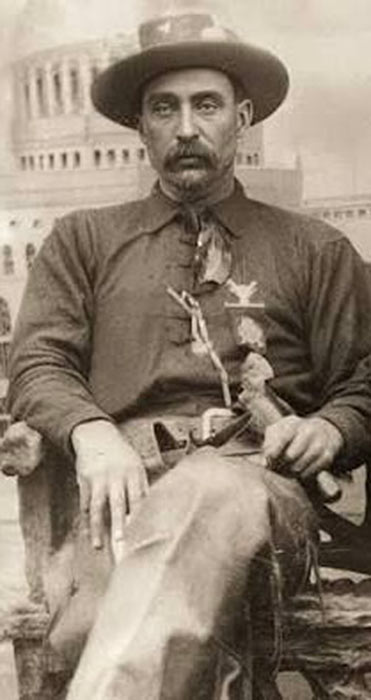
Chalk Beeson & his Colt SA Revolver.

Tucson Lawman and Pima County Sheriff Nabor Pacheco.
By Steven Pacheco McCann.
From the late 1890s through the early 1900s, the Wild West territories of Arizona and Kansas were slowly being tamed after their raucous, rowdy days. Lawmen in these areas were using their words instead of their guns to bring highly wanted and extremely dangerous outlaws to justice. While their methods of pursuing bad guys could differ, their well-thought-out approaches could also be similar, with both styles producing the same desired results: convictions that led to confinement behind bars. This is the mirrored story of two historic lawmen and honorable stand-up citizens: one who lived and worked in a lawless Dodge City, Kansas, and the other in the frontier town of Tucson, Arizona.
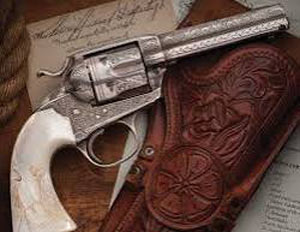
Nabor Pacheco’s Bisley Revolver with Holster.
These two incredible men were Sheriff Chalkley McArator Beeson and Sheriff Nabor Cruz Pacheco, who were, in essence, “Cut from the Same Cloth.” Sheriff Beeson, who preferred and actually demanded that he be called Chalk, and Sheriff Pacheco shared so many of the same needed lawman skills, personal high moral characteristics, and post-law enforcement careers in their individual ranching ventures. Both legendary peace officers loved their personal sidearm of choice: the Colt Single Action. 45 caliber revolver, in the performance of their official duties. In their later years, because of weakness in their right hands, they turned to the British-designed target revolver, the Colt Bisley Single Action. .45, with its special grip design that handled the revolver’s kick more comfortably. It is also noted that both men were in their early forties when they served two terms totaling four years each as Sheriffs for their respective counties. Both men faced several confrontations with wanted outlaws in their pursuit of bringing these desperados to justice. Ford County Sheriff Chalk Beeson is not widely known as the most commonly talked about and written-about lawman in Wild West history but is nonetheless as important to the making of that folklore.
Virtually all Beeson family lineage in this country, including those who were heavily established in Colorado and Kansas in the 1800s, trace back to a single Quaker immigrant, Edward Beeson. Edward came to America from England in the 1680s during the William Penn cross-Atlantic voyages. Unlike his contemporary counterparts and personal acquaintances, Wyatt Earp and Bat Masterson, who lived and ruled by the gun, Chalk Beeson was famous for his restraint, favoring peaceful de-escalation. He once successfully talked an angry gang of two dozen armed Texas cowboys into handing over their guns without a single fired shot. Local newspapers praised his subdued effectiveness, noting that while he was a man of steel who “always got his man,” they offered humorous satire that he was not fierce enough, as “he had not shot a man in several days.” No one doubted how tough Chalk was, as a Dodge City newspaper quoted him as saying that he “drank bullets in his coffee for breakfast”
Lawmen and criminals alike in the surrounding area knew how tough Sheriff Beeson was, as he had a reputation for tracking down even the most notorious lawbreakers until they were either caught or killed.
In November of 1892, Chalk decided to venture into the Oklahoma Territory on his own to arrest the notorious Dooling Gang who had recently robbed the Spearville Ford County Bank. These thieves had pulled off their heist in broad daylight, and Beeson was not going to let them get away with it. He was so annoyed by this gang’s actions that he refused to wait on a posse to be formed and took off after the bandits by himself. As published in the August 12, 1912 edition of the Hutchinson Newspaper, “He went to Oklahoma under an alias, and when he found the headquarters of the gang near Ingalls, he went to Guthrie and was appointed as a Deputy United States Marshall, as he was far out of his jurisdiction as Sheriff.”
One particular gang member Chalk wanted to capture was Oliver Yantis, who lived with a woman in a cabin five miles outside Ingalls. With another lawman that Beeson trusted, they rode to the Yantis cabin and hid in the brush a few yards from the front door until the following morning. The two men figured Yantis would exit the cabin through that entrance to feed his horses. Sure enough, just after sunrise, Yantis appeared walking toward the barn when Chalk ordered him, “Throw up your hands,” but Oliver tried to run away. The Deputy attempted to shoot him, but the morning mist had dampened the caps on his revolver, causing the gun not to function. Chalk then fired on Yantis as his mistress sprang from the house carrying the bandit’s revolver. The highwayman did not survive the ordeal and ultimately died from his wounds before arriving at Ingalls. Chalk Beeson ultimately “got his man” as he always did.
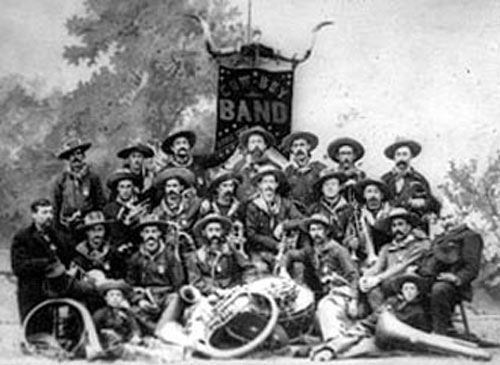
The original Chalk Beeson – Dodge City Cowboy Band
Chalk Beeson was a man of many talents well beyond his law enforcement career, like being an accomplished horse trainer and an expert musician. He played numerous instruments, including the violin, trombone, and French horn. He founded the Dodge City Cowboy band, which entertained in local parades and often performed at the Long Branch Saloon, previously owned by Chalk. The band wore their finest cowboy attire while holstering their six guns, and Beeson actually used the butt end of his pearl-handled Colt 45 as a conductor’s baton. He was often asked if the revolver was loaded, and he would claim it was so he could “shoot the first man who played a false note!”
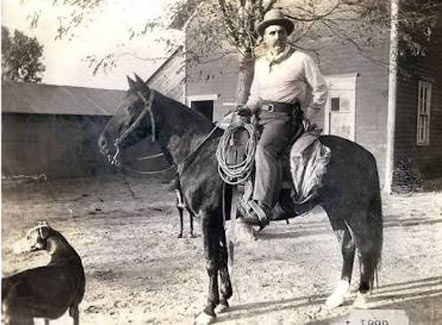
Chalk Beeson riding his horse with his faithful dog nearby working on his COD ranch in the early 1900s
After his Sheriff duties were completed in 1896, Chalk also served as a representative of the area in the state Legislature from 1902 to 1906. He also owned a partnership in the highly successful COD Ranch, where he unfortunately died on August 8, 1912; three days earlier, he was mounted on his favorite horse, which got spooked by a loud noise from a nearby road construction crew. The horse reared up, and before Chalk was able to regain control of the animal, it threw him hard against the saddle horn, causing internal injuries from which he was never able to recover, dying at 64 years young.
During his storied law enforcement service, Sheriff Pacheco had a similar confrontation as Beeson experienced with a would-be killer in July of 1906 when a vicious wanted outlaw named Jesus Trujio made the mistake of coming into Tucson thinking he would go unnoticed. Sheriff Pacheco learned Jesus was in town and tracked him down near the community pool after a long search.
Trujio, who knew the Sheriff, saw the officer as soon as he saw the desperado. Trujillo made a pass for his revolver, but his hand never reached the holster as Pacheco was quicker on the draw and had Trujio covered first, saying in Spanish, “Throw down your gun!” Trujio, knowing the Sheriff’s prowess with a gun, complied. The Sheriff arrested, handcuffed, and then marched his prisoner to jail to be arraigned at a later date. Unlike the lawbreaker Oliver Yantis, who resisted and ran when given the same command to surrender by Sheriff Beeson in Oklahoma, Trujio complied and lived to stand trial for his crimes.
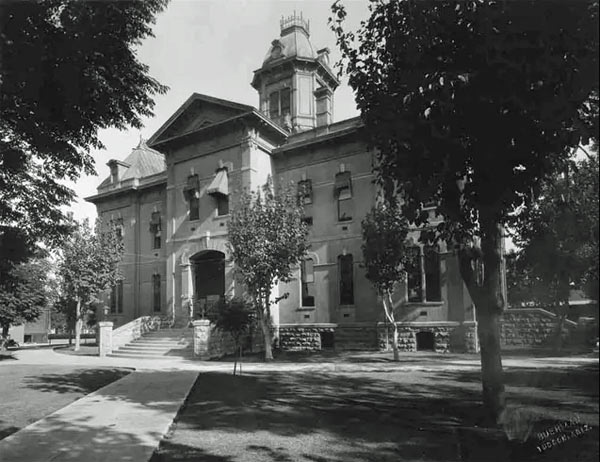
Tucson Courthouse circa early 1900s, where the last public execution in Arizona was carried out for convicted murderer Edwin W. Hawkins on August 14, 1908
Just like Chalk Beeson, Sheriff Nabor Pacheco rode in numerous posses and worked hand in hand with some of the most famous peace officers of the time, such as Arizona Ranger Captain Harry Wheeler, Arizona Ranger Sergeant Jeff Kidder, U.S. Marshall Charles A. Overlock, Maricopa County Sheriff Carl Hayden, and many more of the “best of the best.” While Chalk was representing his constituents as a Kansas State Representative in the early 1900’s, Sheriff Pacheco was at the same time pushing hard on Arizona’s legislation along with Sheriff Hayden to move these “very distasteful” public executions permanently to the state’s prison. He accomplished this shortly after presiding over the last two hangings held in the Tucson Courthouse yard during the summer of 1908.
Nabor Pacheco served a distinguished career as a Tucson Policeman and Constable from 1885-1904, a Territorial Sheriff from 1905-1908, Tucson Chief of Police in 1909, and as a Deputy U.S. Marshal in 1910. He retired to run his own cattle ranch using the Diamond Bell brand granted to his family by the King of Spain, Carlos IV, in 1818. Nabor also died way too young from a heart attack after his morning neighborhood walk on February 14, 1920. He was only 60 years old, leaving behind a grieving wife and seven fatherless children.
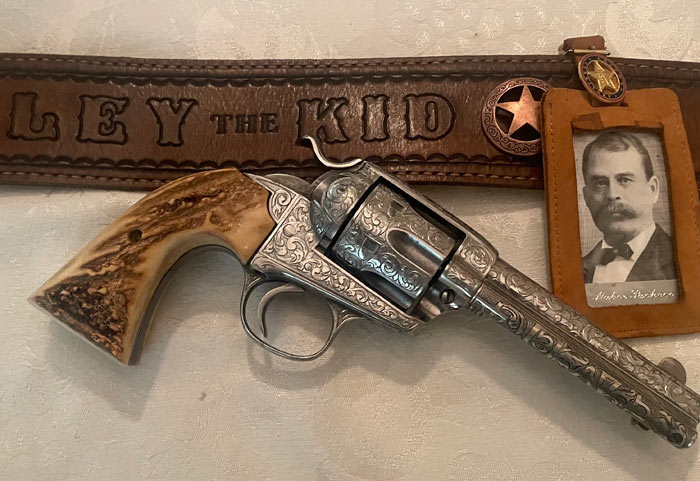
Bisley the Kid’s 1907 “Fast Draw” D. W. Harris Master-engraved, nickel-plated Colt Bisley 45 tribute revolver to Sheriff Nabor Pacheco’s actual duty carried Bisley, with several of the family’s famous ranch cattle brands etched on the ejector rod housing, including the Diamond Bell.
While lawmen Ford County Sheriff Chalk Beeson and Pima County Sheriff Nabor Pacheco most likely never met in person, their law enforcement legacy lives on in the historical museums in their respective states and in print through the many articles written about them. However, the highest tributes and personal respect paid to them come from their own heirs and namesakes, where at least four of them living in the Phoenix, Arizona area can feel what it is like to draw and fire a .45 caliber Colt Single Action revolver just like those drawn and shot by their famous legendary ancestors. Association of Arizona Gunslingers club members and Chalk’s direct bloodline cousin mother and her two “Beeson Boys,” along with Pacheco heir aka Bisley the Kid, enjoy the opportunity to pay homage to their historic Western family lawmen in CFDA competition. I am pretty sure these two heroic Sheriffs would be so very proud of their “Cut From the Same Cloth” fast-drawing descendants.
“Shooters on the line… Shooter Set!”
©Steven “Pacheco” McCann, great-grandson of Lawman Nabor Pacheco, Alias Bisley the Kid, for Legends Of America, November 2026.
Also See:
Nabor Pacheco – Pima County Lawman
Nabor Pacheco’s Three Draws: The Grit and Gun of An Arizona Lawman
Bound by Duty & United in Friendship (the Nabor Pacheco/Harry Wheeler Story)
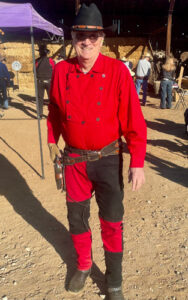
Author Steven McCann
About the Author: Steven “Pacheco” McCann is an Arizona native with a family history on his mother’s side dating back to the 1700s when the family patriarchs were ranching and farming on lands in southern Arizona. They used the state’s oldest recorded cattle brand, the Diamond Bell, which the King of Spain granted them in 1888.
Steve grew up spending quality cowboy time with his grandfather on Ricardo’s ranches located around Tucson, where his love of western life and its historical significance was born. During his youth, he branded numerous cattle with his grandfather’s A Triangle Bar and Box 3 branding irons and learned to ride and rope right beside this giant of a man that he idolized.
With some knowledge of his great-grandfather Nabor Pacheco’s decade-plus career in Arizona law enforcement, Steve’s interest in early Arizona law enforcement has grown into a deep, sincere passion. Reading several books on the Arizona Rangers by renowned author Bill O’Neal lit a fire in Steve from Bill’s detailed accounts of several of Sheriff Nabor Pacheco’s co-captained posses with the Arizona Rangers. Captain Harry Wheeler, Captain Thomas Rynning, Sargent Jeff Kidder, Billy Old, and many more of the Rangers’ best, to mention a few. Steve has enjoyed talking with and becoming friends with Bill O’Neal and has grown to share Bill’s fervor for these never-to-be-forgotten heroes, especially the mutual love of Captain Harry Wheeler.

Photos of the family’s 1907 Colt Bisley, a fully engraved & nickel-plated .45-caliber revolver and a favorite gun of Lawman Nabor Pacheco.
The multiple assignments Pacheco and Wheeler performed together, and their deep friendship, have become one of Steve’s focused areas of interest. They shared so much in common, as both men were shot and wounded during in-the-line-of-duty gunfights, both men served as Arizona Sheriffs (Pima and Cochise Counties, respectively), and both men wore the badge of Deputy U.S. Marshal. They both had strong convictions about righting the many wrongs they encountered during their service; both men were highly proficient with their high-caliber Colt.45 revolvers and lever-action rifles, and unfortunately, both men died of natural causes much too early. Steve enjoys participating in local Cowboy Fast Draw competitions with his own Colt Bisley. 45 Caliber revolvers when not researching and writing about Arizona’s Old West History in hopes his two sons will develop the “interest” as well.