
Two Historic Arizona Lawmen Meet Up At Career Crossroads
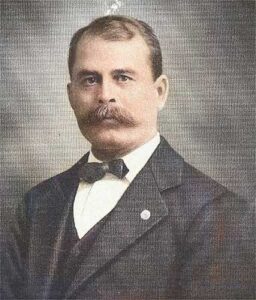
Nabor Pacheco.
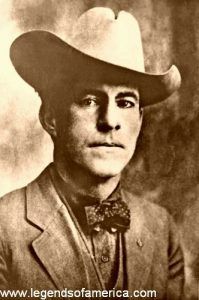
Harry Wheeler
by Steven “Pacheco” McCann, great-grandson of Lawman Nabor Pacheco
As the calendar year of 1908 came to a close, it marked a time of significant transition for two of Arizona’s most distinguished lawmen, Arizona Territorial Sheriff Nabor Pacheco and Captain Harry Wheeler of the Arizona Rangers. 1909 would prove to be a start of both a pivotal and an equally challenging time for both of these great law officers. While they worked together numerous times after Harry Wheeler became an Arizona Ranger, they would come across each other’s path once again and face individual crossroads in this new year that would affect the rest of their lives, both in their law careers as well as in their personal lives.
In 1903, Nabor Pacheco was nearing the peak of his illustrious law enforcement career, having started as a Tucson Policeman in 1885 rising in rank to the position of Constable in November 1900. He would serve in that position for two two-year terms through 1904. Harry Wheeler was coming off a very honorable military career, serving five years in the U.S. Cavalry before joining the Arizona Rangers that same year. It has been well documented and written about in many publications and by this author about their working relationship and the numerous times they brought the “bad guys” to justice. A deep friendship also developed from their law enforcement cooperation co-captaining several large posses and as well as joint “hunts” with just the two of them working side by side.
Nabor Pacheco would go on to become the first native born person of Spanish descent to be elected Sheriff for Pima County from 1904 to 1908. He would cover a huge amount of territory in those four years, not only in mileage traveled on horseback and later by automobile but also in the wide amount of endless duties he performed as Sheriff. He decided not to run for re-election as the political environment in Arizona was vastly changing towards a direction he did not favor as reported in this daily local newspaper.
Arizona Daily Star, December 19, 1908
J.S. Hopley will resign the office of City Marshal the last day of this month and the first of the new year will enter the Sheriff’s office as under sheriff to John Nelson…
With the resignation of Hopley comes the filling of the vacancy caused thereby, and it was reliably reported yesterday that Nabor Pacheco, the present sheriff, will occupy the post immediately after he relinquishes his present post. Mr. Pacheco has been a most efficient officer and is well acquainted with current conditions. He will leave the office of sheriff with an unblemished record and in the event of his appointment would make a worthy successor to the present marshal.
Before officially being named Marshal of Tucson, Pacheco’s main concern was what would happen to his faithful sidekick, Jack the dog. As stated in the Star:
Arizona Daily Star, December 24, 1908
In speaking yesterday regarding his retirement from office on the first of the new year, Sheriff Pacheco said that he did not know what would become of his dog “Jack, for he had become so accustomed to the courthouse that he acted as if the building was his.
Prior to his election as sheriff when he was on the city police force, the dog followed him over his beat and refused to leave his side at any time, and whenever he attempted to make an arrest and his prisoner showed fight, the dog jumped in and helped him.
Several American cities, following a custom established in Belgium, have trained dogs to catch thieves and assist police in their work, and now that Mr. Pacheco is going back on the police force, Tucson, will in addition to his service, have a regular dog thief-catcher.
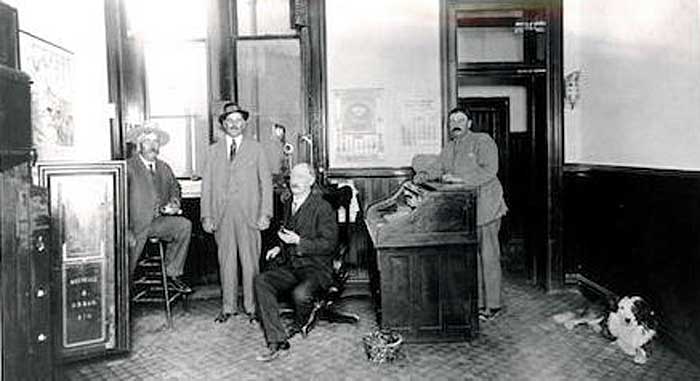
Tucson Chief of Police Nabor Pacheco, also called City Marshal (left), Sheriff John Nelson, Undersheriff Joseph Hopley, Deputy Sheriff Charles Huss, and “Jack the Dog” at the Pima County Courthouse. circa 1909
Harry Wheeler’s career was very successful as well, and he was promoted several times in this same time period, resulting in him becoming the third and final captain of the Arizona Rangers. These same changing politics would adversely affect him, as well as rumblings about shutting down the Rangers were starting to emerge. Early in the new year, the Democrat-heavy state house voted to disband the Arizona Rangers with a large enough majority to override the veto of Arizona Governor Murphy.
Both of these storied men would soon face being out of a job, however, they were not quite yet done as Arizona lawmen.
Nabor Pacheco started his new assignment soon after assuming the City Marshal position with a crackdown on the illegal opium business and dark crime. As reported in this newspaper:
Tucson Daily Citizen, January 16, 1909

Opium Den
Marshal Raids Opium Joints
Marshal Nabor Pacheco last evening single-handedly raided two opium joints in Chinatown.
In both of the places, the marshal captured pipes and a supply of opium and they are being held at the police station as evidence against four Chinese men and a negro who were captured in the raid.
The marshal made his first raid shortly before 6 o’clock last night and arrested a J. King, and a John Doe. An hour later he made a second raid in Chinatown and arrested C. Bing, Jim King and G. Fook, all Chinese men. All were released under bond. It had been suspected for some time that opium joints were operating in Chinatown.
However, Nabor Pacheco’s entire world would soon be rocked to its core as his oldest son was involved in a murder as reported in a Phoenix newspaper:
The Arizonan Republican, March 17, 1909
SON OF CITY MARSHAL MURDERS A WOMAN – Killer is Young Nabor Pacheco of Tucson
Nabor Pacheco Jr., son of City Marshal Nabor Pacheco and former sheriff of this county tonight shot and killed Rena Cain, a woman of the underworld. The killing took place in the lobby of the Windsor Hotel.
Young Pacheco, who is twenty-three years of age, has hitherto borne a good reputation, but for a long time he had been insanely jealous of the woman. She had been out of town for a time and only recently returned. Pacheco met her on the street this afternoon and had a conversation with her, the nature of which is not known.
The woman intended to leave the city again tonight and about nine o’clock was at the desk of the hotel office when Pacheco entered and shot her. She lived about three-quarters of an hour. It is said that the young man then tried to commit suicide. He was immediately arrested by the police and taken to the city jail.
Marshal Pacheco, a man of great pride and integrity, offered his immediate resignation. However, the powers that be declined his resignation knowing the fine reputation of this man and wanting him to remain on the job. Nabor would continue to justly perform the duties of his office for the following six months until another big challenge would be presented to him in August of that year.
Side note: Nabor Pacheco Jr. was convicted of manslaughter and sentenced to five years in the Yuma territorial prison. No man or “son” is above the law as was proven out. He would be released for good behavior after serving two years of his incarceration term and would live out the rest of his life without any further incidents with the law.
Professional trials for Marshal Pacheco would continue as politics dealt its nasty hand when Tucson Mayor Ben Heney was hell bent to get his Chief of Police fired as stated he had some issues with Nabor Pacheco’s performance. As reported in this Arizona newspaper:
Weekly Journal-Miner Prescott August 25, 1909
STRENUOUS MAYOR SUSPENDS TUCSON POLICE CHIEF – Appoints in His Stead Former Captain of Rangers
Development of a startling nature in municipal affairs are coming thick and fast in the Old Pueblo. An exchange states that on Thursday Mayor Ben Heney, brother of Frank Heney, the graft prosecutor, formally suspended City Marshal Nabor Pacheco, one of the most well known officers in Southern Arizona and appointed as temporary police chief, Harry Wheeler, former captain of the Arizona rangers. The exchange says: Mayor Ben Heney Thursday suspended City Marshal Nabor Pacheco for investigation of charges of “violation and neglect of duty” preferred by the mayor against the head of the police department. In his recommendations to the city council, preferring the charges against Marshal Pacheco and suspending him from office, the mayor announces the temporary appointment of Captain Harry C. Wheeler, former chief of the Territorial Rangers, as marshal, pending inquiry into charges against Pacheco. The mayor in an interview states that “if Pacheco’s suspension is made permanent by the council, after a hearing of the charges, he will name Wheeler permanently as city marshal for the purpose of suppressing gambling and prostitution and making a general moral clean-up of the city”.
However, Mayor Heney’s ill-conceived vendetta would ultimately backfire on him as the support for the Tucson Marshal by the city council prevailed and Pacheco’s impeccable reputation was restored per this area newspaper article:
Bisbee Daily Review – September 16, 1909
TUCSON MAYOR IS REQUESTED TO RESIGN
After unanimously adopting a resolution exonerating Nabor Pacheco of the charges of violation of city ordinances and neglect of duty, the city council at a special meeting today adopted a resolution requesting the resignation of Mayor Ben Heney. Heney is accused of bad faith in bringing the charges against Pacheco. Heney refused to resign and impeachment proceedings are already talked of. Heney fell down in his attempt to prove charges of his, which savors of malice and local feeling is bitter on the matter. The six councilmen are now unanimous against Heney.
Mayor Heney eventually succumbed to pressure to leave his office and soon after resigned. However, between the two mentioned trials and tribulations suffered by Nabor Pacheco, the damage had been done. He would run for re-election for Chief of Police in November of 1909 but unfortunately, he would ultimately lose the election by a mere five votes. So the old adage that “every vote counts” could not be more true than in this situation.
Nabor Pacheco would make one last appearance as a law officer when he was appointed a Deputy U.S. Marshal during the 1910 calendar year by U.S. Marshal C.A. Overlock. As the next year was fast approaching, now nearly 50 years of age, Pacheco would retire in 1911 from a law enforcement career to live out the rest of his life as a full time rancher and independent business man.
Nabor Pacheco after finishing a morning walk and talking to his neighbors died suddenly of a heart attack on February 14, 1920 at the age of 59. Nabor had cast a very long shadow throughout his life as a man and as a law officer, a lifetime of dedicated achievement that may never be surpassed.
The years 1909 through 1910 were also be a very difficult time for Captain Harry Wheeler as he started the year actively campaigning to keep the Arizona Rangers organization retained. As reported in the Bisbee newspaper, Captain Wheeler stated the following:
The Bisbee Daily Review, February 10, 1909
RANGERS PERFORM SERVICE THAT OTHERWISE GOES UNDONE
Captain Harry C. Wheeler, of the Arizona Rangers, as fine a body of police as can be found beneath the gun, was in Bisbee yesterday on business. He will leave this morning with Sheriff White. Captain Wheeler is a very popular man in Bisbee and all day yesterday he was kept busy receiving proffers of aid in defeating the move to abolish the Rangers, and in listening to condemnations of the legislature for such a foolish move. The Ranger is optimistic in regard to the ultimate defeat of the bill, and indeed could be scarily otherwise with such a host of friends working on behalf of himself and his men.
At the request of the Review, Captain Wheeler called at the office last night and talked about his men and the work they do. As one listened to him, with his quiet demeanor and friendly manner outlined the work of his men, the small pay they receive, the qualifications they must have before entering service and the practically universal favor and good terms which they enjoyed with the county precincts and city peace officers, one wondered if any legislator could honestly do the same and think he was doing his people a service by getting rid of the most effective check on the graver crimes of the country.
“Will you state in a few words why you think the Rangers are required?” was asked Captain Wheeler.”Yes, their usefulness lies in the fact that they cover territory that cannot be covered by the other officers, and which it would be unreasonable to expect the latter to cover,” was his reply. Continuing, the captain said “Since I have been with the Rangers there has never been a case of friction between the Rangers and the officers that come to my notice. There are nine sheriffs known to me personally and from eight of these I have received letters endorsing the service and expressing a wish that it be continued. Five of them spoke in terms that really praised us more than I think we deserve, while the other three were quite emphatic in their ideas of the necessity of our force being maintained.”
“The men have instructions to deal with only the graver crimes and never interfere in local affairs until called upon to do so. They are always at the command of the officers of the county without reporting to me, and always respond to a call for assistance in capturing a criminal. They are always on the move, and each man knows that he is expected to average riding ten miles a day, the total force covering between eight and nine thousand miles each month in territory that is not otherwise policed. It is an easily established fact that an increase in crime has always followed a removal of the Rangers from any part of the territory.”
“You ask what has been urged against the Rangers. I know of nothing except that the step was taken as a course toward economy. I do know that Texas, New Mexico, California, Nevada and Sonora have a force of Rangers, although all of them are less of a frontier country than Arizona. The appropriations for the Rangers will average $25,000 a year, or as little as $100 per month for each man in service. Out of this the Ranger must keep himself and his horse, and pay for all of his transportation. The men are hand picked men, chosen with reference to their quietness of demeanor, gentlemanly conduct, honesty and sobriety, and their ability to ride. Most of them have been foremen of ranches and all are men of ability, whose pay should be increased rather than completely cut off.”
“Our friendliness with the Mexican officials is one of our greatest assets. They cooperate with us to the fullest extent. On a recent trip through Sonora a colonel and detachment of the Mexican troops accompanied us on a three weeks’ hunt, and gave every possible aid in securing the criminals of whom we were in search. I have a personal order from Governor Torres, of Sonora, instructing all officers to receive our men with courtesy and aid them at all times. It is an order that is always obeyed to the letter. The Mexican authorities, in their efforts to assist in breaking up the stealing of stock, have passed a law making it a felony to receive stock stolen on this side of the line.”
Captain Wheeler was dealing with regret last night over the resignation of Sergeant Chase, who will leave the force to accept a position which will pay him better. The force, which at its full quota numbers of twenty-six men is now down to twenty. As will be seen by reading the assignment list, they are in all parts of the territory, being stationed thickest where most needed”.
Unfortunately, despite his and many other prominent supporters’ efforts on behalf of keeping the force on duty, on February 15, 1909, the act establishing the Arizona Rangers in 1901 was repealed.
Harry Wheeler, a man who had faithfully and dedicated nearly six years of his life to the Arizona Rangers, found himself unemployed. However, his services would be very much in demand as per this story in a Tombstone newspaper:
Tombstone Epitaph, March 14, 1909
Captain Harry Wheeler, formerly chief of the Arizona Rangers, arrived in the city last evening from his home at Naco on business. Capt. Wheeler has been offered a number of good positions since the abolishment of the Rangers but as yet has not decided to continue as a peace officer or to engage in another business.
In March 1909, the former Captain of the Arizona Rangers was once again a law officer as reported in the Williams newspaper:
The Williams News, March 27, 1909
Captain Harry Wheeler, formerly chief of the Arizona Rangers, has been offered the position of chief deputy by Sheriff White of Cochise county.
Deputy Sheriff Harry Wheeler would again perform the duties of a lawman from late March until early fall of 1909, when he was presented with numerous additional law enforcement opportunities. His good friend and former co-captain on numerous posses, Tucson City Marshal Nabor Pacheco was suspended by Mayor Heney of Tucson for obvious political reasons on charges of neglect of duty. Nabor said that he welcomed the investigation stating that he “had done nothing wrong and that he would be vindicated on all charges”.
Deputy Sheriff Wheeler, I am sure, through conversations, received Nabor’s approval, said that he would only take the job if his occupancy was made permanent, but not otherwise. It was later determined that Wheeler was found ineligible as not being an elector of the city of Tucson. Marshall Nabor Pacheco was completely exonerated and therefore found innocent of all charges and returned to duty with his stellar reputation intact. However, as stated before the city council asked for and received the resignation of Mayor Heney who falsely accused Pacheco.
Early in September 1909, newly appointed United States Marshal Charles A. Overlock, appointed former Captain Harry Wheeler as a Field Deputy United States Marshal for Tucson due to his distinguished law career reputation. Deputy U.S. Marshal Wheeler would perform his duties with great skill and success until the year end when he resigned to take a position as a line rider in connection with the Douglas Custom House. A very complimentary article telling of his next position in the Weekly Journal-Miner newspaper in December pays a sincere tribute Harry Wheeler’s time as an Arizona Ranger:
Weekly Journal-Miner, December 29, 1909

Harry C. Wheeler when serving as Sheriff of Cochise County
FRONTIERSMAN NOW IMMIGRATION OFFICER
Harry Wheeler, Captain of the Arizona Rangers at the time the legislature legislated that efficient force out of existence, has entered the service of the government and has been assigned to Douglas as a mounted customs inspector, says the Douglas Dispatch. He is expected to arrive here toward the end of the week and immediately assume the duties of his position. The news that Harry Wheeler is again to be a resident of Douglas will be gratifying to local circles and pleasing to the hundreds of friends and acquaintances here, for, as an officer who combines cleverness and resourcefulness with a pleasing personality and natural gentility, his like has not been known in the territory.
Wheeler has been well known in Cochise County for many years but it was during his connection with the ranger force that his acquaintance was so widely extended. He was a lieutenant under the captaincy of Tom Rynning and when that officer became warden of the territorial penitentiary, Wheeler was given the commission of captain. That Wheeler increased the efficiency of the ranger force in great degree is no reflection upon any of his predecessors. Times and conditions had changed to a large extent and the improvements Wheeler made in the force were only such as new conditions prompted. The old time bad man was gradually eliminated from the force, but this does not mean they were displaced by anyone resembling a mollycoddle. On the contrary, men were taken on only after certain examinations and tests, the principal requisites being ability to ride and withstand hardships. So many notches on a gun detracted from rather increased chances of an applicant. Captain Wheeler in this respect surrounded himself with a body of men, generally young, who could stand any hardship, and it is not recorded that any of them flinched when the time came to display the stuff that was within them.
A short time after Wheeler became captain of the rangers he moved his headquarters to Naco for strategic reasons, and from there the comings and goings of that remarkably efficient force of men were directed. Seldom were they more than 25 to 26 in number, yet so well did Wheeler know his men and his country that, scattered as they were, along both north and south line, they were a homogenous force which kept outlawry at a minimum all over the broad territory.
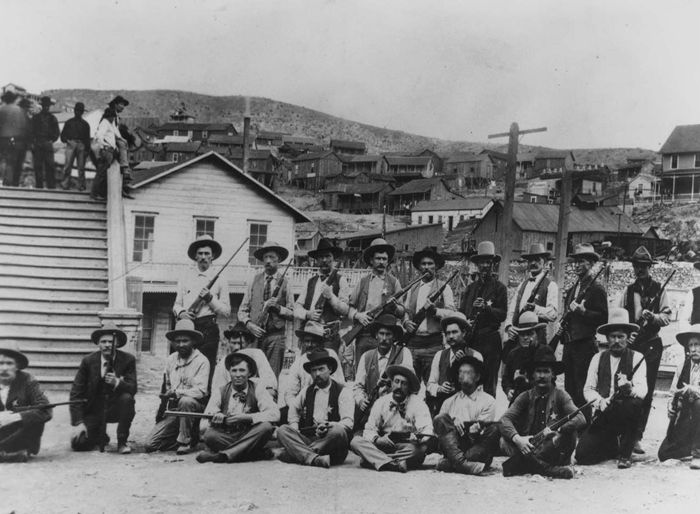
Arizona Rangers, 1903
As captain of the rangers, Harry Wheeler is best known for the esprit d’ corps which he injected into the force and for the energy he displayed. There was nothing of the grandstanding about him when he was directing his little command, and he never gave an order that he himself could not execute, whether it was to arrest a notorious gunman or make a five hundred mile ride. He was a worker, not a desk man, and the trail in Southern Arizona that has not felt the impress of his pony’s hooves has not been made. The border line between Arizona and Mexico being naturally a point of vantage of wrongdoers, especially cattle rustlers, it was in the south that Wheeler was generally found, and during his captaincy cattle rustling was reduced to as near a negligible degree as was possible under existing conditions. Many a rustler was caught, many others driven into Mexico and then kept there and still others were dissuaded from rustling through the moral effect conducted by the efficiency of the ranger body.
Wheeler is among the most modest of men, his gentility of demeanor approaching that of a woman. An eastern man, whose conception of the captain for a force of Arizona fighting men would include every exaggerated idea the tenderfoot has of the west, would never, after sizing him up, take Wheeler for the man for the job. Rather he would be taken for a dapper second lieutenant just out of West Point. The character of the man is best indicated by his hesitancy to talk about affairs when, in pursuance of his duty he has been compelled to take a fellow man’s life. There have only been two or three such instances during several years of a career, every day of which he was rubbing up against an element of outlawry and constantly exposed to danger. The Tracy affair at Benson, when he directed a fatal bullet after a woman had sought his protection, and when he himself was seriously shot, is of too frequent occurrence to elaborate upon. There was another affray elsewhere in the territory when his bullet prevented a bad man from getting him first.
Wheeler has always been known as a Democrat in politics, but as an officer it is not known that he ever let his politics influence him in the performance of his duty, and the that he was appointed by a Republican and that at least half of his men were Republicans shows how nonpartisan the ranger force was. Wheeler was never known to flinch from his duty, for any consideration of politics or private interest, as manifested at Naco when it became his duty to keep illegal voters from the polls. That act required no physical nerve, but there were other considerations involved that would have seemed insurmountable to men lacking Wheeler’s strength of character Wheeler is just about as near the ideal officer as the new Arizona has, for he combines all of the nerve and ready efficiency of the old time Arizona officer with suavity and resourcefulness of the present metropolitan Hawkshaw.
In June 1910, lawman Harry Wheeler was eying his next law enforcement position, that of Sheriff of Cochise County. According to the local Bisbee newspaper:
The Bisbee Daily Review, June 16, 1910
CANDIDATES WAIT STATEHOOD NEWS
Public interest in the prospective candidacies is growing daily, being intensified by the recent primary call issued by the board of supervisors. The candidates are themselves more interested than anyone else, but are waiting (on Arizona Statehood status), which is all they can do.
It was reported in Bisbee yesterday that one candidate had decided to take the situation by the horns and place his petition before his supporters. This is Harry Wheeler of Douglas, formerly captain of the Arizona Rangers. It was stated that he is already circulating his petition of candidacy on the democratic ticket for the office of Sheriff.
And the rest they say is “history”!
Harry Wheeler would continue to serve as a mounted custom inspector through the end of 1910 when in November he was voted in as the next Sheriff of Cochise County, winning a popular re-election every two years to this position through 1918.
This is where I will end the Nabor Pacheco and Harry Wheeler joint saga and leave Harry’s remaining story to authors such as Bill O’Neal who in his book Captain Harry Wheeler Arizona Lawman details the remainder of Wheeler’s life and his achievements much better than I could ever do. Leave it to say that this transition period from respected Arizona Ranger Captain to accepting lesser recognized positions to once again attaining the prestigious stature as Sheriff of Cochise County, his final law position, was a very trying time for him, however, he persevered in continuing his stellar law enforcement career on his terms.
Harry Wheeler would suffer another great loss before becoming the Cochise County Sheriff in 1911 and maybe one of his hardest to personally handle as reported in this Bisbee newspaper article:
The Bisbee Daily Review, November 15, 1910
Loses Valued Pony
Captain Harry Wheeler has had to have killed his favorite pony. The animal in the past had carried him over hills and mountains, no matter how rough the trail, but stumbled near the smelter on smooth ground and broke its shoulder, becoming perfectly helpless.
In closing out this last chapter of the Pacheco/Wheeler story, it was definitely a tough, challenging road to travel with many ups and downs for these two great lawmen. But as with all things associated with Nabor and Harry, their law enforcement careers were performed with the utmost integrity and deserve the highest honors bestowed upon them. The old adage “you can judge the character of a man by the company he keeps” could never be more true than with these two men.
On behalf of the citizens of Arizona, the current modern Arizona Rangers, the great authors who have written about them, along with myself, I sincerely thank Sheriff Nabor Pacheco and Captain Harry Wheeler for their dedicated and faithful service. You both are the best of Arizona’s heroes and should never be forgotten!
©Steven “Pacheco” McCann, for Legends of America, September 2025.
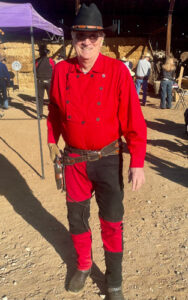
Author Steven McCann
About the Author: Steven “Pacheco” McCann is an Arizona native with a family history on his mother’s side dating back to the 1700s when the family patriarchs were ranching and farming on lands in southern Arizona. They used the state’s oldest recorded cattle brand, the Diamond Bell, granted to them by the King of Spain in 1888.
Steve grew up spending quality cowboy time with his grandfather on Ricardo’s ranches located around Tucson where his love of western life and its historical significance was born. During his youth he branded numerous cattle with his grandfather’s A Triangle Bar and Box 3 branding irons and learned to ride and rope right beside this giant of a man that he idolized.
With some knowledge of his great-grandfather Nabor Pacheco’s decade-plus time as an Arizona law enforcement officer, Steve’s interest in the history of early Arizona law enforcement has grown into a deep, sincere passion. Reading several books on the Arizona Rangers by renowned author Bill O’Neal lit a fire in Steve from Bill’s detailed accounts of several of Sheriff Nabor Pacheco’s co-captained posses with the Arizona Rangers. Captain Harry Wheeler, Captain Thomas Rynning, Sargent Jeff Kidder, Billy Old and many more of the Rangers’ best, just to mention a few. Steve has enjoyed the pleasure of talking and becoming friends with Bill O’Neal and has grown to share Bill’s fervor for these never to be forgotten heroes but especially the mutual love of Captain Harry Wheeler.

Photos of the family’s 1907 Colt Bisley, fully engraved & nickel plated 45 caliber revolver, a favorite gun of Lawman Nabor Pacheco.
The multiple assignments Pacheco and Wheeler performed together and their deep friendship has become one of Steve’s focused areas of interest. They shared so much in common, as both men were shot and wounded during in the line of duty gunfights, both men served as Arizona Sheriffs (Pima and Cochise Countys respectively), and both men wore the badge of Deputy U.S. Marshal. They both possessed strong convictions of righting the many wrongs they encountered during their time of service, both men were extremely proficient in handling their high caliber Colt 45 revolvers and lever action rifles and, unfortuately, both men died of natural causes much too early. Steve enjoys participating in local Cowboy Fast Draw competitions with his own Colt Bisley 45 Caliber revolvers when not researching and writing about Arizona’s Old West History in hopes his two sons will develop the “interest” as well.
Also see:
Nabor Pacheco – Pima County Lawman
Bound by Duty – United in Friendship (the Nabor Pacheco/Harry Wheeler Story)
Nabor Pacheco’s Three Draws: The Grit and Gun of An Arizona Lawman
The Original “Dirty Harry” (Harry Wheeler)
Marshal Virgil Earp’s “What If” Could Have Changed History Forever