
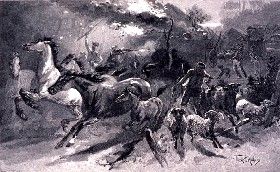
Horse Thieves.
Henry Borne (also spelled Bourne), better known as Dutch Henry, was an outlaw and one of the most notorious horse thieves and cattle rustlers of the Old West.
Henry was born July 2, 1849, in Manitowoc, Wisconsin, to German immigrant parents. In the 1860s, he moved with his family to Montague, Michigan, where he worked as a lumberjack. At some point, he joined the Seventh Cavalry but left in the late 1860s. Shortly afterward, Borne was arrested at Fort Smith, Arkansas, for stealing 20 government mules. He was sentenced to prison but escaped just three months later.
In 1868 and/or 1869, Born scouted for General George Custer. By 1870, he had moved on to freighting for George Hoffman and was at Fort Harker, Kansas, in June 1870. Cooking for Mark Bedell and buffalo hunting occupied his next few months. After a conflict with Cheyenne Indians and the army at Fort Lyon, Colorado, he turned to horse and mule theft.
According to historian and author Roger Myers:
“By June 1874, Born was living on his homestead North of Ellsworth, Kansas. On June 15 of that year, he was wounded three times and captured by U.S. Deputy Marshal Alex Ramsey, taken to Topeka, Kansas, and then to Leavenworth, Kansas, where he spent approximately 15 months in jail awaiting trial for stealing government mules. Acquitted on April 23, 1875, he returned to Leavenworth and was jailed for several months on charges of jailbreak and theft of a shotgun during that escape attempt.
Myers points out that Borne’s story of being at the Second Battle of Adobe Walls in Texas couldn’t be true because he was in a Kansas jail at the time.
Soon after the close of Texas’ Red River Indian War in 1875, Dutch Henry emerged as the leader of a horse-stealing ring operating across a vast area from Kansas to eastern Colorado, New Mexico, and the Texas Panhandle.
Although the actual number of Borne’s followers is disputed, it is estimated to have been as many as 300. Henry specialized in Indian ponies and government mules, for which he found a lucrative market. At one time, Borne declared that he had never taken “a white man’s horse.”
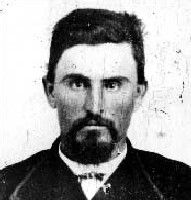
Charles Goodnight.
Nevertheless, newspaper reports embellished his reputation as a “road agent and murderer.” In 1877, after establishing the JA Ranch, Charles Goodnight met with Dutch Henry, and 18 members of his band camped on Commission Creek near Fort Elliott, Texas. They made a pact, sealed with a drink, that bound the outlaw leader from raiding below the Salt Fork of the Red River, the northern boundary of Goodnight’s range. Borne kept his word, and Goodnight left him alone.
Demands to bring Dutch Henry to justice increased. He had escaped from jails and eluded law officers more than once, but in December 1878, Las Animas County Sheriff R.W. Wootton arrested him in Trinidad, Colorado.
There, Borne was tried for stealing mules and ordered transferred to the Bent County Jail. Instead, Bat Masterson took him to Dodge City, Kansas, under a warrant for grand larceny. However, Borne was acquitted in January 1879. Soon, he drifted on to Las Vegas, New Mexico, where he was said to have been a member of the notorious Dodge City Gang. By then, he had become so good at stealing horses that one legend says he once sold a sheriff his own recently stolen horse. Their term, “Dutch Henry,” soon became known as a stolen horse.
Finally, the State of Arkansas caught up with him, putting him back in prison for the Fort Smith robbery years before. However, his time behind bars was apparently brief; by the late 1880s, he was known to have been prospecting at Summitville, Colorado, and had opened the successful Happy Thought Mine in Creede.
In the 1890s, he filed on 160 acres on the West Fork of the San Juan River 20 miles from Pagosa Springs, Colorado. The acreage would eventually become known as Borne’s Lake. In July 1900, Henry married Ida Dillabaugh and fathered four children. In his later years, he talked little about his past and, for seven years, did not even keep a gun in his home, claiming that he had “had all of the killing that he wanted.” Borne died of pneumonia on January 10, 1921, and was buried at Pagosa Springs, Colorado.
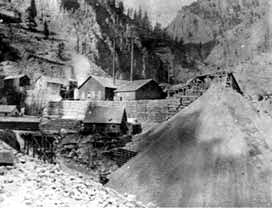
Creede, Colorado.
©Kathy Alexander/Legends of America, updated September 2026.
Also See:
See Sources.