
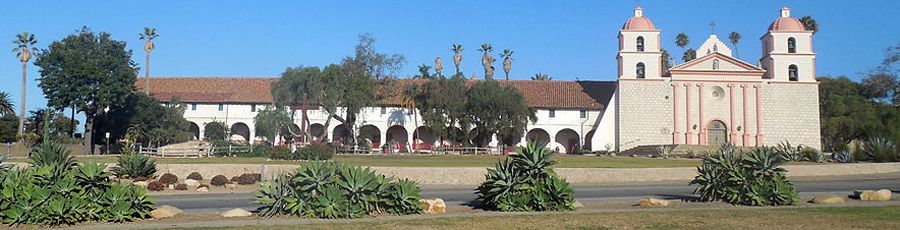
Santa Barbara Mission, California, by Niranjan Arminius, Wikipedia
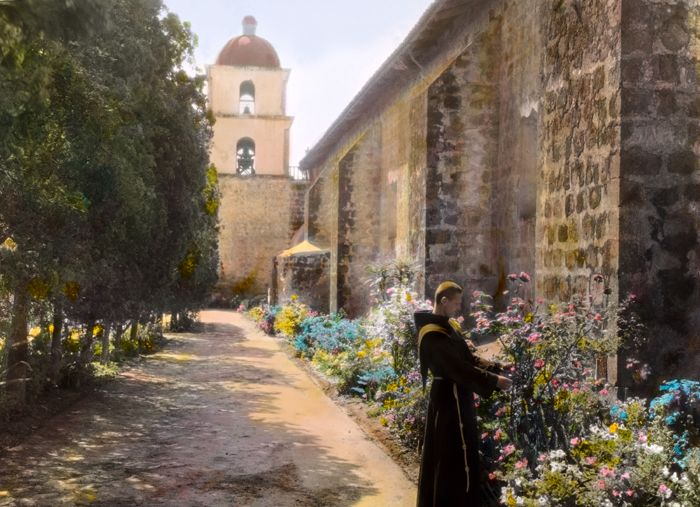
Franciscan Priest at Santa Barbara Mission, California by Frances Benjamin Johnston, 1917.
Mission Santa Barbara was the 10th of 21 California missions founded by Franciscan priests during the 18th and early 19th centuries.
The Mission grounds occupy a rise between the Pacific Ocean and the Santa Ynez Mountains and were consecrated by Father Fermín Lasuen on December 4, 1786, the feast day of Saint Barbara. The mission is the only one that has remained under the leadership of the Franciscan Friars since its founding. The mission is the namesake of both the city of Santa Barbara and Santa Barbara County.
Before the Spanish arrived in the area, numerous American Indian tribes populated the West Coast. The mission was established to contact and convert the Chumash people, who lived along the coast between Malibu and San Luis Obispo. The Chumash were skilled artisans, hunters, gatherers, and seafarers, but had no formal agricultural system.
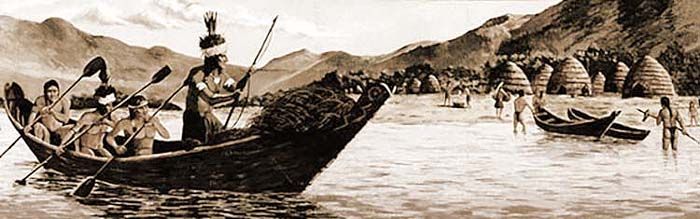
Chumash Indians.
When Padre Fermín de Francisco de Lasuén first established the Santa Barbara mission in 1786, he aimed to introduce religious and sustainable farming practices to the native population. The first mission church in Santa Barbara was built of logs with a thatched grass roof in 1787. It was rudimentary and soon required replacement in 1789. As the mission grew, so did the scale and quality of its church building. The church, which dates from 1794, was constructed from adobe and tile.
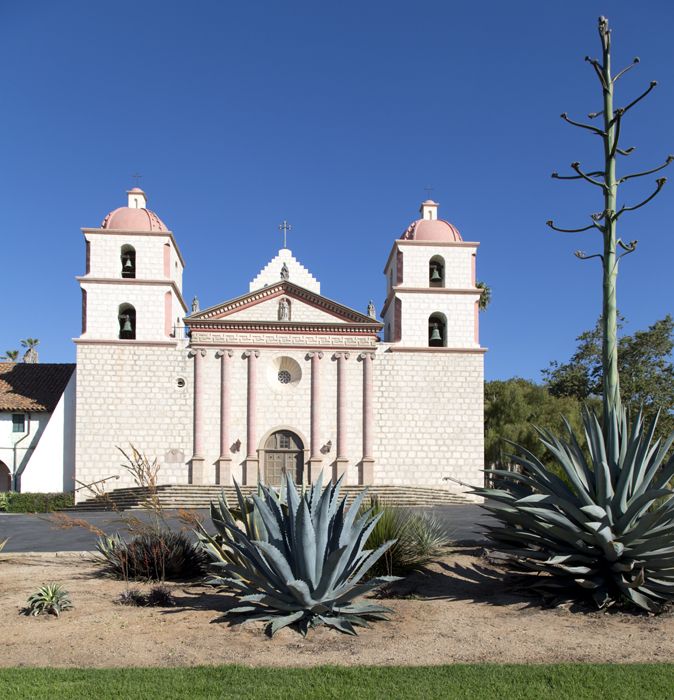
Mission Santa Barbara, California, by Carol Highsmith
The fourth and present church was conceived after the great earthquake of 1812 destroyed the church and the village. In 1815, construction of the new and present church began. Converted natives accomplished most of the labor under the guidance of master stonemason Antonio Ramirez. The new stone church was essentially complete by 1820, and its classical-inspired façade was one of the finest architectural works in California at the time. The new church was immense, measuring 179 feet long and 38 feet wide, with its interior comprising six chapels. The main walls were constructed from local sandstone, and the exterior featured heavy buttresses for added support. Two symmetrical towers adorned the façade along with classical elements such as Ionic pilasters, an entablature, and a pediment. In addition to the church, the Santa Barbara Mission also included housing for the priests, workshop space, storehouses, and hundreds of small adobe huts for native residents.
Throughout the early 1800s, life at the mission centered on both agricultural pursuits and religious activities. Thousands of cattle, sheep, goats, pigs, mules, and horses thrived on the mission’s land. The Franciscans and converted Indians tended crops of wheat, barley, corn, beans, peas, oranges, and olives. As early as 1807, an impressive aqueduct system was implemented that included a dam across nearby Pedregoso Creek. Water was diverted into a large settling tank for filtration and then collected 500 feet from the mission church in a stonewalled reservoir. A fountain and a long laundry trough sprang from the reservoir by 1808. The fountain and reservoir are still intact just outside the church today.
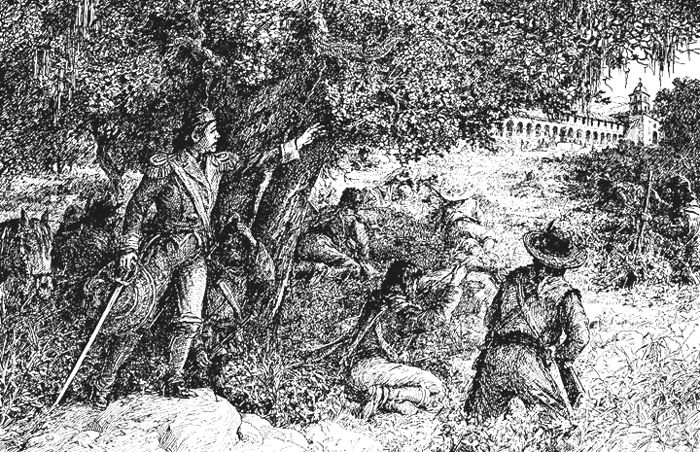
Chumash Revolt by Alexander Harmer.
The missionaries encountered little opposition from the local Indians and no forcible resistance during the construction of five missions in the area. However, some of the bands began to resist missionary rule. In 1824, the Indians at Santa Barbara, Santa Inés, and La Purísima revolted against the mission authority, though there were few lives lost.
In 1834, following Mexico’s independence, a new law mandated the secularization of the missions, including the one at Santa Barbara. For the other 20 Spanish missions, secularization led to land division, abandonment of buildings, and ultimately disrepair and severe ruin. The Santa Barbara Mission, however, managed to escape this type of neglect and decay. Although its buildings and lands were sold, the Franciscan friars were allowed to stay and occupy the mission. It soon became the Franciscan capital of California, and in 1842, California’s first bishop arrived at the site to establish the seat of his diocese.
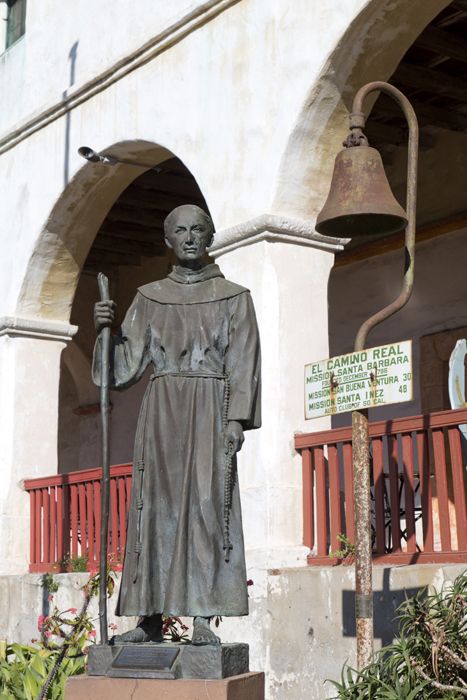
Statue at Santa Barbara Mission, California, by Carol Highsmith.
By 1853, the church had founded a Franciscan missionary college, and while the other 20 missions languished in various states of abandonment, the Santa Barbara mission thrived. In 1865, President Lincoln returned the mission’s buildings and 283 acres of land to the Catholic Church. From 1869 to 1877, the mission also functioned as a college for laymen, making it Santa Barbara’s first institution of higher education. In 1896, this education initiative led to the creation of a high school seminary program, which in 1901 would become a separate institution, Saint Anthony’s Seminary. While several of its buildings had undergone alterations over the years, the mission church itself remained essentially unchanged since the day it was constructed.
The church survived remarkably intact until tragedy struck in 1925 when a violent earthquake shook Southern California. The church suffered severe damage, including the complete collapse of the eastern tower. Interior fixtures, furnishings, and art were mangled by falling stone from the church’s walls. Luckily, the building’s seven massive buttresses held fast, and much of the exterior remained standing. Since the church had been carefully documented, a complete restoration was possible. The entire building was then reconstructed, mainly using original stone, by 1927.
In 1929, the college-level program was relocated to Mission San Luis Rey de Francia. It became San Luis Rey College from 1950 to 1968, before relocating to Berkeley, California, where it is now known as the Franciscan School of Theology.
The church sustained only one other major renovation project when, in 1950, the settling of the building caused dangerous cracking in the towers. The damage required the dismantling of the entire façade, including the two towers, and its reconstruction on new, solid foundations.
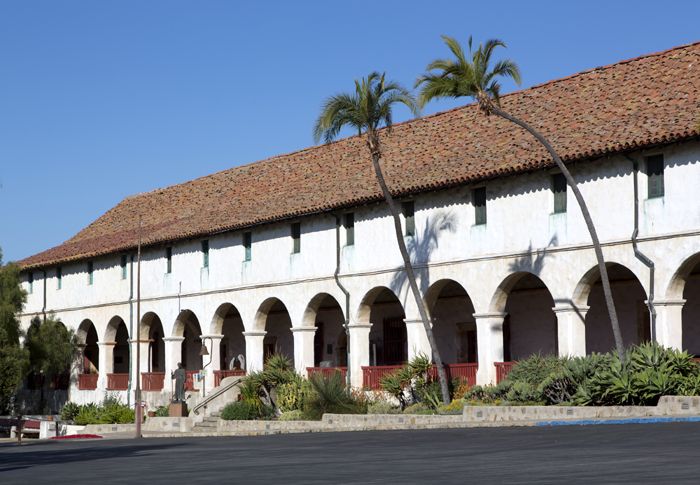
Santa Barbara Mission, California, by Carol Highsmith.
Over 200 years after its construction, the church remains the home of an active parish and a thriving community of Franciscan friars. The current mission property, encompassing 12 acres, now features a retreat center and museum, as well as a historic cemetery, beautifully landscaped gardens, and an aqueduct system with a fountain for visitors. Surrounded by 200-year-old sandstone walls, the Historic Mausoleum is situated in the center of the cemetery and has served as a final resting place for Franciscan friars since 1893.
In addition to its nationally landmarked architecture, the mission is a significant repository of historical records, art, and objects from all eras of California history. The Spanish altar is original, and the Stations of the Cross came from Mexico in 1797. Hundreds of other religious and secular objects, statuary, paintings, and memorabilia remain in the church’s collection. Many of these are on display within the church itself or interpreted for visitors in the Santa Barbara Mission’s museum.
Today, a National Historic Landmark, the Santa Barbara Mission Church is the only original mission church to have survived unaltered into the 21st century. Its historic sanctuary light has never been extinguished. Self-guided tours are available daily, and docent-led tours occur regularly on weekends. There is an admittance fee.
More Information
Santa Barbara Mission
2201 Laguna Street
Santa Barbara, California
805-682-4713
©Kathy Alexander/Legends of America, updated September 2025.
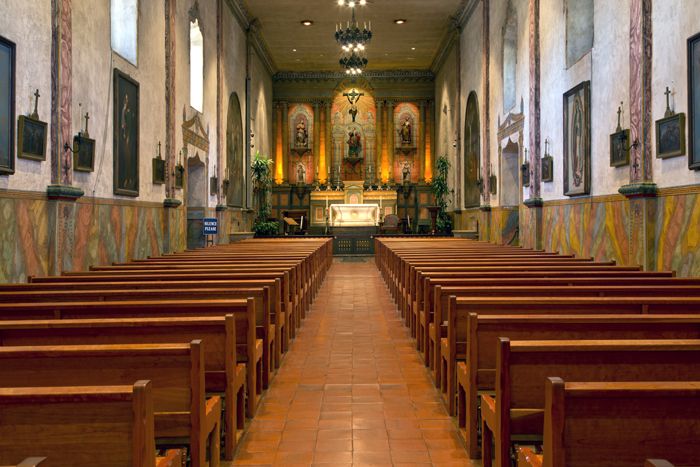
Santa Barbara Mission Interior, California by Carol Highsmith
Also See:
Missions & Presidios of the United States
Sources: