
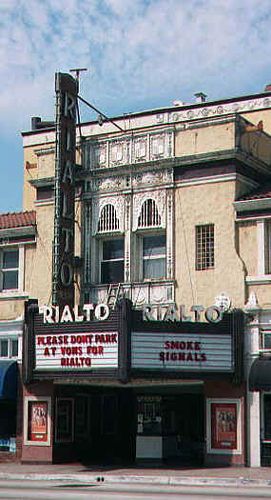
Rialto Theatre, South Pasadena, California.
A long-standing Route 66 icon, the Rialto Theatre in South Pasadena, California, closed its doors after 81 years, shutting out its customers but not its ghosts.
The historic theatre, built in 1924 in a Spanish Baroque design with Egyptian touches, seated 1200 people and included ten dressing rooms, a scenic loft, an orchestra pit, and a deep stage. The décor featured picture tiles, colorful stenciling, and plaster ornaments, such as harpies (half-woman, half-vulture) and mythical gargoyles.
On its opening night of October 17, 1925, an organist played its large Wurlitzer organ, and the Rialto orchestra accompanied the world premiere of the Picture “What Happened To Jones?” Before the premiere movie, customers were entertained by Vaudeville acts and trapeze artists. Admission was .30 cents. When the depression started, the theatre survived by offering prizes to entice its customers and made it through the hard times.
When Vaudeville lost popularity in the 1930s, three-act prologues were presented before the feature film. During this decade, the theatre also suffered a backstage fire that temporarily closed its doors. After it reopened, live theatre never returned to the stage.
Over the years, the theater and many fixtures, including its historic Wurlitzer organ, were sold.
By the 1960s, the single-screen theatre was showing more niche films, including silent films. The theatre suffered another fire in 1968, but was restored and survived.
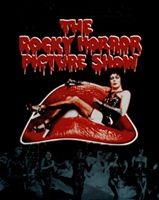
Rocky Horror Picture Show
After the classic Rocky Horror Picture Show came out in 1975, it ran for three decades at the old theatre, shown every Saturday night at midnight for years, before it lost popularity and was shown only monthly.
In July 1976, the theatre’s operations were taken over by the Landmark Corporation under a 100-year lease of the building. However, soon after they took over, redevelopment in South Pasadena posed a threat to tear down the legendary movie house. Locals protested, and the Rialto was soon listed on the National Register of Historic Places in 1978.
In the 1970s and 1880s, the Rialto began hosting concerts and soon began running more mainstream movies to attract more customers.
But, before long, multiplex theaters began to sprout up all over the area, and in the meantime, the Rialto continued to deteriorate. Discussions began in the 1990s to completely renovate the theater to either return it to its former glory or split it into a multiplex. However, in 2000, Landmark’s parent company, Silver Cinemas, declared bankruptcy, leaving no funds for renovation.
Although one of the finest and least adulterated theaters in the greater Los Angeles area, it had frayed carpets, chipped paint, and fading velvet seats. Customers may have fondly remembered the aging movie house, but they chose to patronize the more modern cinemas with their large parking lots, comfortable seating, and a wider selection of movies.
Though the Rialto Theatre survived the death of vaudeville, two fires, and threats of demolition and conversion to a parking lot, it finally succumbed to low ticket sales and, sadly, closed on August 19, 2007.
The building will be saved from demolition because it’s on the National Register of Historic Places. Its future, however, remains unknown. A yet-unapproved redevelopment plan is in the works, but the building’s future remains unknown as of this writing.
Rumors of the theatre being haunted have been consistently circulated throughout its long history. Tales abound of people having died there, particularly a girl who allegedly slit her wrists in the bathroom before making her way up to the balcony and bled to death. Another story tells of a man who went insane in the projector booth.
In any event, staff and visitors allege that the stalls in the girls’ bathroom have been known to shake on their own accord. In the theater itself, the apparition of an older man is often seen sitting in various seats and walking up and down the balcony stairs. Could this be the man who went insane in the projector booth?

Black cat.
Others say that a cat also haunts the theater. In its early days, the theater’s mascot was a cat who roamed the old movie house, brushing up against customers’ legs and often walking in front of the screen. According to some tales, the cat continues to move stealthily through the theater and produces an eerie red light when the phantom walks in front of the movie screen.
Another visitor reported the image of a dark figure gliding down off the stage, making his way toward the theater seats, before disappearing into the lobby.
Other “normal” paranormal events have also been reported, such as abnormalities in photographs, uneasy feelings people experience in various areas of the theater, especially in the women’s restroom, and whispers that are sometimes heard.
Paranormal groups investigating the theatre agree that it is most likely haunted.
The historic Rialto Theatre is on old Route 66 at 1023 Fair Oaks Avenue in South Pasadena, California.
©Kathy Alexander/Legends of America, updated March 2026.
Also See:
Pasadena – A Village Inside a City
See Sources.