

by Jim Hinckley
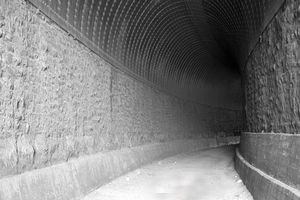
The Johnson Canyon Railroad Tunnel is an engineering marvel and a wilderness time capsule, photo by Jim Hinkley.
By late summer 1881, the westbound track-laying crews of the Atlantic & Pacific Railroad had reached a point near present-day Williams, Arizona. The railroad’s course across northern Arizona to this point was an almost endless string of engineering marvels, the most notable of which was the span of the 250-foot-deep chasm at Canyon Diablo.
Survey crews faced a new challenge: the western escarpment of the Colorado Plateau was scarred by steep, narrow canyons. To avoid constructing a costly loop that would sweep for miles to the south, engineers selected Johnson Canyon, even though this would result in a roadbed with a 112-foot drop per mile, an incline that exceeded grade-level standards.
However, this was one of the obstacles engineers and construction crews faced within the canyon. Just west of the summit, a sheer rock shoulder formed a cliff at a point where the canyon made a sharp turn.
As the required tunnel —the only one on the central line west of Albuquerque —was relatively short at 328 feet, engineers predicted it would cause only a very short delay. The daily progress dropped to mere inches as the tunnel crews struck a basalt core.
Meanwhile, as tunnel construction progressed, albeit slowly, other crews addressed the remaining obstacles, including bridging two gorges, one of which lay immediately to the west of the tunnel face. These projects required something more than a simple rail gang. The railroad began luring powder men, miners, and bridge builders, professionals from the four corners of the earth, by offering unheard-of wages – $2.40 per day for laborers, and $2.80 per day for drillers.
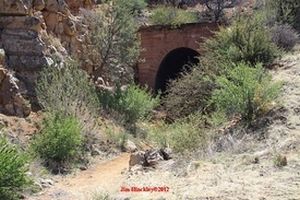
The west portal of the Johnson Canyon Railroad tunnel was built in 1883.
Soon, a small railroad camp with stores, saloons, and brothels was booming among the pines 200 feet above the tunnel site. Injuries and work-related deaths were common, but surprisingly, shootings and similar violence were rare enough that when they did occur, it was newsworthy.
An article in the Arizona Weekly Miner published in February of 1882 records one such incident in which an altercation between James Casey and William Ryan ended when Casey shot Ryan in the head. Armed and enraged citizens forced Casey to barricade himself in a saloon. The newspaper account chronicles the end of the affair with a succinct statement, “Luckily, a ball from one of the guns ended his (Casey’s) villainous career, and he was sent to meet his Maker with the blood of Ryan fresh on his hands.”
Death on a large scale struck in August as a premature explosion of blasting powder tamped into drill holes set off a nearby stockpile. Several men vanished, and the official death toll was six.
The slow pace of tunnel construction brought the Atlantic & Pacific Railroad to the brink of bankruptcy, forcing it to sell stock to the rival Atchison, Topeka & Santa Fe Railroad. This only postponed the inevitable, and soon the A & P was little more than a historic footnote.
As it turned out, the tunnel’s completion in late 1882 led to new engineering challenges, as rockfalls plagued the site. To address the problem, an intricate lattice of heavy timbers held the ceiling in place, but a fire in 1898 and the subsequent rockfall led to the line’s closure for 11 days and the deaths of 2 men.
Repairs to the tunnel included adding a riveted iron ceiling and lowering the floor. Between this date and the abandonment of this line in 1959, the only modifications of note were exterior ones, including a gun emplacement built over the tunnel during World War II, as this railroad bottleneck was deemed a vital resource.
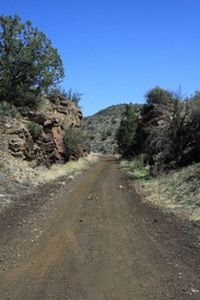
Johnson Canyon Rail Bed, photo by Jim Hinckley.
The tragedies associated with the tunnel construction are only a small part of the canyon’s bloody history. A series of derailments, some of which resulted in trains plummeting 100 feet to the canyon floor below, gave Johnson Canyon a national reputation as one of the most dangerous railroad lines in America.
The tunnel’s obscurity is somewhat puzzling in light of its importance to Western development. The ease of access to the site compounds this mystery.
An adventure to the tunnel begins at exit 151, Welch Road, on I-40 west of Williams, Arizona. Continue north on Forest Road 6, crossing two early alignments of Route 66, and drive several miles to the site of Welch Station, dominated by a large concrete slab.
Now, follow the old rail bed approximately 2.5 miles east into the canyon. This is a relatively easy hike, as the rail bed is wide and level, with minimal grade. This area is very remote, so be prepared and watch for snakes —they are quite plentiful during the summer. Notify someone of your destination and when you plan to return, carry plenty of water, and savor the solitude as you climb higher into the scenic canyon.
©Jim Hinckley, November 2012, updated November 2025.
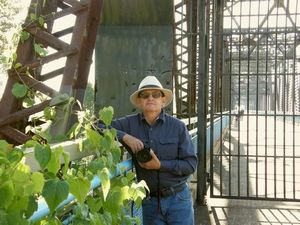
Author Jim Hinckley
About the Author: Jim Hinckley is an award-winning author and photographer. Hinckley is a former Associate Editor of Cars and Parts Magazine and author of multiple books, including several on Route 66. You can follow him on Jim Hinckley’s America.
Also See:
Jim Hinckley – Author & Legends of America Contributor
Jim Hinckley’s America – Photo Prints