
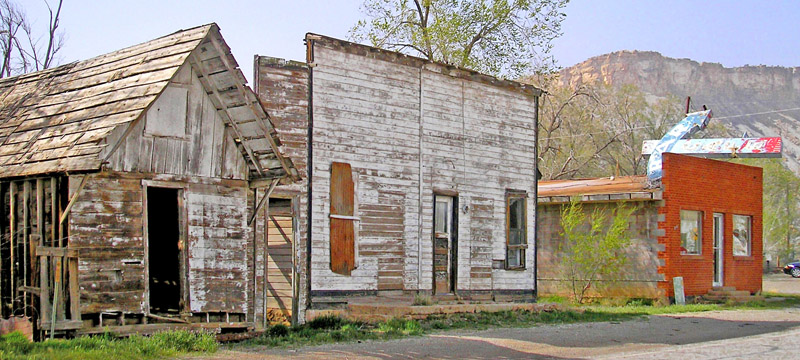
Thompson Springs, Utah, old buildings by Kathy Alexander.
Thompson Springs, Utah, which was officially known as Thompson for a time, is a small census-designated place in the high-desert country of central Grand County. The population was 34 at the 2020 census.

Book Cliffs near Thompson, Utah.
Though this tiny town still has several current residents, it is all but a ghost town today. It is not the typical type of ghost town, such as the many mining camps of the American West, with crumbling shacks and rusting equipment lying all around; rather, it is more like the many towns of Route 66 that died when the interstate replaced the highway. Though an exit still exists from I-70 into the town, it is a bit off the interstate, and Thompson’s old businesses are all closed.
The town began when E.W. Thompson, who lived near the springs, operated a sawmill to the north, near the Book Cliffs. Soon, a small community called Thompson Springs was born, comprised of small-scale farmers, sheepherders, and cattlemen.
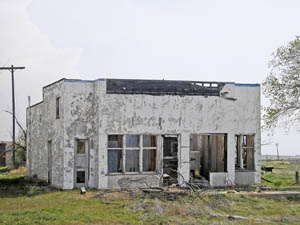
Old business building in Thompson’s, Utah by Kathy Alexander.
However, one ambitious man in the area, an Englishman named Harry Ballard, had big plans. A successful sheep and cattleman, Ballard began to buy up much of the property surrounding Thompson Springs and, before long, owned a hotel, store, saloon, and several homes in the small settlement.
Soon, the little community was large enough to convince the Denver and Rio Grande Western Railroad, which had completed its line through the region in 1883, to add a stop in the settlement; cattle and sheepmen welcomed the railroad, which soon became a small shipping point for their stock.
A post office was established in 1890 called “Thompson’s” after the original owner, E.W. Thompson. Sometime later, Harry Ballard discovered a large vein of coal on land adjacent to his ranch about five miles north of Thompson’s. Keeping his discovery to himself, he soon bought the surrounding property and began small-scale coal operations. However, Ballard sold his operation to Salt Lake City investors in 1911, and the coal-mining town of Sego was born, bringing greater prosperity to the area.
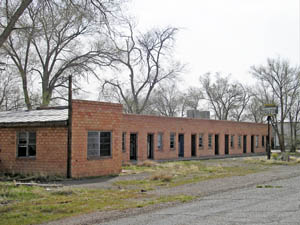
Old motel in Thompson Springs, Utah, by Kathy Alexander.
Thompson became even more important in 1914 when the Ballard and Thompson Railroad was constructed from the mines in Sego Canyon north of Thompson to connect at the Thompson railhead. Bringing out numerous loads of high-grade coal, Thompson never grew very large, but it contained two motels, a saloon, the railroad station, a couple of stores, a school, a restaurant, and several homes.
Though the coal was in high demand, the mine suffered financial difficulties from the start due to a lack of water and management issues. Railroad operations to the mine ceased in 1949, which placed further operational issues on the mine. However, mining continued in Sego Canyon until 1955, when the railroad began using diesel engines, replacing coal-powered steam engines and reducing the need for the mine’s products. Sego then became a ghost town. Unfortunately, Thompson wasn’t far behind.
Another blow was dealt to Thompson when I-70 was built through the area in the 1970s. Thompson had survived the mining decline because it was situated on a main highway through the area, NV-128, and provided services to travelers passing through the region. Afterward, the town found itself just a few miles north of the new highway, and traffic through the small community dramatically decreased, prompting businesses to close.
The Denver and Rio Grande Western Railroad continued service through the area until 1983. Afterward, the city was served by various Amtrak trains.
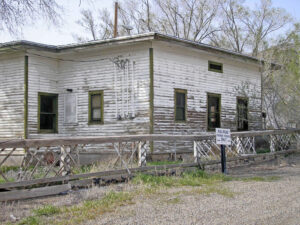
Old railroad station in Thompson Springs, Utah by Kathy Alexander.
Those few remaining residents reinstated the original town’s name, Thompson Springs, in 1985. However, the United States Postal Service still listed it as “Thompson”.
Another blow to the town occurred when its flag stop station, which served Amtrak travelers, was finally closed in 1994. The later movement of the passenger train stopped about 25 miles to the west in Green River in 1997, leading to further economic hardship for Thompson Springs.
Thompson’s post office closed in 2006.
After sitting vacant and vandalized for years, the old train station was demolished in 2016.
Today, much of the town is uninhabited. There is still an exit from I-70 (#185) with a gas station. The town is a mile or so down the road. It is still home to the Desert Moon Hotel & RV Park, which has served the area since the 1930s. The Union Pacific Railroad runs through Thompson Springs.
North of Thompson Springs, in Sego Canyon, Native American rock art and petroglyphs can be seen. A bit further down the road is the ghost town of Sego.

Desert Inn Motel in Thompson, Utah.
The town is just north of the east–west highway route shared by Interstate 70, U.S. Route 6, and U.S. Route 50, between Crescent Junction and Cisco. Moab, the county seat, is 37 miles to the south.
©Kathy Alexander/Legends of America, updated March 2026.
Also See:
Sego Canyon – History and Ancient History
See Sources.