
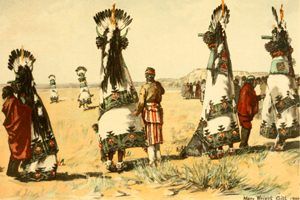
Kachina Dancers, by the Bureau of American Ethnology, 1895.
Jump to:
Kachina Types:
Many different styles of kachinas exist to provide examples and guidance for the tribe. Each type has a particular set of characteristics and a distinctive personality. Costumes, song styles, and body movements are repeated and unique when impersonated. Most kachinas are considered benevolent friends; some are clowns, and others punish wayward people.
Chief Kachinas – Those who take part in nine-day ceremonies. Chief kachinas are important, and certain chiefs are important to specific clans. Their roles mirror those of the elders—they look after the clan’s well-being and can only be portrayed by specific clan members. Chief kachinas include:
Aholi
Death Fly/Mastop
Long Billed/Wupamo (also a Guard)
Red Tail Hawk (Palakwayo)
Wupamo (Also a Warrior kachina)
Ogres – The ogres are disciplinary kachinas. Their purpose is to frighten children into good behavior. During ceremonies, they demand food and visit each home in the pueblo or village. Each ogre has its own personality and role in a ceremony. The ogre kachinas include:
Giant Ogre (Chaveyo)
Natask (Black Ogre)
Ogre Soyok’mana
Ogre Woman
Warriors or Guards – Serve as policemen and are important for functions before and during war. In the ceremonies, they enforce actions such as communal cleaning, prevent interruptions, protect the kachinas, and punish the unruly clowns. They may carry yucca whips or bows. Warrior kachinas include:
Broadface (Wuyak-kuita)
Crow Man (Angwus)
Hilili (Also a Whipper kachina)
Warrior Maiden (He-e-e or He-wuhti)
Wupamo (Also a Chief kachina)
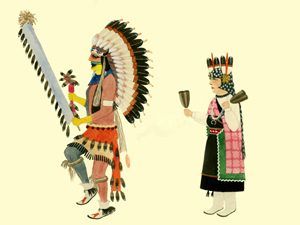
Comanche Dance, Alfonso Roybal 1925.
Runners – Runners are racing kachinas who run and race with the men of the pueblos during ceremonies. Those who lose the race are whipped with yucca leaves and are forced to eat chile or have mud thrown at them by the Runners, while those who beat them are given piki bread. Runner kachinas include:
Chief (Mongwi)
Chili Pepper (Tsil)
Fox
Rattle Runner (Aya)
Red Kilt Runner (Palavitkuna)
Red Tail Hawk Kachina
Road Runner (Hospoa)
Sikya Heheya
Squash (Patung)
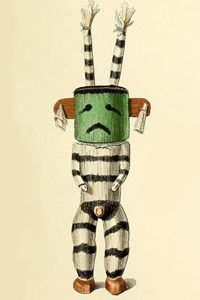
Tcukuwympkiya, a Clown Kachina.
Clowns – Those who offer comic relief during the dances. Clown kachinas include:
Crow Mother
Hemis
Masau
Scorpion (Puchkofmoktaka)
Sun Kachina (Tawa)
General Styles – Animals, plants, and other natural forms, living and non-living
Female (Momoyam) – Female kachinas are the wives, mothers, and sisters of other kachina spirits, but men often still portray them. The exception is Pachavuin Mana. Each usually accompanies another kachina. Female kachinas include:
Butterfly Maiden (Palhik)
Cloud Maiden
Corn Maiden (Corn Mana)
Kachina Maiden (Hoho Mana), a Zuni kachina
Warrior Maiden (He-e-e or He-wuhti)
White Corn Maiden (Angak china Mana or Kocha Mana)
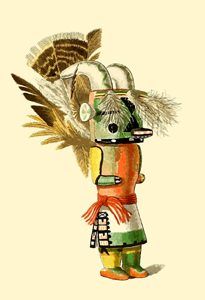
Mountain Sheep Kachina Doll.
Animals (Popkot) – Animal kachinas act as advisors, doctors, and teachers. They taught the use and administration of herbs in healing and taught warriors how to avoid danger. Animal kachinas include:
Antelope (Chop/Sowi-ing)
Badger
Deer Dancer (Sowi-ingwa)
Fox Dancer
Great Horned Owl (Mongwu)
Turkey (Koyona)
White Bear (Hon)
Other Kachinas – Other kachina groups can include plants, whippers, hunters, and kachinas borrowed from other pueblos.
Individual Kachinas: (This is not a list of all kachinas, but it includes many of the more popular and most-seen ones.)
Ahol Mana– A maiden spirit, she arrives with Ahola during the Powamu ceremony and visits various kivas and ceremonial houses with him. On these visits, she carries a tray with various kinds of seeds.
Aholi – The Chief Kachina’s (Eototo) lieutenant helps the chief bring moisture to the villages. Aholi Kachina is a beautiful doll that usually appears with a tall blue helmet and a colorful cloak in colors that represent the flowers and the essence of summer, and the likeness of Muyingwa, the Germ God. A patron of the Hopi Pikya clan, Aholi once allowed his throat to be slit so that Eototo could escape.
Ahola – Also known as Ahul, this Hopi kachina, embodied by a man, is one of the important chief kachinas for the First and Second Mesas because he opens the mid-winter Powamu ceremony, sometimes called the bean planting festival. On the festival’s first night, he performs inside a kiva before going with the Powamu Chief to give prayer feathers to Kachina Spring at dawn. Afterward, he and the Powamu Chief visit the kivas and ceremonial houses, give out bean and corn plants, and mark the doorways with stripes of cornmeal. At the end of the ceremony, Ahola descends to a shrine, bows four times to the Sun, and asks for health, happiness, long life, and good crops. Ahola is also the friend of Eototo (Aholi), and one legend tells of Ahola having his throat cut to let Eototo escape.
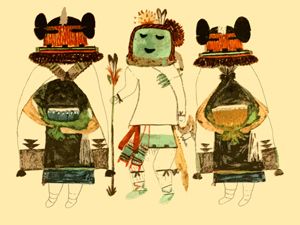
Ahulani and Two Soyal Mana Kachinas.
Ahulani – This figure participates in the Soyal Ceremony, appearing with two Soyal Manas on the morning of the event’s last day. The Ahulani mask’s decoration differs in symbolism on alternate years, depending on whether the Snake or Flute Dance is celebrated. Ahulani carries several ears of corn and spruce boughs or twigs under his left arm. He bears a chief’s badge and skin pouch with a sacred meal in his left hand, while in his right, he carries a staff. In the image on the right, two Soyal Mana kachinas escort Ahulani; they differ only in the color of corn they carry: one is yellow, and the other is blue corn.
Antelope – Known as Chop or Sowi, this kachina dances to increase its numbers and brings rain. This spirit has many similarities with the Deer Kachina, but they differ in the deer’s antlers versus the antelope’s horns. When he appears, he is often accompanied by the Mountain Sheep Kachina and the Wolf Kachina.
Apache Dancer – Known as Yoche, this spirit is mainly seen during the Kiva Dances. Also called the “Mountain God,” he protects the Apache tribe in wartime and appears in coming-of-age ceremonies for young girls.
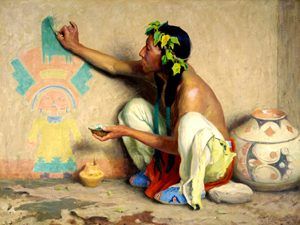
Kachina Painter by E. Irving Couse, 1917.
Badger – Called Hototo, this kachina has many roles, including guard, gift bearer, and warrior. It plays an important part, as animals are teachers, advisors, and doctors. The preparer of food and the most respected of the war kachinas. He is mainly seen during the Bean and Mixed Kachina Dances.
Bean – Dances for a plentiful bean crop.
Bear – Also called Hon, the Bear Kachinas are very powerful, can cure serious illnesses, and are great warriors. They are frequently distinguished only by color, such as white, black, blue, or yellow.
The bear dances as a watchman or side dancer during the Soyal Dance, and he sings while dancing outside the lines during the Mixed Dance. His most distinctive feature is a bear footprint on both cheeks.
Black Crow Dancer/Raven – A warrior whose primary purpose is to make war on the Clown kachinas and to warn anyone else who does not behave.
Blue Ahote – The Ahote Kachina is also seen as coming from Plains Indian influence, mainly due to the wearing of a long eagle feather headdress.
Blue Whipper – Known as Sakwa Hu, this being is considered an old kachina, although small boys usually impersonate it. Its main function is to guard certain ceremonies, where it is known to punish clowns, children, and people when they misbehave.
Broad Faced – Called Wuyak-kuita, this guard kachina helps the other guards prevent any transgression on the kachinas’ path during ceremonies. He accompanies the Soyoko (Ogre Woman) and helps her in all her activities. Carrying yucca whips and moving intimidatingly, he terrifies the clowns when he moves toward them. On Third Mesa, the kachina guards the kivas to keep Ha Hai-i Wuhti (Grandmother) from getting too close during the Palolokong Ceremony.
Broadface Dancer – This kachina carries yucca whips to bring the village together to clean community areas.
Butterfly Dancer – Represents the butterfly that lands on flowers, which the medicine man uses in his medications.
Butterfly Maiden/Palhik Mana – Known as Poli Mana, she dances from flower to flower, pollinating the fields and bringing life-giving rain in the spring. A woman dancer represents her at the yearly Butterfly Dance, a traditional initiation rite for Hopi girls. Hopi girls participating in the Butterfly Dance wear ornate headdresses called kopatsoki. One of the most popular carved dolls, this beautifully dressed figure is not a kachina, but rather a woman’s dance personage. Generally, she is not masked; the doll typically includes butterfly and corn symbols.
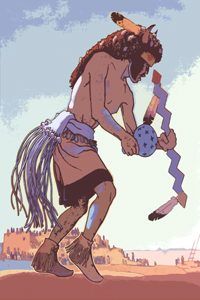
Buffalo Dancer by Don Louis Perceval.
Buffalo Dancer – The most powerful among all Kachina dolls, he can kill any evil thought and is a great spiritual protector.
Buffalo Maiden – The Buffalo Maiden, or Mosairu Mana, appears with Mosairu (Buffalo Kachina). She prays for more Buffaloes along with Mosairu. Like most maidens, the Buffalo Maiden also asks for rain. It carries the sun on its back, representing her presence in summer dances.
Buffalo Mosairu – The Buffalo Kachina (Mosairu) looks similar to the Buffalo Dancer, but with one exception: the Buffalo Kachina wears a mask. The mask has globular eyes and a snout. He usually dances in the Plaza Dance with the Mixed Dancers. They perform using the rattle and the lightning stick, and along with the other game animal Kachinas, they pray for an increase of buffalo. In the past, most Buffalo Kachinas were made with green masks, but nowadays, they are commonly found with black and white ones.
Butterfly Man – Known as Poli Taka, this impersonating Kachina brings rain and crops to the earth and participates in the Butterfly Dance. The doll is usually unmasked but wears a tablet. Originally, the Kachina did not have wings, but over time people added wings to the doll to increase its popularity.
Buffalo Warrior Dancer – He protects the food supply and ensures adequate food for the Winter.
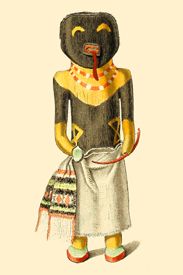
Chakwaina Kachina Dolls of the Tusayan Indians, 1894.
Chakwaina – Also called Tcakwaina, this kachina appears in Zuni and Keresan ceremonies but not in Tewa ceremonies. Usually depicted as an ogre with ferocious teeth, a black goatee, and a black mask with yellow eyes, it is often claimed that Chakwaina is a ceremonial representation of Estevanico, a Moroccan-born slave who led the first Spanish party to the Pueblo tribes as a scout for the expedition of Fray Marcos de Niza in 1539. Estevanico was said to have been killed by the Zuni. Although usually black, Chakwaina can be white or albino.
Chasing Star – A symbol for the plants and stars; he can resurrect those that have fallen from the sky by lifting them back up.
Chief Dancer – An ancient kachina who represents the power of knowledge.
Chief Eototo – This Chief Kachina is the spiritual counterpart of the village chief and is known as the “father” of all Kachinas. He knows all of the ceremonies and appears each year. Usually, he arrives with his companion or lieutenant, Aholi, and then they begin the ceremony by blessing each village and marking it so that the rain clouds will come. At each blessing, Eototo is given prayer feathers, and in return, the kiva chief takes some of the corn sprouts he carries. These actions symbolize the gift of water to the villages and their crops. His simple appearance is characteristic of many older Kachinas.
Chili Pepper – Known as Tsil, this kachina is a runner who chases people and, when he catches them, puts red pepper powder or a whole pepper in their mouths. Usually, he is seen carrying yucca whips in one hand and a red pepper in the other. Red peppers can also be seen on the top of his helmet.
Cloud – Known as Omowuh, cloud kachinas help bring rain.
Clown – Called Tsuku, they run races with the Wawarus Kachina and are the butt of much humor with the Piptuka. The Warrior Kachinas and the Owl Kachina severely chastise them for their misbehavior.
Clown Kaisale – This clown kachina has many colorful stripes on his body. His actions are similar to the Tsuku, the Hopi clown, but his acts are more outrageous. For example, he would eat a watermelon by putting his face in it. This act is a favorite among the audience. With this clown and others, the artist can put his own sense of humor and style into making the doll.
Clown Koshari – This clown kachina has many names, which give some information about his origin. The Koshari can be found in many pueblos and is considered the father of Kachinas. These clowns are both sacred and profane to the people; their actions are both humiliating and funny. Carvers usually add their own styles when making the clown, depending on what they see as funny or humiliating.
Cold-Bringing Woman – Called Horo Mana or Yohozro Wuhti, this is originally a Tewa Kachina. Her purpose is to bring the cold or the whiteness of Winter. She is mostly seen during the Powamu Ceremony (or bean dance). Horo carries a comb made of yucca, which she uses to mess up people’s hair when she appears with her grandson, Nuvakchina, who brings the cold Winter winds. Horo is dressed mainly in white clothing to represent the white seen in Winter.
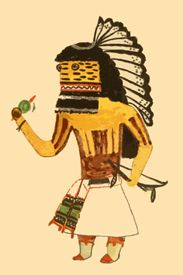
Comanche Kachina.
Comanche – Known as Komantci or Turtumsi, this kachina is not originally Hopi, but was later adopted as a Hopi Kachina. It represents a neighboring tribe of the Hopi: the Comanche. These Kachinas are usually seen as social dance figures when they participate in dances. This doll wears a goggle-eye mask, a row of feathers, a beard, body paint, and carries a rattle, bow, and arrow.
Corn Dancer – Known as Kae, he is probably the most popular of all the kachinas; he represents a prayer for corn to grow and bear fruit. His costume is similar to the designs of the eastern pueblos with distinguishable horizontally crossed feathers on the crown. He appears in the Kiva Dances, Plaza Dances, and Mixed Dances.
Corn Maiden – A corn woman or maiden figure in many stories. She is said to purify the women who grind the corn for ceremonies and other uses.
Corn Planter – Known as Koroasta, this Rio Grande Keresan Kachina is also known as Akorosta. He appears during dances carrying a stick (used for planting) and seeds. He influences corn growth and is usually seen carrying corn kernels in his sack.
Cow – Known as Wakas, this kachina is a recent addition to the Hopi beginning in the early 1900s. The cow kachina dances to increase cattle, and its name is derived from the Spanish word for cows – vacas. During the dance, villagers sometimes take a feather from him to put in their homes and corrals so it can increase their cattle stock.
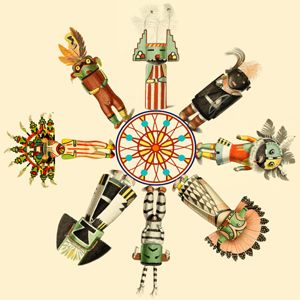
Kachina Design by Kathy Alexander.
Crazy Rattle – Known as Tuskiapaya, this kachina is a runner who carries yucca sticks, which he uses to whip anyone who loses a race. Crazy Rattle gives the winner piki bread as a reward. This kachina appears mainly during spring dances when running with the men of the villages.
Cricket -Known as Susopa, this kachina is a runner in some villages and a kiva dancer in others. It is said to appear in the Kiva Dance at night and is one of the few kachinas known to dance empty-handed. The Cricket Kachina usually appears with a black bandolier and cricket antennas, and he wears a plaid shoulder blanket-made kilt.
Crow – Known as Angwusi, this kachina usually teams up with the Lizard and Owl kachinas during the Soyohim Ceremony. Their main function is to keep the clowns in line. He joins the other kachinas in chastising the clowns’ actions until the clowns go too far. Then, he would punish them with the whips he carries. All animals are an important part of the Hopi culture. They are believed to provide guidance, health, and protection.
Crow Bride – Called Angwushahai-i, this Hopi kachina is dressed entirely in white and talks or sings during ceremonies.
Crow Mother – Known as Angwusnasomtaka, this figure is highly dignified. Many Hopi also consider the mother of the Hu, or Whipper Kachinas, to be the mother of all kachinas. She appears during the Powamu Dance on all three mesas, during the children’s initiation ceremony. As each child is brought in for the ceremony, the Crow Mother supervises the initiation in the kiva. She gives the Hu Kachinas a whip, and each child receives four healthy strokes. The children then receive a prayer feather and a meal before leaving the kiva. Later in the same ceremony, she leads other kachinas into the village, carrying a basket of corn kernels and bean sprouts to symbolize seed germination during Winter. Kachina dolls of Crow Mother were plentiful several decades ago but are not as commonly made today.
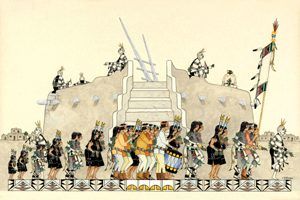
Plaza Procession of Kachinas by J.D. Roybal.
Cumulus Cloud – Known as Tukwinong, this kachina represents a prayer for heavy rain to nourish the fields. He always carries a jug of water and is barefoot.
Cumulus Cloud Girl – Known as Tukwinong Mana, this is the sister of the Cumulus Cloud Kachina. The sister and brother are rarely seen and appear only during the Hopi Salako. Besides helping her brother, her role is unknown. She is usually seen carrying a bowl full of meals, which are sometimes divided into directional Hopi colors.
Death Fly – Known as Mastop, these kachinas always arrive in pairs on the next-to-last day of the Soyal Ceremony. They represent a prayer of fertility for the Hopi women from their dead Hopi ancestors. In pairs, they would seek women from children to the very oldest, grab their shoulders from behind, and make a series of small hops indicating copulation. All Hopi women do not shy away from his embrace because it is a serious fertility rite.
Deer Dancer – Dances with the promise of more deer so villagers will have plenty to eat in the future.
Deer Woman – Called Sowi-ing Mana, this kachina has many similarities with the Antelope Kachina Mana. The Deer Kachina Mana’s dance is a prayer for more rain and for more deer. When she appears, she is often accompanied by the Deer Kachina and is usually impersonated by a man. All animals are an important part of the Hopi culture; they are believed to provide guidance, health, and protection.
Disheveled – Known as Motsin, this kachina is a guard, but behaves more like a community leader. He enforces attendance at community work parties. Carrying whatever tools he needs to enforce (usually a rope in one hand and another tool in the other), he takes all the necessary actions to get his job done. He used to wear striped or torn-up shirts, but now carvers have made him better clothing. Still, he usually appears black-faced, with warrior pahos on his head, and feathers all around his ears.
Dog Poko – This spirit represents all domestic animals. It is a very old Kachina and very important, as it is believed to be the first domesticated animal. Its importance and functions are friendship, protection, and sheep herding. Sometimes the Dog is considered to be a hunter. He is normally dressed as a line dancer. The dog itself can vary in costume and appearance because there are so many different types of dogs.
Dragonfly – The Sivuftotovi or the Dragonfly Kachina is usually seen carrying a yucca whip in one hand and a jar of corn smut (dark in color). Other times he is seen carrying just the yucca whips. He is a runner or racer. Sivuftotovi would race his opponent, and once he beat them, he would either beat them with his yucca whip or smear them with the corn smut! This Kachina appears in many variations, depending on the village it came from!
Dress Kachina – The Kwasa-itaka or Dress Kachina is the Hopi version of the Zuni Koroasta. He is called the Dress Kachina because he usually wears a woman’s dress without a belt. The lines around his face represent the colors of the rainbow. He has influence over the growth of the corn crop and distributes seeds to spectators during the ceremony.
Eagle – Known as Kwahu, this kachina represents strength and power and rules the sky as a messenger to the heavens. As the overseer of all the Kachinas, he is treated as an honored guest and given presents like the children. He appears most often with mud heads in the Kiva or Repeat Dances of early March, is one of the main dancers in the Solstice Parade, and is personified in the Powamu Ceremony. Each dancer is pressured to imitate every step and cry of the eagle perfectly.
Earth God or Skeleton Man – Called Masauwu, this kachina is not only the God of the Earth but also the Spirit of Death; he controls the land of the Underworld, is the Keeper of Fire, and is the doorkeeper to the Fifth World. He is the only kachina who does not go home after the season’s final ceremony (Niman Ceremony). On earth, he gives the Hopi their land and honor and blesses them on their travels. In the Underworld, he controls the passage of the dead and the movements of the kachinas emerging from the Underworld into the world of the living. He does many things in reverse because the world of the dead is the reverse of this world. He may come down a ladder backward or perform other actions in reverse. Similarly, though he is described as wearing a hideous mask, he is also described as a handsome, bejeweled man beneath it. Occasionally, he may appear as a pair and behave wildly—singing loudly, beating on the kiva hatchways with willow switches, dancing around the fires of the cooking pits, and sometimes even walking through the fires. However, he is also assigned specific benevolent attributes.
Fire God – Known as Shulawitsi, this kachina is mainly portrayed by a boy. Though not a hunter, he is sometimes seen carrying a bow and arrow. His purpose is to look after the Sun and fire.
The Shulawitsi is very close in appearance to the Kokosori, but they are not the same. He is usually seen in the Mixed Dance with Zuni Kachinas.
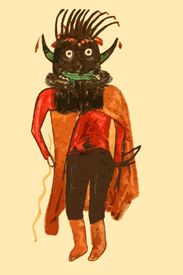
Pakiokwik Fish Kachina.
Fish – Called Pakiokwik, very little is known of this mysterious Kachina except that he is thought to be very old. The lack of fish on the Hopi mesas suggests that he originates in one of the pueblos along the Rio Grande.
Fly – Known as Sohonasomtaka, this kachina can be a Chief, Guard, or Hunter depending on the ceremony. He may also appear as a warrior who punishes the clowns when they get out of hand. As a guard, he protects ceremonies from outside intrusions. Insect and animal kachinas offer advice and teach the Hopi people about life.
Frog – The Frog or Paqua (Pauataga) Kachina’s purpose is to bring rain and more Frogs. Rarely seen, when he makes noises, he is calling out for rain. The Frog and other reptile Kachinas are believed to provide guidance, health, and protection. The origin of this kachina is unknown, but it is probably a Water clan Kachina.
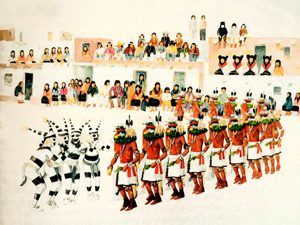
Hopi Ceremonial Dance by Fred Kabotie, 1921.
Germination God – Called Ahola, he plays a significant role in the Hopi culture, controlling the growth and reproduction of all things. He is the oldest of the Kachina Clan, the Solstice or Return Kachina and the Sun Kachina. Most Hopi women place corn seeds at the door of the kiva before the Ahola appears so his presence blesses them to be fertile. He visits each kiva to offer strength for the upcoming year, and at the end of the ceremony, he descends to a shrine where he bows four times to the Sun and asks for long life, good health, happiness, and good crops for his children.
Giant – Known as Chaveyo, this threatening kachina appears at any time in spring to punish or discipline villagers who have misbehaved, such as breaking rules of conduct or failing to meet work requirements. He and Hahai-i-Wuhti (Pour Water Woman) are the parents of the dreaded ogres known as Nataskas. He is usually seen in the Powamu, or Water Serpent, Dance and is often seen with the Soyoko (Ogre Woman). Hopi Oral history includes the story where Chaveyo headed the Hopi warriors in the Pueblo Rebellion at the Hopi village of Oraibi in killing the Franciscan priest and destroying the church and mission. In Hopi oral literature, when the villagers misbehave, their chief seeks help to end their evil ways. He would confront the offender in full warrior/hunter regalia, ordering him to follow proper Hopi ways. More recently, during the summer celebrations, the Giant Ogre assumes the role of a policeman. The Giant Kachina is a favorite of kachina carvers.
Grandmother – Also known as Pour Water Woman or Mother Earth, her Hopi name is Ha Hai-i Wuhti. Like the Crow Mother Kachina, she is also known as the mother of all Kachinas and nourishes all beings, including humans and kachinas. Some Hopi say she is married to Eototo, the chief of all kachinas. She is in many important ceremonies, such as the Hopi Shalako, the Water Serpent, Soyoko, and the Powamu. Her personality is as colorful as a sprightly Hopi grandmother and is unusual in that she is quite vocal, a rarity among kachinas.
Great Horned Owl – Called Mongwu, this kachina is a warrior who disciplines the clown when their behavior becomes too outrageous. He appears in Mixed Kachina Dance and in some ordinary dances. Kachina carvers favor him.
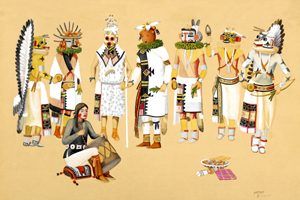
Group of Kachinas by Waldo Mootzka, 1933.
Guard – Called Heoto, this Kachina can be considered a warrior or a guard. Individually, the Heoto may function as a policeman. Over the years, many of these functions have been lost. He is related to the Chawaina Kachina. He may have originated from Zuni. In the Bean Dance Parade and during Initiation years at the Pachavu Ceremony, he functions as a guard.
Guard Woman – Known as Heoto Mana, this kachina is in a category of Kachinas that can be considered warriors or guards. Individually, the Heoto Mana may function as a policewoman. Over the years, many of these original functions have been lost. The HeoManaana and the Heoto may have come from the Zuni tribe. The Heoto Mana appears everywhere with Heoto and dances on all three mesas. Her function is similar to that of He-e-e, the Warrior Maiden Kachina. She also acts as a guard in some places.
Hair Cutter – Known as Hemsona, this runner kachina participates in races, and when he beats a challenger, he grabs him, holds him to the ground, and cuts off a knot of his hair. Therefore, he races with a pair of shears, scissors, or a knife. One legend tells that Hemsona used to be a killer hired by the Walpi Indians to murder the chief’s son during a race. Hemsona cut the chief’s son’s throat when he caught him. From then on, Hemsona was hampered in races because he wore a mask and a heavier costume, which would hopefully keep him from winning more races.
Hano Mana – Also called Tewa Girl, this long-haired kachina maiden holds spruce and corn in each hand; she is a favorite for the first or second gift the men of their villages give the girls. Usually, she wears a maiden shawl and is sometimes displayed with her hair put up in a Tewa-style knot. She appears in the Bean Dance and Water Serpent Ceremony.
He-e-wuhti – Wearing the black face of a warrior, this female kachina is powerful and terrible to behold. She holds a bow, and her hair is tied up on one side onto the wooden form used to create a Hopi maiden’s “Whorl” hair design. Her hair is down and flowing on the other side, as it was when she was found, as her mother prepared her hair when an enemy attacked the Pueblo. She is so powerful that Whipper Kachinas keep spectators away from her path to protect them from her spirit.
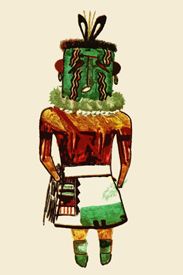
Hehea Hopi Kachina drawn by native artists, 1904.
Hehea – A Hopi clown kachina, Hehea’s mask is decorated with a zigzag marking on each cheek, a crooked mouth, and his arms and legs painted with phallic symbols. He appears in certain kiva exercises at the ceremonial grinding of the meal by the Ana kachina manas. He is also associated with the Corn Maidens and the Natackas. He sometimes appears in ceremonial public dances. Hehea is an ancient kachina, and because he appears in many primitive ceremonies, both public and secret, he is thought to be connected with very old rituals.
Hehea Mana – The sister of Hehea, this kachina accompanies the Natacka group in the Powamu ceremony. She is represented in this image with the characteristic coiffure of a maiden and has the same zigzag facial lines as her brother. She wears the same phallic symbols on her arms and carries a lariat in her hand. If anyone refuses to grant Natacka’s requests for meat or food, she and her brother try to lasso the offender.
Heluta – The father of the kachinas and the creator of deer. As the father of the kachinas, he is the first to appear at kachina dances, announcing the kachinas to the people by means of signs. He appears in many stories.
Hemis – A kachina of the Jemez tribe; the Hopi borrowed it because it appears particularly effective. This kachina wears a mask that shows fertility symbols and shakes a rattle to evoke the sound of rain. It brings abundant, high-yielding corn crops.
Ho’e – A clown Kachina who appears in the Bean Dance. Several Ho’esually chase through the crowd as the procession travels around the village, and they are the last to settle down and go into the kiva.
Hototo – The food preparer and the most respected of the war Kachinas.
Hoop Dancer – He amuses the audience at ceremonies, tossing rings representing the circle of life.
Horse – Known as Kawai-i, this kachina got its name from the Spanish word for horse, caballo. A relatively new kachina, the Hopi didn’t introduce it until the early 1900s, as they long preferred the burro as a beast of burden. He is said to represent the horse’s spirit and is identified by the black horse figure painted on each cheek of his white mask. He appears in the Soyohim Ceremony, the Mixed Kachina Dances, the Bean Dance, and the Kiva Dances.
Hornet or Wasp – Called Tatangaya, this colorful Kachina is thought to be of Zuni origin and adopted into Hopi culture. Though insects and reptiles are an important part of Puebloan traditions, their exact purpose is unknown. He appears in Pamuya or Mixed Katsina Dances, where dancers often present the dolls to young girls.
Hu – A whipper kachina, these spirits purify children, clowns, and Crow Mothers by whipping them with the yucca fronds he carries in both hands. Bulging eyes and fierce zigzag teeth serve as a terrifying reminder of the persistent role of giants in Hopi culture.
Hummingbird – Called Tocha, this kachina appears during Kiva Dances in the Winter and during the Soyohim Dances in the spring. When it enters a kiva, it usually dances by bobbing its head and making calls like the hummingbird before moving rapidly around the kiva. During a dance, when it catches an individual, it whips them with yucca leaves. This kachina often appears as a runner because it is fast.
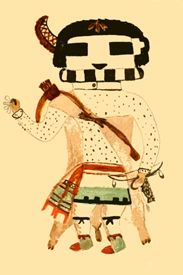
Hututu Kachina.
Hututu and/or Sai-astasana – These kachinas originated in the Zuni Pueblo and were adopted by the Hopi. Hututu got his name from the sound he makes, and the name is the same with both the Zuni and the Hopi. Hututu is a Zuni Rain Priest of the North, holding a Bow and the Shoulder Bones of a Sheep. He appears with many of the other Zuni kachinas when they dance at Hopi. The only difference an observer may note between Hututu and Sai-astasana is the horn on Sai-astasana’s head. At the same time, Hututu has a terraced ornament on one side of the head.
Kachina Maiden – Called Kachin’ Mana, she appears more often than other “female” kachinas and offers a prayer for corn. Also called Blue Corn Maiden and Yellow Corn Maiden.
Kobictaiya Kachina – Powerful spirit beings similar to kachinas. A story tells how it was determined that they would never know sexual intercourse. A war chief’s daughter dies. Her body is stolen by witches (kanadyaiya) who revive her to seduce her. The Kobictaiya come to her rescue.
Kokopelli – A hunched-back flute player, fertility god, seducer of young girls, and baby-maker, he carries a bag of presents to distribute to the women he seduces. Probably the most popular kachina of all, his image appears widely in rock art and ancient pottery throughout the Southwest, and today, this figure is a widely used motif on pottery, jewelry, and other Native American items. He appears only in the Mixed Kachina Dances, and sometimes in the Night Dance. Although his origins and the significance of his prehistoric appearances are speculative, he remains a contemporary figure in Hopi stories and as a Hopi kachina.
Koshari Clown – Known by various names, including Clown, Glutton, and Hano Clown, variants of this kachina appear in most pueblos in New Mexico and on the Hopi Mesas of Arizona. These figures can be both sacred and profane, displaying actions that, though often humorous, are also inappropriate. They are often shown with watermelons to show they are gluttonous and generally display actions of overdoing everything they set about.
Koyemsi – See Mudhead.
Left-Hand – Also called Siyangephoya, he is the only Kachina with all his gear reversed and carries his bow in his right hand instead of his left. In fact, he does almost everything, the opposite of what is expected. He appears in many dances, like the Mixed Kachina, in groups in the kivas or separately as a warrior in the Powamu ceremony. Often, he has trouble with Ho-e when they appear in the same dance. Sometimes he acts as a prompter; sometimes he dances by making strange bobbing-mincing steps at the edge of the procession. Despite his odd behavior, he is considered an excellent hunter. He is a favorite subject for carving Kachina dolls and for paintings.
Little Fire God – Called Shulawitsi, this Zuni kachina descends from the hills to begin the Shalako ceremony, followed by the Shalako kachinas, who are accompanied by Longhorns, mud heads, and many other kachinas as well as priests. During the ceremony, participants recite long prayers, then priests pray before food is served and the dancing begins.
Lizard– called Monongya, this warrior kachina helps to ensure that the Hopi clown does not get too far or get out of hand and is involved in punishing or chastising the clowns. He is also known to bring sweethearts together, similar to Cupid. He represents a particular species of lizard called the Crotophytus, chosen because it is very fast and represented by the bright color turquoise. The Lizard Kachina appears in the Mixed Dance and in the Powamu Ceremony.
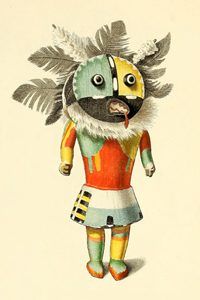
Long Billed Kachina
Long-Billed – Called Wupamo, this kachina is a guard who carries whips to keep everyone in their proper place. He is usually found during the Powamu procession circling from the sides or swinging in from the rear. He keeps onlookers clear of the procession route and controls the clown’s boundaries. He is also known as a healer, and those suffering from any sickness may request his aid by being allowed to strike the affected body part with his whip.
Long-Haired – Called Angak’china, his primary purpose is to bring rain to the people and their crops. His long hair, worn loosely down his back, resembles falling rain, with eagle breast plumes rising like clouds above it. These kachinas appear in the Niman Ceremony. He is one of the most favored Kachinas among the Hopi because of the melodious songs and beautiful dances they perform in the spring. Wide varieties of this kachina exist, including Barefoot, Bounding, Navajo, Tewa, and Lightning.
Marble Player or Gambler – Known as Qoqole, this kachina can be seen during the Soyal ceremony accompanied by his maiden spirit. He is usually seen in groups of Qoqole. He opens the Kivas so other kachinas can visit the village. They are often seen shooting marbles. One thing that separates the Qoqole from other kachina dolls is that he wears old Anglo clothing.
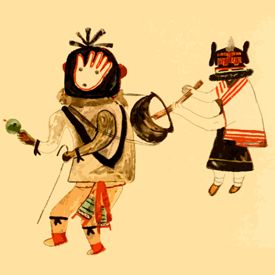
Matia Kachina.
Matia – This figure has a human hand painted on its face, which is why it is called Matia, or Hand Kachina. Another designation, Talakin, refers to the girl who follows, stirring the contents of a cooking pot that Matia carries on his back. He is said to appear in the foot races. A being with the figure of a hand on the face also occurs in Zuni dances. He is also known as the Pot Carrier, Sivu-i-quil Taka, Malachpeta, and Malatsmo.
Medicine Man – Prepares herbs and roots to prevent and cure sickness. He is also wise and gives advice.
Mocking – Known as Kwikwilyaka, this clown kachina mimics anything and everything in his sight. He entertains the crowd by reflecting the personality of anybody he sees and will not stop until he finds a more interesting victim to make fun of. He is usually seen in the Bean Dance and competes with the Ho-E Kachina for the crowd’s attention. The Mocking Kachina has hair made of cedar bark, which the Ho-E Kachinas sometimes set on fire to get rid of him.
Morning Singer – This kachina appears on village rooftops and sings to wake everyone up.
Mountain Lion – Called Toho, this kachina often accompanies such animals as the Deer or Antelope Kachinas when they appear in the Line Dances of Spring. In this event, he is a side dancer who carries a talavaiyi, a cane with eagle feathers, and red horsehair fringe in his hands. However, during the Pachavu or Tribal Initiation about every fourth year, Toho appears as a guard, often accompanied by the Deer Kachina. Armed with yucca whips, he patrols the procession with He-e-e, Warrior Woman, and other warrior or guard kachinas.
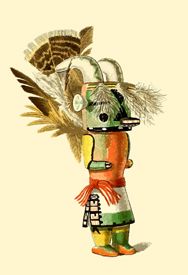
Mountain Sheep Kachina
Mountain Sheep – Called Panwa, this mountain sheep kachina is represented by a well-carved doll that illustrates many of the symbolic characters of this interesting personage. The top of the head has two curved, slightly twisted white horns, along the front of which are zigzag green lines. Upon these are fastened little clusters of downy breath feathers. Like other animal kachinas, the Panwa kachina has the power to strengthen the chance of abundant animals for hunting season.
Morning Singer – Known as Talavai, this kachina’s function has changed over the years. He used to appear in pairs, stand on rooftops, and sing at dawn to wake the villagers. However, although they still sing in pairs, they are just seen standing on the side of the main Powamu procession today. They sing only occasionally, usually while holding their spruce trees and ringing their bells. The Morning Singer wears the red-and-white maiden’s robe, typical of any kachina that appears in the early morning.
Mouse Kachina – The mouse is a hero of the Second Mesa legend. The mouse helped the village to get rid of an unwanted chicken hawk by tricking him into diving into a wooden stake.
Mudhead Kachina – Known as Koyemsi, these are the most popular Kachinas among the Hopi people because they appear in all of the ceremonies. Mudhead usually accompanies most Kachinas during ceremonies, and they come as clowns, announcers of dances, drummers, and singers. During dances, they may play games with the boys and girls in the audience. This multi-faceted clown is borrowed from the Zuni.
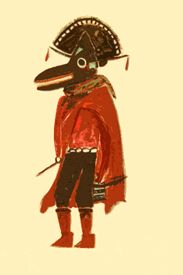
Natacka Naamu – Ogre Father Kachina
Natacka – These kachinas are the feared Ogres of the Hopi. Of these, there are several: Nanatacka Tataki – Natacka male; Nanatacka mana – Natacka maiden; Natacka wuqti – Natacka’s mother; and Natacka naamu – Their father. During the process of collecting food from Hopi homes for distribution to the kachinas in the kivas, the Natackas make horrible noises to scare the children. From the earliest ages, Hopi children have heard stories about how the Natackas would abduct children and eat them, so they are terrified of them. The parent or parents bargain with the Natackas to leave the children alone, and when the Natackas agree, the parent is the hero, and the children are saved. Pictured on the left is Natacka Naamu, the father ogre.
Navajo Grandfather – Known as Tacab Yebitcai – Grandfather Kachinas sings songs for a successful growing season. He does not speak but pantomimes whatever he wants. He starts the dance, leading both singing and dancing. His dance steps are exaggerated and lively, and may be interspersed with comic actions. In this drawing, the artist depicts a stalk of corn on a white face. Two half-rectangles surround the eyes and mouth. A conventional ear of corn is painted on the left cheek. A crest of eagle feathers also appears on the head. Yebitcai wears a blue calico shirt, black velvet pantaloons, and Navajo leggings. The pantaloons and leggings have a row of white disks along the outside, representing the well-known silver buttons, and he wears a belt of silver disks strung on a leather strap. A buckskin is represented over his right shoulder; in his left hand, he carries a bow, two arrows, and a skin pouch for a sacred meal.
Navajo Kachina – Represents the Navajo Tribe as viewed by other tribes in the Southwest.
Navajo Grandfather – Called Tasap Yeibichai, this is the grandfather of the Navajo Kachina and is one of the more enjoyable features of the Navajo Kachina Dance. He does not speak but pantomimes comically. He starts the dance, leading the singing and dancing. His dance steps are a lively exaggeration, often interspersed with comic actions such as requesting large amounts of food. His pantomime brings the audience laughter.