
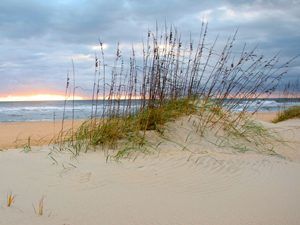
Cape Hatteras National Seashore.
The nation’s first national seashore, Cape Hatteras National Seashore, was established in 1937 to preserve significant segments of unspoiled barrier islands along North Carolina’s stretch of the Atlantic Coast. Barrier islands are narrow, low-lying landforms that parallel ocean coasts, are separated from the mainland, and constantly move and reshape in response to storms, ocean currents, sea-level changes, and wind.
A haven for recreation and relaxation, the seashore, rich in cultural and natural diversity, also draws scientists from many disciplines, including meteorologists, geologists, oceanographers, biologists, and more.
Over the years, the islands that make up the seashore have been home to Native Americans, farmers, fishermen, slaves, lighthouse keepers, and many others who continue to shape the area’s heritage. Through the centuries, these folks have witnessed hurricanes, the death of Blackbeard the pirate, Civil War battles, the construction of its now-famous lighthouses, U-boat attacks, and much more. Today, history lives on in the determination of the area’s people, culture, places, and stories.
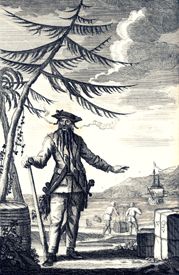
Edward Teach was better known as the infamous pirate Blackbeard.
Historians estimate that Hatteras Island was first inhabited by small Native American tribes who subsisted on game, shellfish, and seafood in about 500 AD. Located miles offshore, these natives lived peacefully for more than 1,000 years, free from the threat of invading tribes. They were also fortunate not to have to endure harsh winters or dwindling food supplies like many mainland native communities.
The island was one of the first regions “discovered” by New World explorers. In 1524, Spanish explorer Giovanni Da Verrazzano landed on the North Carolina coastline, most likely somewhere between Hatteras Island and Cape Lookout, where friendly natives met him. It would be decades before the area’s people would see Europeans again. The island first appeared on an English Map in 1585 as “Hatterask,” named for the Hatteras tribe who lived on the barrier island.
In 1587, Captain John White, the leader of one of the first new English settlements, landed on Hatteras Island before heading north and settling on Roanoke Island. The course change may have been fatal for the 116 colonists who would inevitably disappear, becoming known as the “Lost Colony.” Though their fate remains unknown, some historians believe the colonists moved south to Hatteras Island to escape hostile tribes on Roanoke Island. This theory is supported by documentation from the 1700s describing unusual “blue-eyed” natives found on the island, and by a 16th-century English ring found in Buxton in the 1990s. The Outer Banks were first settled by English colonists in the 1700s and maintained a small local population that depended on commercial fishing, hunting, the lumber trade, and subsistence farming. Many of these first settlers still have descendants living on the islands today.
It was during the 18th century that shipwrecks became prevalent along the dangerous Diamond Shoals off the coast of North Carolina due to a popular trade route for mariners. In 1794, the newly formed US Government approved the construction of a lighthouse on Hatteras Island to help mariners navigate the region. However, construction did not begin until 1799. It was finally lit in October 1803. Made of sandstone, it was 90 feet tall with a lamp powered by whale oil. Unfortunately for ships traveling in the area, the light proved unreliable. It was not visible to most offshore mariners because it was too short, the unpainted sandstone blended into the background, and the signal was not strong enough to reach them. In the end, the structure was deemed a failure.
By 1850, the island was home to about 1,000 people, with the majority living in the village of Buxton. In 1853, following studies by the Lighthouse Board, it was decided to raise the Hatteras lighthouse by 60 feet, making the tower 150 feet tall. The newly extended tower was painted red on top of white, making the lighthouse more recognizable during the day. At the same time, the tower was retrofitted with a first-order Fresnel lens that used refraction and reflection to channel light, resulting in a stronger beam.
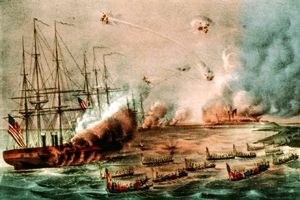
Bombardment and capture of Fort Hatteras, North Carolina.
Less than a decade later, the Outer Banks would be immersed in the Civil War. Hatteras Island began the Civil War as a Confederate island, but Union forces in the Battle of Hatteras Inlet in August 1861 quickly took it over. Six months later, in February 1862, the Confederates lost control of Roanoke Island. Under Union authority, the island became a haven for freed and runaway slaves.
When the war ended, the Hatteras Light needed extensive repairs, and Congress appropriated funds for a new lighthouse. Construction began in October 1868. Two years later, on December 1, 1870, the lighthouse, a conical brick structure rising from an octagonal brick-and-granite base, was lit. It is the tallest brick lighthouse in the United States, measuring 198.49 feet from the bottom of the foundation to the top of the tower’s pinnacle. This height was needed to extend the light beam’s range from the tower’s low-lying beach site. The Fresnel lens installed was powered by kerosene and could be seen from approximately 16 miles offshore. The following year, the old 1803 lighthouse was demolished in February 1871.
During this time, the ocean waters off of Hatteras Island were among the most traveled and dangerous for coastal mariners due to the infamous Diamond Shoals. The US government was forced to step in after dozens, if not hundreds, of shipwrecks were recorded in the region within a few decades. In the 1870s, US Lifesaving Stations, manned by some of the most decorated Lifesaving Service crew members, were established throughout the Outer Banks to perform ocean rescues and assist shipwrecks in need. That service would be re-established as the US Coast Guard in 1915. Today, Coast Guard stations on Hatteras Island include the Chicamacomico Lifesaving Station in Rodanthe, the Pea Island Station near Oregon Inlet, Kinnakeet Station in Avon, and Little Kinnakeet Station just north of Avon.
In the early 20th century, wealthy visitors began visiting Hatteras Island for fishing and hunting, establishing several hunting clubs and launching a range of tourist activities and services.
Before bridges were built in the 1930s, the only means of transport between or off the islands was by boat, keeping them isolated from much of the mainland. This helped preserve the maritime culture and the distinctive Outer Banks accent or brogue, which sounds more like an English accent than an American accent. Many “bankers” have often been mistaken for being from England or Ireland when traveling outside the Outer Banks. The brogue is most distinctive the further south one travels on the Outer Banks, with the thickest brogue on Ocracoke Island and Harkers Island.
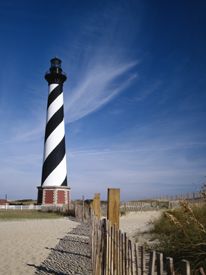
Cape Hatteras, North Carolina, Lighthouse.
The beacon of the 1870 Cape Hatteras lighthouse was electrified in 1934; a year later, the Bureau of Lighthouses decommissioned the lighthouse due to threatening beach erosion. On November 9, 1937, the Cape Hatteras Light Station was transferred to the National Park Service. While the park was not operational at the time, the lighthouse and the keepers’ quarters became part of the nation’s first National Seashore. In the meantime, the beacon was moved to a skeletal steel tower.
As technology improved, the Diamond Shoals became less of a threat, but during World War II, a new danger lurked off the shores of Hatteras Island: German U-boats. Stealthy and hard to detect, the U-boats destroyed several British ships passing through. It was not unusual for wreckage and even bodies to wash ashore on Hatteras Island regularly.
In 1953, Cape Hatteras National Seashore was officially established, with miles of land donated or sold by residents. Approximately 60% is now protected from private ownership and future development. Years later, the Herbert C. Bonner Bridge was completed, replacing the former Oregon Inlet ferry and paving the way for thousands and millions of visitors to access Hatteras Island. The completion of the bridge spurred development and tourism on Hatteras Island, and a new oceanfront community known as “Hatteras Colony” was established.
In 1999, the Cape Hatteras Light Station had to be moved due to the threat of shoreline erosion. When completed in 1870, the Cape Hatteras lighthouse was located a safe 1,500 feet from the ocean. Even then, however, storm-driven tides thoroughly washed over Hatteras Island, eroding sand from the island’s ocean side and depositing it on the sound side. By 1970, this process, which has caused the gradual westward migration of the Outer Banks for at least the past 10,000 years, left the lighthouse just 120 feet from the ocean’s edge, leaving it almost certain to be destroyed. The light station, which included seven historic structures, was successfully relocated 2,900 feet from the spot on which it had stood since 1870.
Cape Hatteras National Seashore protects parts of three barrier islands: Bodie Island, Hatteras Island, and Ocracoke Island. Beach and sound access ramps, campgrounds, nature trails, and lighthouses can be found and explored on all three islands.
More Information:
Cape Hatteras National Seashore
46375 Lighthouse Road
Cape Hatteras Light Station
Buxton, NC 27920
252-473-2111
©Kathy Alexander/Legends of America, updated December 2025.
Also See:
Great Smoky Mountain National Park
North Carolina – The Tar Heel State
Roanoke Island Settlement & the Lost Colony
Sources:
Hatteras, North Carolina
National Park Foundation
National Park Service
Wikipedia