
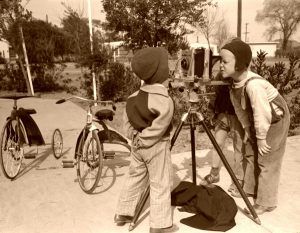
Children inspecting the photographer’s camera, Phoenix, Arizona, by Russell Lee, 1942.
The Farm Security Administration (FSA) was created in the Department of Agriculture in 1937. The FSA and its predecessor, the Resettlement Administration (RA), created in 1935, were New Deal programs designed to assist poor farmers during the Great Depression and the Dust Bowl.
On March 9, 1933, the new president, Franklin D. Roosevelt, called a special session of Congress, telling them that unemployment could only be solved “by direct recruiting by the Government itself.” For the next three months, Roosevelt proposed, and Congress passed a series of important bills that attempted to address the problem of unemployment. These programs became known as Roosevelt’s New Deal.
The Resettlement Administration (RA) was created in 1935 to relocate struggling urban and rural families to federally planned communities.
However, this objective was unpopular with the majority in Congress, as it appeared to some to be socialist and threatened to deprive influential farm owners of their tenant workforce. Its focus changed to building relief camps in California for migratory workers, especially refugees from the drought-struck Dust Bowl of middle America and the Southwest. Though this objective was highly resisted by a large share of Californians, who did not want destitute migrants to settle in their midst, 95 camps were built that gave migrants clean quarters with running water and other amenities. Though the program assisted some 75,000 people, they were a small share of those in need and were allowed to stay only temporarily.
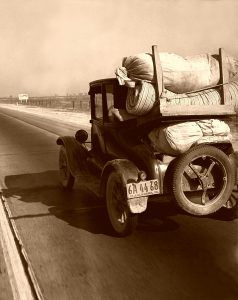
Drought refugees arriving in California.
After facing enormous criticism for poor management, the Resettlement Administration was transferred to the Department of Agriculture in September 1937 as part of the Farm Security Administration. This department, established in 1935, had a set of responsibilities that included support for small farmers and the refurbishment of land and communities ruined by the Depression. Focused on improving the lifestyles of sharecroppers, tenants, and poor landowning farmers, and on purchasing sub-marginal land and resettling them on government-owned group farms, this program also had its critics. One of the largest, the Farm Bureau, strongly opposed the FSA as an experiment in collectivizing agriculture.
Ultimately, the program failed because the farmers wanted ownership, and when the United States entered World War II in 1941, millions of jobs were available in the cities. By 1943, Congress significantly reduced FSA’s activities and transferred its remaining responsibilities to the Office of War Information. The following year
During the FSA’s existence, a small but highly influential photography program portrayed the challenges of rural poverty. The program was managed by Roy Stryker, who initially headed the photograph division of the Resettlement Administration. When that program moved to the FSA, Stryker went with it. Under him, the Information Division of the FSA adopted a goal of “introducing America to Americans” by focusing on photography and written narratives.
At first, the photo division focused on the lives of sharecroppers in the South and migratory agricultural workers in the Midwestern and western states. However, the project’s scope expanded over time, and the photographers turned to recording rural and urban conditions throughout the United States, as well as mobilization efforts for World War II.
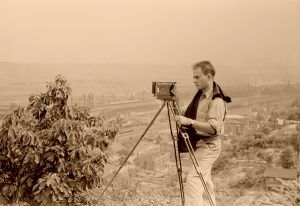
Arthur Rothstein, FSA photographer, 1938.
To carry out these tasks, Roy Stryker employed a small group of photographers, including Jack Delano, Walker Evans, Dorothea Lange, Russell Lee, Gordon Parks, Marion Post-Wolcott, Arthur Rothstein, Ben Shahn, John Vachon, and other well-known Depression-era photographers.
The Farm Security Administration (FSA) and Office of War Information (OWI) photographs were transferred to the Library of Congress beginning in 1944.
These photographs form an extensive pictorial record of American life between 1935 and 1944. The RA-FSA took more than 250,000 images of rural poverty. About half of these images survive.
©Kathy Alexander/Legends of America, updated April 2026.
Also See:
Dust Bowl Days or the “Dirty Thirties”
Galleries of FSA Photographers
President Roosevelt’s New Deal
See Sources.