
Vigilantes.
Articles:
Lynchings & Hangings of America
Vigilante Groups:
Atchison County Protective Association
Committee of 101 in Skagway, Alaska
The Fierce Missouri Bald Knobbers
Shelby County, Texas Regulators
Vigilantes and Bad Men of Arizona
Vigilantes of California, Idaho, & Montana
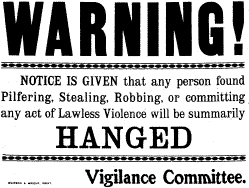
Vigilante Notice
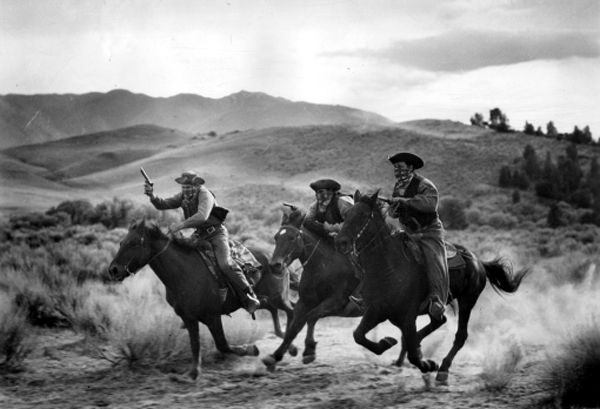
In the Wild West, where the law was often nonexistent, vigilantes often took “enforcement of the law” and moral codes into their own hands. The term vigilante stems from its Spanish equivalent, meaning private security agents.
Vigilantes were most common in mining communities but were also known to exist in cow towns and farming settlements. These groups often formed before any law and order existed in a new settlement. Justice included whipping and banishment from the town, but offenders were often lynched. Sometimes, however, vigilante groups formed where “authority” did exist but where the “law” was deemed weak, intimidated by criminal elements, corrupt, or insufficient.
The vigilantes were often seen as heroes and were supported by law-abiding citizens, who viewed them as a necessary step to fill a much-needed gap.
Though this was usually the case, sometimes the vigilance committee began to wield too much power and became corrupt. At other times, vigilantes were nothing more than ruthless mobs, attempting to take control away from authorities or masking themselves as “do-gooders” when their intentions were little more than ruthless, or they had criminal intent on their minds.
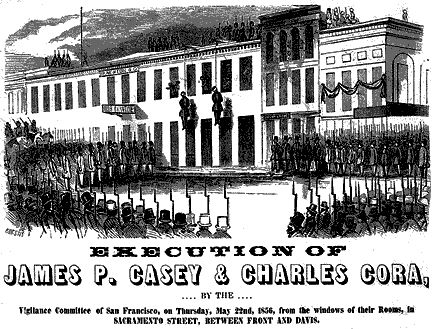
The San Francisco vigilantes hanged James Casey and Charles Cora.
One of the first vigilante groups formed was the San Francisco Vigilantes of 1851. After several criminals were hanged, the committee was disbanded. However, when the city administration became corrupt, a vigilante group formed again in 1856.
Hundreds of these groups were formed in the American West, such as the Montana Vigilantes, who hanged Bannack Sheriff Henry Plummer in 1864. Controlling the press, the sheriff was made out to be the leader of an outlaw gang called the Innocents.
However, history now questions if it wasn’t the vigilante group that was behind the chaos in Montana and that Henry Plummer was, in fact, an innocent man.
Following the Civil War, the Reno Gang began to terrorize the Midwest, forming the Southern Indiana Vigilance Committee. The next time the Reno Gang attempted to rob a train, a vigilante group lynched its leaders – Frank, William, and Simeon Reno.
Tales like these abounded throughout the Old West as numerous vigilantes attempted to tame the lawless frontier.
©Kathy Alexander/Legends of America, updated September 2025.
Also See:
Adventures in the American West
See Sources.