
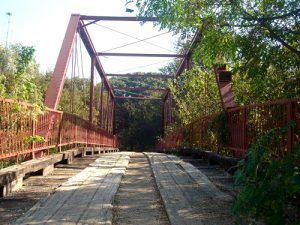
Alton Bridge, courtesy of Texas Escapes.
About 3.5 miles from the present-day town of Corinth in Denton County, Texas, once stood the small village of Alton, which served as the county seat for a decade. When Denton County was formed in 1846, the first pioneers chose a place along Pecan Creek for the county seat and named it Pinckneyville in honor of Texas’ first governor, James Pinckney Henderson.
But Pinckneyville held the title for only two years and never developed into a town. Finally, water shortages forced the county seat to move to a new site in June 1848. Located less than a mile from present-day Corinth, the new townsite was called Alton on a high ridge between Pecan Creek and Hickory Creek.
Though Commissioners were appointed and directed to lay out a town and sell lots, no records were ever kept, and no public buildings were erected. The only residence that existed was that of a man named W.C. Baines, who established a farmstead long before the designation of the new county seat.
Most of the time, the county held business at the Baines residence under the shade trees in his yard. However, the second county seat location also proved unfavorable because of a lack of potable water, and the state Legislature soon directed that the site be moved again.
The third county seat location was designated in November 1850, about five miles Southwest of present-day Corinth on Hickory Creek. The new site retained Alton’s name and applied for a post office. This location did grow, and before long, it boasted a hotel and two stores.
By 1856, the small town boasted several homes, a blacksmith shop, three stores, a school, a saloon, a hotel, two doctors, and several lawyers. The Hickory Creek Baptist Church, which still stands, was organized in 1855.
Though the fledgling town had begun to grow, the county seat’s location was still unsatisfactory for most Denton County residents. They soon petitioned for yet another county seat—one more centrally located and, again, with better water. In November 1856, voters moved the county seat again to Denton. Townsite lots began to be auctioned in January 1857.
Meanwhile, Alton began to die as many of its businesses moved to the new county seat. Finally, in May 1859, its post office doors closed forever.
Today, little remains of the old townsite except for the Hickory Creek Baptist Church and the old Alton Cemetery, which contains graves dating back to 1852. The church is located at 5724 Teasley Lane ( F.M. Road 2181), Denton, Texas, and the cemetery is next to it.
Years later, in 1884, long after Alton had died, an iron through-truss bridge was built over Hickory Creek on Copper Canyon Road, South of the old townsite. Built by the King Bridge Company of Cleveland, Ohio, the 145-foot-long bridge would serve area travelers for over a century. The Old Alton Bridge, sometimes called the Argyle Bridge, is better known among locals as “Goatman’s Bridge”; it was first built to carry horses but later carried vehicles across the creek.

Alton Bridge Sign.
It remained in use until about 2001, when it was replaced with a concrete-and-steel bridge and a new road that straightened a sharp curve. Before the new bridge was built, motorists had to honk their horns on the one-lane bridge to let other travelers know they were coming.
The bridge was listed on the National Register of Historic Places in July 1988 and closed to vehicle traffic in 2001. Today, it is open only to pedestrians.
The Old Alton Bridge is not only a picturesque historic site, but it is also said to be haunted by the “Goatman,” hence its nickname.
Half a century after the bridge was built, an African-American man named Oscar Washburn settled with his family near the bridge. He earned his living raising goats and soon became known as the “Goatman” by locals. An honest businessman, he made a success of his goat-raising business. But unfortunately, some did not welcome a successful black man in their midst.
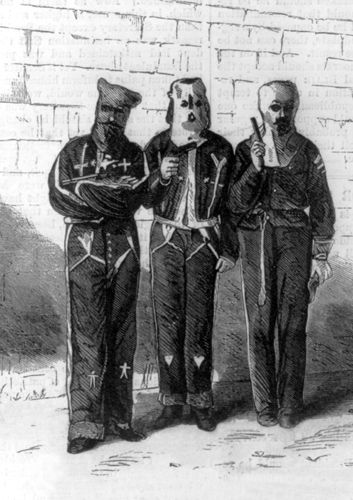
KKK, Illustrated in Harper’s Weekly, 1872.
When Washburn posted a sign on the bridge advertising “this way to the Goatman,” it angered local Klansmen. On a night in August 1938, these hateful men crossed the bridge without their headlights, then burst into Washburn’s home and dragged him from his family to the bridge.
The Klansman then fitted a noose over his head and pushed him over the side of the bridge. However, when they looked over to make sure he was dead, they could see only the rope. Washburn was gone and was never seen again. The hateful Klansman then went back to his home and killed the rest of his family.
Since that fateful day, several strange things have reportedly occurred on and around the bridge. Many believe that the Goatman haunts the overpass and the nearby woods. The tale continues that when travelers crossed the bridge at night with their headlights off, they would meet the Goatman on the other side. These tales are obviously old, as the bridge has been closed to vehicle traffic since 2001.
Several other reports mention numerous abandoned cars found near the bridge, with their occupants missing.
Others report seeing a ghostly man herding goats over the bridge, while others say they have seen an apparition staring at them, holding a goat head under each arm. Stranger stories even include people who say they’ve seen a creature resembling a half-goat, half-man.
More tales describe strange noises, including horses’ hoofbeats on the bridge, splashing in the creek below, maniacal laughter, and inhuman-like growling from the surrounding woods.
Visitors sometimes tell of mysterious lights in the area, car doors locking and unlocking of their own accord, and numerous vehicle breakdowns near the old viaduct.
According to legend, if you visit on Halloween and honk your car horn twice, visitors can see Goatman’s glowing eyes.
And the Goatman is not alone. Other reports tell of a woman’s spirit who wanders the area, allegedly searching for her lost baby. Maybe that spirit is that of La Llorona, who is well known for haunting the rivers of the Southwest.
The bridge is located about seven miles South of Denton. Take I-35E S/US-77 S to exit 463 and merge into the I-35 Frontage Rd. Turn right onto Lillian Miller Pkwy and go 0.8 miles, where the road becomes Farm to Market Rd 2181/Teasley Ln; continue 3.2 miles, then turn right onto Old Alton Rd.
©Kathy Alexander/Legends of America, updated September 2026.
Also See:
Legends, Ghosts, Myths & Mysteries
See Sources.