Moriarty
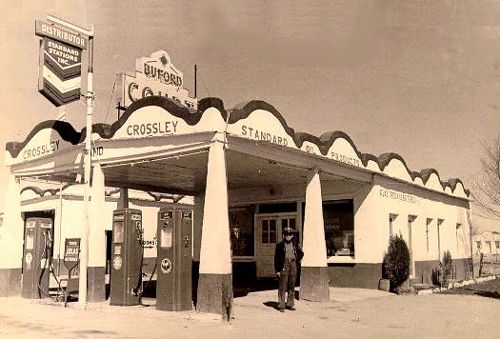
The Crossley Standard Oil Gas Station in Moriarty still stands, last known to be used as a shoe store.
When traveling Route 66 from Cline’s Corners, New Mexico, your next stop will be Moriarty, home of the Fighting Pintos. Established in 1887, Moriarty was named for Michael Moriarty, one of its original homesteaders. In its early days, most of its residents were dryland farmers. Still dependent upon area farming, today’s more sophisticated farmers utilize large pivot irrigation rigs to raise alfalfa and feed corn, wheat, pinto beans, pumpkins, and other crops.
The Santa Fe Central depot was completed in 1903, and traces of the old railroad bed can still be seen today. The metal-sided depot, one of four such structures on the mainline from Santa Fe to Torrance, still stands.
Later known as the New Mexico Central Railroad, the line was absorbed by the Santa Fe Railroad in 1926. In 1949, a small frame building and a wooden boxcar replaced the depot. The original depot passed through several hands over the years, serving as a feed store, a workshop, and a Catholic Church.
Moriarty became part of Route 66 in 1938 when the highway was realigned. Like many others along Route 66, the small town rose to the occasion with several motor courts, restaurants, and other services. Many of them still stand and operate today.
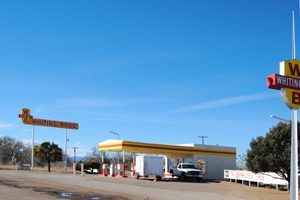
Whiting Brothers Station, Moriarty, New Mexico.
As you first enter the town, you will see the Sunset Motel and the last operating Whiting Brothers Service Station on the right side of the road. Across the highway is the Sands Motel.
In the Southwest, Whiting Brothers gas stations were a familiar sight along Route 66, a tradition that continued until the 1990s when the gas station chain ended. The old Whiting Brothers station in Moriarty is the only one that is left, thanks to Sal Lucero, a lifelong employee of Whiting Brothers. In the 1980s, Lucero bought the station from the Whiting Brothers and never bothered to change the name. Today it continues to stand as a tribute to the heyday of Route 66.
A bit further down, you’ll see the Boot Shoe Shop, once home to the old Crossley Service Station. Across the street stand the old Yucca and Cactus Motels, which are long closed, and the Lariat and Ponderosa Motels, which continue to operate to this day. While in Moriarty, be sure to check out the El Comedor Restaurant’s restored “rotosphere.” Consisting of two vertically counter-rotating spiked hemispheres, the entire unit rotates horizontally above a pole. Each of the 8-foot-long rainbow-colored spikes is individually outlined in neon. The rotosphere is believed to be the only operational one of its kind along Route 66, thanks to the Route 66 Neon Restoration Project. Managed by the New Mexico Route 66 Association in partnership with the New Mexico Historic Preservation Division and the National Park Service Route 66 Corridor Preservation Office, the project has restored the rotosphere and ten other vintage Route 66 signs across New Mexico. The El Comedor is located at 1005 Route 66.
While in Moriarty, you can also stop at the Moriarty Historical Society Museum, housed in the town’s first fire station. The museum focuses on the town’s growth and development during its early railroad days. Located at 777 Old U.S. Route 66, and admission is free.
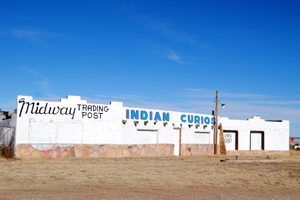
Midway Trading Post between Moriarty and Edgewood, New Mexico.
As you leave Moriarty, Route 66 becomes Highway 333 and shares the road with the Salt Missions Trail Scenic Byway to Tijeras. Along this stretch, some original architecture remains, and the spirit of Route 66 lives on in the many modern, family-operated businesses along the old route. Leaving the flatlands, the byway begins to rise in elevation as you near Edgewood, on the very edge of the mountains, as its name implies. As you leave Moriarty, Route 66 becomes Highway 333 and shares the road with the Salt Missions Trail Scenic Byway to Tijeras. Along this stretch, some original architecture remains, and the spirit of Route 66 lives on in the many modern family-operated businesses along the old route. Leaving the flatlands, the byway begins to rise in elevation as you near Edgewood, on the very edge of the mountains, as its name implies.
Edgewood
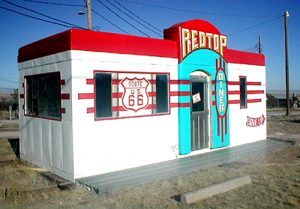
The Red Top Valentine diner in Edgewood, New Mexico, photo courtesy of Jerry Ueckert.
Homesteaders moving into the American West created the initial settlements that grew into what is now Edgewood. Founded in the early 1930s, Edgewood is a “young” town by New Mexico standards. Established just in time to meet the needs of the changed 1937 Route 66 alignment, Edgewood exudes the very essence of the Mother Road. All manner of motor courts and other services soon popped up.
Today, due to its proximity to Albuquerque, it is one of the fastest-growing communities in the state. Though its population is about 3,700 people, the area abounds with horse properties, and it’s not unusual to see modern-day cowboys riding their steeds along the roadways.
The original two-room schoolhouse still stands. Travelers might want to visit Wildlife West Nature Park, located at exit 187. Here, you can view numerous native New Mexican animals, including whitetail deer, bobcats, cougars, coyotes, javelinas, raptors, mountain lions, and wolves. Trails through the 122-acre park are constructed through natural habitats.
Edgewood also has an old Valentine Diner that once stood in Magdalena, New Mexico, before Jerry Ueckert purchased it and moved it to Edgewood. The diner had extensive damage and has now been fully restored. It is located on Route 66.
Barton
Just about three more miles will bring you to Barton, New Mexico, which is officially a ghost town but is now little more than a scattering of buildings considered part of Edgewood. Named for an early resident, Barton received a post office in 1908, but by 1936, it had closed, and area residents received their mail from Edgewood. In 1946, Jack Rittenhouse described the town as having a gas station, a grocery store, and a few cabins. At the corner of old Route 66 and Mountain Valley Road once stood an old Conoco gas station. Though it is gone today, the site still holds a couple of old gas pumps, a few rusting cars, and the original Barton jail, which once held outlaws such as the Dawson Gang. From Barton, the highway continues to climb toward Tijeras.
Sedillo
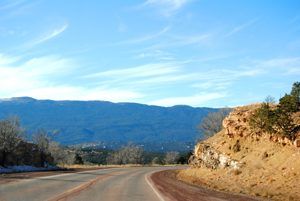
Sedillo Hill, New Mexico.
Route 66 climbs to some 7,000 feet in elevation up Sedillo Hill to Sedillo, New Mexico. The town was named for Pedro de Cedillo, originally from Querétaro, Mexico. Arriving in the area before the Pueblo Revolt of 1680, he served as a captain until he and his family were forced out. His descendants returned to New Mexico after the reconquest of 1692. In 1819, one of his descendants, Esteban Sedillo, was given land in Tijeras Canyon East of present-day Tijeras. Soon afterward, the Sedillos moved East to the town now named for them. Beyond Sedillo, the route drops into the valley through Tijeras Canyon.
Tijeras
About 900 years ago, Native American people lived in Tijeras Canyon villages, which were still occupied when the Spanish arrived. Right in the center of the canyon once stood the Tijeras Pueblo. Established around 1300 A.D., the adobe structure housed about 400 people, believed to have been part of a broader migration of inhabitants from the Four Corners region. The structure, encompassing some 200 rooms, was arranged in a large U-shape. By the mid-14th Century, the people had left, and the pueblo was falling into ruin. Around 1390, another group of Native Americans inhabited the site and rebuilt the pueblo on a smaller scale. They, too, didn’t stay long; by 1425, it was permanently abandoned, most likely because of drought in the Rio Grande Valley. Today, all that remains of the old pueblo is a grass-covered mound located directly behind the Sandia Ranger Station. You can take a self-guided tour any time during daylight hours (stop at the Ranger Station for directions).
“Tijeras,” meaning “scissors” in Spanish, comes from the fact that the pueblo sat at the crossroads of two major trade routes: one extending from Mexico City to Santa Fe and the other from the Great Plains to the Pacific Ocean.
After the Pueblo dwellers, Apache Indians used the Canyon as a passage and campground when they rode West to raid communities along the Rio Grande. Later, the Comanche also utilized the canyon as a staging area to discourage settlers in the area.
However, in 1763, the Spanish government offered land-ownership incentives to those willing to homestead the area. Hispanic settlers, primarily from Albuquerque, came to the canyon. Still, in 1770, an Apache attack drove the settlers back to Albuquerque, though they often traveled to the canyon for timber and hunting. In the early 1800s, attempts to settle the area were more successful despite sporadic Indian raids that continued into the mid-1860s.
Before the Civil War, the Canyon transported information and military supplies between Albuquerque and Fort Stanton. Both Confederate and Union armies occupied it during the war, but no battles took place in the canyon.
In 1868, more than 6,000 Navajo traveled from Fort Sumner, where they had lived in detention for more than four years, North to Sedillo and then West through the Canyon.
In about 1880, a village called Tijeras was established at the crossing of the Manzano and Sandia mountains. It was initially home to 15 families who primarily worked in farming and ranching. There were also some small mining activities in the canyon.
Once the area was successfully settled, residents needed a church, which began in a resident’s home in 1870 and was later sold to Mrs. Jessie.
Keleher donated the building for use as the Immaculate Conception Church in 1912 with the stipulation that it be maintained as a church. In 1930, the Keleher family received the church building and property back. About five years later, it became a church once again and was renamed Santo Niño (Holy Child). Eventually, the church on the National Register of Historic Places was given to the Village of Tijeras. It sits on the west side of Route 66, just south of the Tijeras Library, and serves as a community events center.
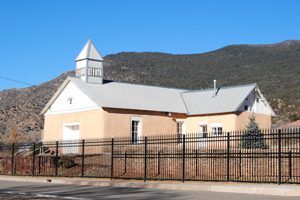
Tijeras, New Mexico Church.
When Route 66 was first established in 1926, it didn’t initially pass through the canyon. However, when the Mother Road was shortened and realigned through the area, it followed US 470, which linked Albuquerque with Moriarty. However, the road soon became too crowded and unsafe, especially along a dangerous, blind turn known as “Dead Man’s Curve.” In the early 1950s, the road began to be rebuilt as a four-lane highway and became the most significant road project ever undertaken in the State of New Mexico. During the drilling, dynamiting, and dirt-moving, a caravan of about 15 cars full of hired union men showed up to slow down the work. Commonly known as hired “goons,” they protested, “Our men are on strike!” However, the road builders and contractors of New Mexico were not part of the union. Day after day, the goons tried unsuccessfully to delay the work and intimidate the employees for almost two months. Finally, the goons disbanded, and the union never succeeded in “organizing” the road crews and contractors in New Mexico. In 1951, it was finally completed. In 1965, I-40 was built through the area, bypassing Tijeras Canyon.
The village of Tijeras, situated within the boundaries of the Cibola National Forest, is the southern gateway to the Turquoise Trail Scenic Byway, which travels to Santa Fe. Along the trail are unique towns, museums, and recreational opportunities where prehistoric peoples once lived. Tijeras is home to one of the Cibola National Forest’s Visitors’ Centers and the Talking Talons Leadership Center & Living Conservation Museum. Today, Tijeras is home to nearly 600 residents and growing.
West of the village, Route 66 emerges from the canyon, offering a beautiful view of the Rio Grande Valley and Albuquerque. Along this stretch, keep an eye out for old trading posts and wayside gas stations, and enjoy the majestic views of the Rio Grande Valley and the Sandia Mountains.
©Kathy Alexander/Legends of America, updated September 2026.
Also See:
New Mexico Route 66 Photo Gallery
Sources:
Bernalillo County, New Mexico
New Mexico Historical Society
The Route-66
Wikipedia