
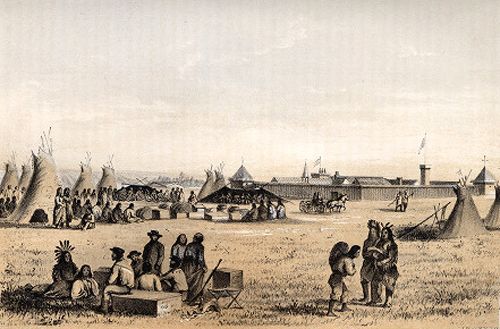
Fort Union, North Dakota.
The Fort Union Trading Post in North Dakota was established in 1828 by John Jacob Astor’s American Fur Company. This was not a government or military post, but a business established to trade with the northern plains tribes.
Located at the confluence of the Yellowstone and Missouri Rivers on the North Dakota/Montana border, the fort was initially called Fort Henry. For the next four decades, Fort Union would serve as the headquarters of the Upper Missouri Outfit of the American Fur Company.
The most critical fur trading post on the upper Missouri River, Fort Union, controlled the bison robe and fur trade over a vast area encompassing North Dakota, South Dakota, Montana, and Wyoming from 1828 to 1867.
Here, Assiniboine, Crow, Cree, Ojibway, Blackfeet, Hidatsa, Mandan, and other tribes traded buffalo robes and other furs for trade goods such as beads, guns, blankets, knives, cookware, and cloth.
During its heyday, the trading post employed as many as 200 people, mostly Métis Indians of French and Native American ancestry.
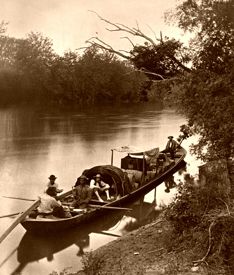
Keelboat, by Jedediah Hotchkiss, 1872
The rivers were the primary means of travel for the fur traders, who used keelboats until 1832, when the first steamboat, the Yellowstone, arrived here. Mackinaw boats were another form of transportation made by the fort’s workers, and bull boats, constructed by the tribes from green buffalo hide and willow, were also used.
In 1867, Fort Union was sold to the U.S. Army, and the post was razed. Its building materials were used to construct Fort Buford, about two miles away. The site of history’s longest-running American Fur Company trading post lay abandoned and neglected for a century.
However, in 1966, local interest in the historical site led Congress to establish the Fort Union Trading Post National Historic Site as a part of the National Park System. After three archaeological projects, the trading post was partially reconstructed from 1986 to 1989, with structures appearing as they did in 1850-1851.
Today, the reconstructed Fort Union represents a unique era in American history, a brief period when two civilizations found common ground and mutual benefit through commercial exchange and cultural acceptance.
A trip to Fort Union takes visitors back to the mid-19th century, the heyday of Fort Union, and the fur trade on the Upper Missouri River.
Fort Union is located just off ND Highway 1804, 25 miles southwest of Williston or 24 miles northeast of Sidney, Montana.
Contact Information:
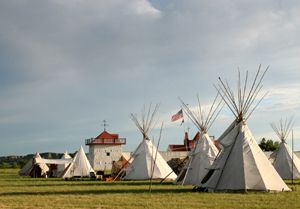
Fort Union Rendezvous Camp.
Fort Union Trading Post
15550 Hwy 1804
Williston, North Dakota 58801
701-572-9083
©Kathy Alexander/Legends of America, updated December 2025.
Also See:
See Sources.