
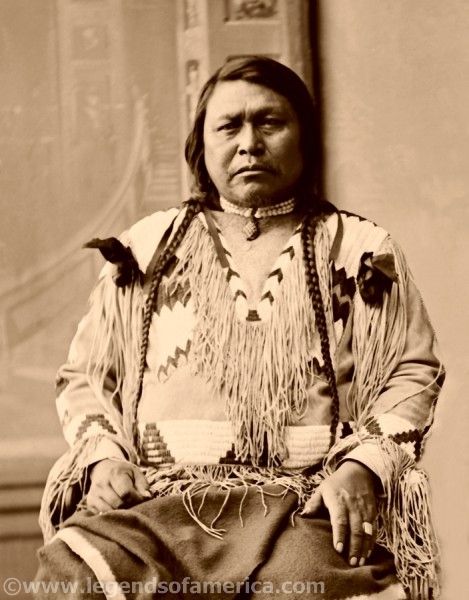
Ute Chief Ouray
“We do not want to sell a foot of our land. That is our people’s opinion. The whites can go and take the land and come out again. We do not want them to build houses here.”
— Ouray
Chief Ouray, born near Taos, New Mexico, around 1833, led the Tabeguache (Uncompahgre) band of the Ute tribe in western Colorado in the 19th Century.
According to oral history passed down by Ute elders, he was born on a gloriously clear night when a magnificent meteor shower streaked across the black Winter sky. The elders believed it was a sign, a message from above of good things to happen.
Ouray’s mother was a member of the Uncompahgre band of Ute, and his father, Guera Murah, was half Jicarilla Apache. Ouray grew up in the Taos area, where Spanish and English were the predominant languages, and he did not learn Ute or Apache until later in life. He spent most of his youth working for Mexican sheepherders and fighting against rival Sioux and Kiowa.
When he was about 18, Ouray traveled to Colorado and joined the Tabeguache Ute band, where his father, despite his Apache heritage, had become the leader. In 1859, he married a Tabeguache Ute maiden named Chipeta, who was actually a Kiowa Apache adopted by the Utes as a child.
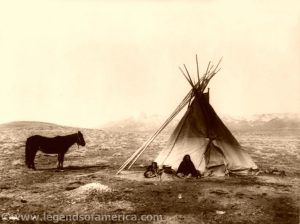
Ute Tipi.
When his father died in 1860, Ouray became chief of the Ute Indians, including the Uncompahgre band. As chief, Ouray was considered one of the Utes’ greatest leaders, with strong traits of patience and diplomacy. He was often called “The White Man’s Friend” as he sought to work with the white settlers and the government.
In October 1863, Ouray negotiated a treaty that assigned the Tabeguache Ute a reservation. Unfortunately, most of the Ute’s lands East of the Continental United States ended up in government hands. In 1868, he traveled to Washington, D.C., to represent his people and was appointed “head chief of the Ute” by the government. A new treaty created reservation lands in Colorado for the Tabeguache, Moache, Capote, Wiminuche, Yampa, Grand River, and Uinta, but again, they relinquished more land.
Though Ouray always tried to secure the best possible conditions for his people while remaining friendly to the whites, each subsequent treaty brought increasing land losses for the Ute. For many Ute, resentment grew, and several attempts were made on Ouray’s life. However, he survived and maintained his conciliatory attitude.
With the discovery of gold in Colorado, conditions for the Ute changed dramatically as miners flocked to their lands. As a result, relations between the Indians and the whites deteriorated. In spring 1878, Nathan Meeker became Indian Agent at the White River Agency. “Dictatorial” in his management style, Meeker undiplomatically tried to force the Ute to farm, raise stock, discontinue their pony racing and hunting forays, and send their children to school. Meeker, determined to convert the Ute from primitive savages to hard-working, God-fearing farmers, kept pushing his reforms, even when warned that he was making the Ute furious. But Meeker ignored the warnings and ordered a horse-racing track plowed under to convert it to farmland. He also suggested to one that there were too many horses and that they would have to kill some of them. The Ute, whose land Meeker was plowing under, resisted, and a fistfight occurred.
As a result, Meeker wired for military assistance, claiming that he had been assaulted by the Ute man, driven from his home, and severely injured. The government responded by sending 200 troops led by Major T.T. Thornburgh.
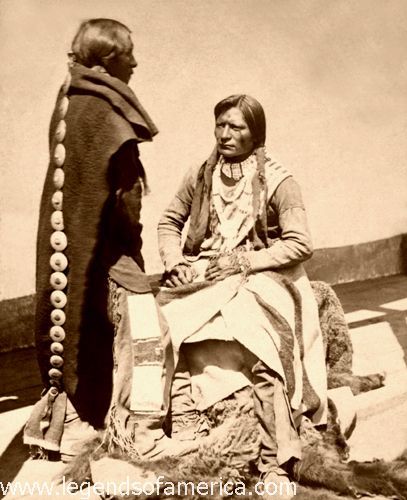
Ute Braves, 1874.
However, perceiving this action as an “act of war,” the Utes revolted. On September 29, 1879, before the troops arrived, the Indians attacked the agency, burned the buildings, and killed Meeker and nine of his employees. The incident is known as the Meeker Massacre. Meeker’s wife, daughter, and another girl were held as captives for 23 days. After the massacre, relief columns from Forts Fred Steele and D.A. Russell, Wyoming, defeated the Utes in the Battle of Milk Creek, Colorado, and ended the uprising.
Though Ouray had ordered the Ute band involved in the attacks to stop, his orders were ignored. Afterward, he did his best to keep the peace, but it was too late. Area settlers demanded the Utes’ removal. One headline in the October 30, 1879 issue of Harper’s Weekly screamed, “The Utes Must Go.”
Ouray found himself explaining to his people why they must leave their land. On March 6, 1880, the Southern Ute and the Uncompahgre acknowledged an agreement to settle on the La Plata River and the Grand near the mouth of the Gunnison, respectively, while the White River Ute agreed to move to the Uinta reservation in Utah.
In the summer of 1880, Ouray and his wife, Chipeta, journeyed to the Southern Ute agency at Ignacio to negotiate again with the white man. Though Ouray completed the journey, he arrived sick. He died of Bright disease on August 24, 1880.
He was buried secretly at Ignacio. Chief Ouray’s obituary in The Denver Tribune read:
“In the death of Ouray, one of the historical characters passes away. He has been regarded for many years as the greatest Indian of his time, and during his life has been quite prominent. Ouray is, in many respects, a remarkable Indian with pure instincts and keen perception. A friend to the white man and protector to the Indians alike.”
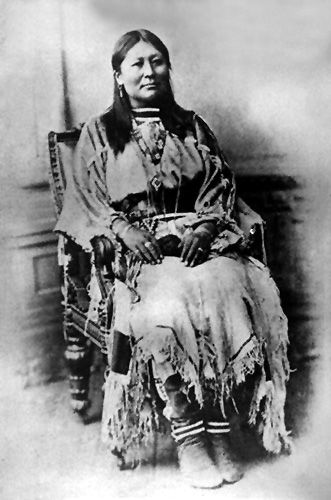
Ouray’s wife, Chipeta.
Forty-five years later, Ouray was re-interred in the cemetery Southeast of the White River Agency, and the grave was appropriately marked.
His wife, Chipeta, continued to work for the Ute. When the Uncompahgre did not find sufficient agricultural land in southern Colorado, a new reservation was established in 1882. Chipeta then relocated to the reservation in northeast Utah, where she was highly valued and always sat in on the chief’s meetings. She passed away in 1924.
The city of Ouray, Colorado, was named for him.
©Kathy Alexander/Legends of America, updated September 2026.
Also See:
Native American Heroes & Leaders
Native American Photo Galleries
Native Americans – The First Owners of America
Ouray, Colorado – Switzerland of America
The Ute Tribe – Roaming the Rockies
See Sources.