
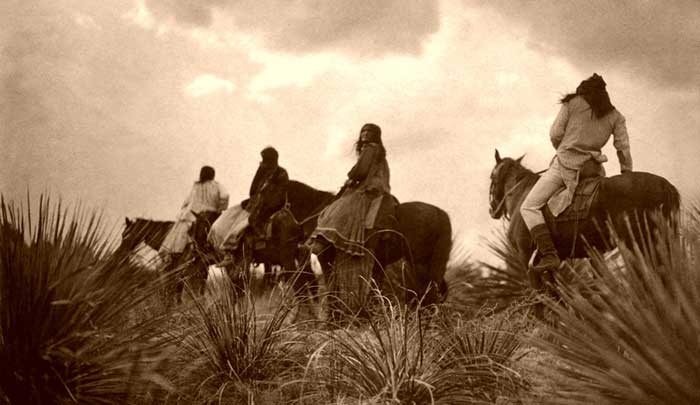
Apache Before the Storm, Edwards S. Curtis, 1906.
One of the most famous Apache leaders to resist westward expansion by white settlers was Cochise of the Chiricahua Apache. Cochise was known to his people as A-da-tli-chi, meaning hardwood, and lived in the area now known as northern Sonora, as well as New Mexico and Arizona. These lands had long been home to the Apache until the Europeans arrived.
However, when early Spaniards began to encroach on Apache lands, tensions grew between the two cultures. Later, when the Mexicans took over the lands, the Mexican government at first issued food rations to the Apache to placate them.
Unfortunately, the Apache became increasingly dependent upon these supplies, which abruptly ceased in 1831. The Chiricahua bands then began to raid to acquire food, and the Mexican government retaliated with a series of military operations to attempt to capture or neutralize the Chiricahua.
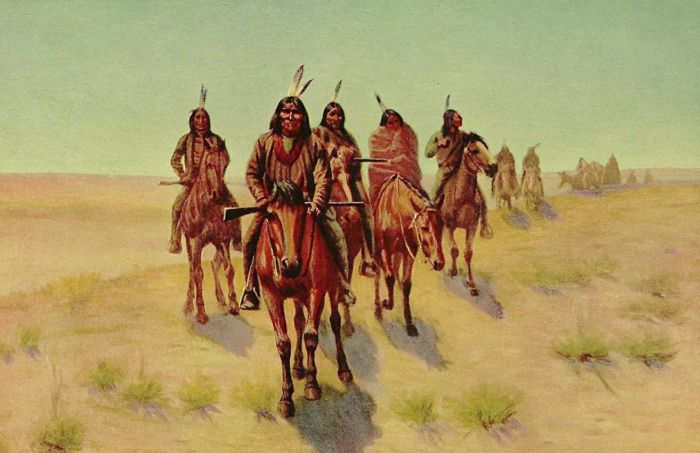
Apache Warriors.
However, they met stiff resistance from Cochise and the other Apache. The Mexican troops then began to kill Apache civilians, including Cochise’s father, which hardened his resolve against the Mexicans. In 1848, Cochise was captured by the Mexican troops but was exchanged for nearly a dozen Mexican hostages.
Cochise, who was described as a large man (for the time) with a muscular frame, classical Roman features, and long black hair, married Dos-Teh-Seh, the daughter of Mangas Coloradas, in the 1830s. The pair had two children: Taza, born in 1842, and Naiche, born in 1856.
In 1850, the United States annexed New Mexico and Arizona, ushering in a brief period of relative peace. For more than a decade, Cochise worked with the new settlers and even helped them learn to live on dry, arid land.
In 1856, Cochise became the principal war leader of the Chokonen band after the death of its chief, Miguel Narbona, and the peace between the Apache and the United States continued.
When the Apache Pass Stage Station was built in 1858, he even worked for a time as a woodcutter for the Butterfield Overland Stage line and also helped protect the stagecoaches from attack.
However, the tenuous peace would not last as more and more white settlers began to encroach upon Apache lands, and it formally ended in 1861, when an Apache raiding party drove away a local rancher’s cattle and kidnapped his eleven-year-old stepson. The rancher, John Ward, believed Cochise was responsible for the raid and demanded that the military confront the Apache leader to recover the boy and livestock.
Before long, on February 3, 1861, 2nd Lieutenant George Bascom, a young graduate of West Point, brought a detachment of 54 men to Apache Pass to confront Cochise regarding the kidnapping of the boy and livestock. When Bascom asked for the return of the captive and the stolen cattle, Cochise said the Coyotero Apache had committed the crime and volunteered to negotiate for the return of the boy. Evidently unbelieving, Bascom then had Cochise, his brother, two nephews, a woman, and two children arrested until the boy and the livestock were returned.
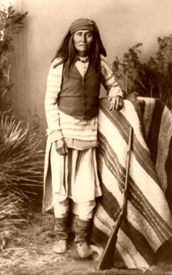
Mangas Coloradas, 1884.
However, Cochise was able to escape and, to ensure the safety of those he had left behind, captured three Americans before sending Bascom this message: “Treat my people well, and I will do the same for yours, of whom I have three.” The inexperienced Bascom decided instead to flex his muscle, hanged the Apache hostages, and began to make preparations for war against Cochise. In retaliation for their deaths, Cochise killed the three Americans he had taken hostage and joined forces with Mangas Coloradas, his father-in-law, and the leader of another Chiricahua band. The two leaders, along with their warriors, then launched a series of retaliatory skirmishes and raids on white settlements.
On July 15 and 16, 1862, General James H. Carleton, leading a Federal army eastward to head off the Confederate invasion of New Mexico, encountered Cochise and Mangas Coloradas at Apache Pass fighting for control of the nearby Apache Springs.
The two leaders, along with 500 warriors, held their ground against the force of California volunteers until the U.S. Army employed a howitzer against the Indian forces. Though it was the first time they had faced artillery fire, they fought stubbornly for several hours before fleeing.
General James Carlton subsequently took over as commander of the territory. In January 1863, General Joseph Rodman West, under orders from General Carleton, captured Mangas Coloradas by meeting him under a flag of truce. Though allegedly a peaceful conference, the U.S. Army took Mangas Coloradas prisoner and later executed him. This, of course, very much angered Cochise, who retaliated in all-out war against the white settlers, which continued for the next nine years. At the same time, Geronimo also fought white encroachment, and the two leaders often joined forces in their retaliation.
The U.S. Army captured Cochise in 1871 and prepared to transfer the Chiricahua to a reservation hundreds of miles away in New Mexico, but he escaped and renewed the resistance campaign.
Finally, in 1872, President Ulysses S. Grant sent General Oliver O. Howard, a peace emissary, to meet with army scout and Indian Agent Thomas Jeffords and Cochise. Cochise agreed to peace as long as his band could stay on the current reservation, with Jeffords as their agent. General Howard agreed. Cochise made Thomas Jeffords his blood brother and a full member of the tribe. Afterward, he quietly retired from the reservation, where he stayed until his death two years later, on June 8, 1874.
Before he died, Cochise had requested that he be buried in an unmarked grave so that the white man would not find his body. One account says that he was buried along with his favorite horse and dog in a deep rock crevice in Stronghold Canyon. Another version says he was buried several miles East of the Stronghold, and his warriors then galloped their horses over the grave so it could not be identified. In any event, the location of his burial remains a mystery today.
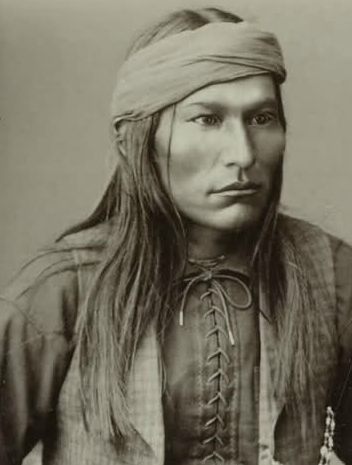
Naiche – Chief of the Chiricahua Apache.
Chief Cochise was succeeded as chief by his son, Naiche, also known as Natchez.
Meanwhile, some of Cochise’s younger warriors disagreed with the peace he had made with the U.S. Government and broke away to join Geronimo’s continued fighting against the U.S. Army and white encroachment. The fighting continued until Geronimo’s surrender in 1886.
Afterward, the remnants of the Chiricahua were shipped off to reservations in the East, where most of them died. Today, only a few descendants of the Chiricahua Apache live in Oklahoma and New Mexico, and none live on their original land.
©Kathy Alexander/Legends of America, updated October 2026.
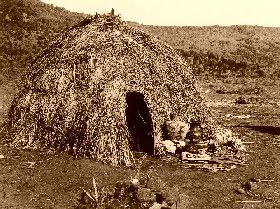
Apache Wickiup, Edward S. Curtis, 1903.
Also See:
Apache – The Fiercest Warriors in the Southwest
Geronimo – The Last Apache Holdout
Indian Wars, Battles & Massacres
Fort Bowie National Historic Site
Native American Photo Galleries
See Sources.