
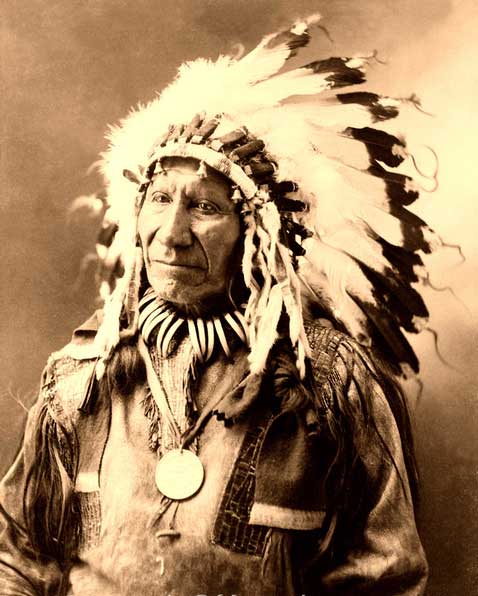
Chief American Horse, Oglala Sioux, 1900.
By Charles A. Eastman (Ohiyesa) in 1918
One of the wittiest and shrewdest of the Sioux chiefs was American Horse, who succeeded to the name and position of an uncle, killed in the Battle of Slim Buttes in 1876. The younger American Horse was born a little before the encroachments of the whites upon the Sioux country became serious and their methods aggressive. His early manhood brought him into that most trying and critical period of our history. His uncle had tutored him since his father was killed in battle while he was still very young. The American Horse band was closely attached to a trading post, and its members, in consequence, were inclined to be friendly with the whites, a policy closely adhered to by their leader.
When he was born, his old grandfather said, “Put him out in the Sun! Let him ask his great-grandfather, the Sun, for the warm blood of a warrior!” And he had warm blood. He was a genial man, liking notoriety and excitement. He always seized an opportunity to leap into the center of the arena.
In early life, he was a clownish sort of boy among the boys —an expert mimic and impersonator. This talent made him popular and, in his way, a leader. He was a natural actor and early showed marked ability as a speaker.
American Horse was about ten years old when he was attacked by three Crow warriors while driving a herd of ponies to water. Here, he displayed native cunning and initiative. It seemed he could scarcely escape, for the enemy was near. He yelled frantically at the ponies to start them toward home while he dropped off into a thicket of willows and hid there.
A part of the herd was caught in sight of the camp, and there was a counter chase, but the Crows got away with the ponies. Of course, his mother was frantic, believing her boy had been killed or captured, but after the excitement was over, he appeared in camp unhurt. When questioned about his escape, he remarked: “I knew they would not take the time to hunt for small game when there was so much bigger close by.”
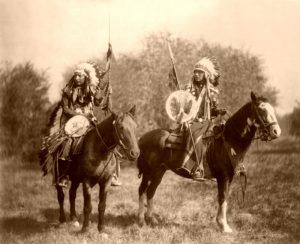
Sioux Indians on Horseback, by Heyn, 1899.
When he was quite a big boy, he joined in a buffalo hunt, and on the way back with the rest of the hunters, his mule became unmanageable. American Horse had insisted on riding him in addition to a heavy load of meat and skins, and the animal evidently resented this, for he suddenly began to run and kick, scattering fresh meat along the road, to the crowd’s merriment. But the boy turned actor and made it appear that it was at his wish that the mule had given this diverting performance. He clung to the back of his plunging and braying mount like a circus rider, singing a Braveheart song, and finally brought up amid the laughter and cheers of his companions. Far from admitting defeat, he boasted of his horsemanship and declared that his “brother,” the donkey, would put any enemy to flight and that they should be called upon to lead a charge.
Several years later, he went to sleep early one night and slept soundly, having scouted for two nights in a row. There was a raid by the Crow, and when he awoke amid the yelling and confusion, he sprang up and attempted to join in the fighting. Everybody knew his voice in all the din, so when he fired his gun and announced a coup, as was the custom, others rushed to the spot to find that he had shot a hobbled pony belonging to their own camp. The laugh was on him, and he never recovered from his chagrin at this mistake. Although he was undoubtedly fearless and tried hard to distinguish himself in warfare, he failed.
It is told of him that he once went with a war party of young men to the Wind River country against the Shoshone. At last, they discovered a large camp, but only a dozen or so of the Sioux. Therefore, they hid and watched for their opportunity to attack an isolated party of hunters. While waiting thus, they ran short of food. One day, a small party of Shoshone was seen nearby, and amid the excitement and preparations for the attack, a young American Horse caught sight of a fat black-tailed deer nearby.
Unable to resist the temptation, he pulled an arrow from his quiver and sent it through the deer’s heart, then, with several of his half-starved companions, sprang upon the yet quivering body of the animal to cut out the liver, which was sometimes eaten raw. It is said that one of the men was knocked down by the dying buck’s last kick, but having swallowed a few mouthfuls, the warriors rushed upon and routed their enemies. It is still told of American Horse how he killed the game and feasted between the ambush and the attack.
At another time, he was drying his sacred war bonnet and other gear over a small fire. The Indians held these articles in great reverence and handled them accordingly. Suddenly, the fire blazed up, and our hero so far forgot to begin energetically beating out the flames with the war bonnet, breaking off one of the sacred buffalo horns in the act. One could almost fill a book with his mishaps and exploits. I will give one of them in his own words, as well as I can remember them.
“We were as promising a party of young warriors as our tribe ever sent against any of its ancestral enemies. It was midsummer, and after a two-day journey from home, we sent two scouts ahead each day while the main body kept half a day behind. The scouts set out every evening and traveled all night. The great war pipe was held out to Young-Man-Afraid-of-His-Horses and me one night. Having met no one at daybreak, we hid our horses and climbed to the nearest butte to take an observation. It was a very hot day. We lay flat on our blankets, facing west, where the cliff fell away in a sheer descent, and with our backs toward the more gradual slope dotted with scrub pines and cedars. We stuck some tall grass on our heads and studied the landscape before us for any sign of man.
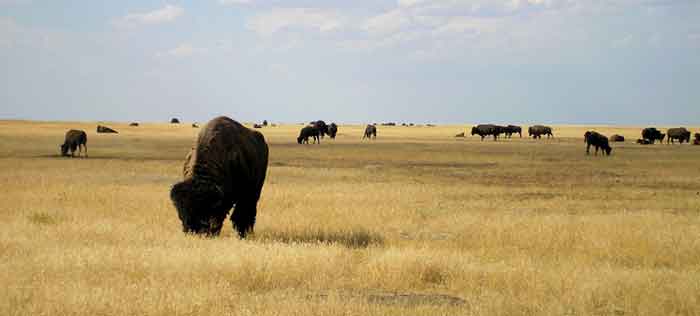
Buffalo in South Dakota, photo by Kathy Alexander.
The sweeping valleys were dotted with herds, large and small, of buffalo and elk, and now and then, we caught a glimpse of a coyote slinking into the gulches, returning from night hunting to sleep. While intently watching some moving body at a distance, we could not yet tell whether it was a man or an animal, I heard a faint noise behind me and slowly turned my head. Behold! a grizzly bear sneaking up on all fours and almost ready to spring!
‘Run!’ I yelled into my companion’s ear, and we both leaped to our feet in a second. ‘Separate! Separate!’ he shouted, and as we did so, the bear chose me for his meat. I ran downhill as fast as I could, but he was gaining on me. ‘Dodge around a tree!’ screamed Young-Man-Afraid. I took a deep breath and made a last spurt, desperately circling the first tree I came to. As the ground was steep, I turned a somersault one way and then the other.
I picked myself up in time to climb the tree. I was fairly out of reach when he gathered himself together and came at me more furiously than ever, holding in one paw the shreds of my breechcloth. In the fall, he had just scratched my back, cut my belt in two, and carried off my only garment for a trophy!
My friend was well up another tree and laughing heartily at my predicament. When the bear saw that he could not get at either of us, he reluctantly departed after I politely addressed him and promised to offer to his spirit on my safe return. I don’t think I ever had a narrower escape, he concluded.
During the troublous times from 1865 to 1877, American Horse advocated yielding to the government at any cost, being no doubt convinced of the uselessness of resistance. He was not a recognized leader until 1876, when he took his uncle’s name and title. Up to this time, he bore the nickname Manishnee, meaning “cannot walk” or “played out”. When the greater part of the Ogallala, to which band he belonged, came into the reservation, he, at once, allied himself with the peace element at the Red Cloud Agency near Fort Robinson, Nebraska, and took no small part in keeping the young braves quiet. Since the older and better-known chiefs, except Spotted Tail, were believed to be hostile at heart, the military relied on him extensively. Many of his young men enlisted as scouts by his advice, and even he entered the service.
In early 1876, there was a rumor that certain bands were in danger of breaking away. Their leader was one Sioux Jim, so nicknamed by the soldiers. American Horse went to him as a peacemaker, but was told he was a woman and not brave. He returned to his camp and told his men that Sioux Jim meant mischief and to prevent another calamity to the tribe, he must be chastised. He again approached the warlike Jim with several warriors at his back. The recalcitrant came out, gun in hand, but the wily chief was too quick for him. He shot and wounded the rebel, and after that, one of his men came forward and killed him.
This quelled the people for the time being, and up to the killing of Crazy Horse. In the crisis precipitated by this event, American Horse was again influential and energetic in the government’s cause. From this time on, he became an active participant in the affairs of the Teton Sioux. He was noted for his eloquence, which was nearly always conciliatory, yet he could say very sharp things about the duplicity of the whites. He had much ease of manner and was a master of repartee. I recall his saying that if you have to wear golden slippers to enter the white man’s heaven, no Indian will ever get there, as the whites have got the Black Hills and with them all the gold.
During the last struggle of his people, at the time of the Messiah craze in 1890-1891, he demonstrated as never before the real greatness of the man. While many of his friends were carried away by the new thought, he held aloof and cautioned his band to do the same. When it developed into an extensive upheaval among the nations, he took a positive stand against it.
Presently, all Indians who did not dance the Ghost Dance were ordered to come into camp at Pine Ridge agency. American Horse was the first to bring in his people. I was there at the time and talked with him daily. When Little was arrested, it had been agreed among the disaffected that he would resist, which meant he would be roughly handled.
On the day of the “Big Issue,” when thousands of Indians were gathered at the agency, this man, Little, who had been in hiding, walked boldly among them. Of course, the police would arrest him at sight, and he was led toward the guardhouse. He struggled with them but was overpowered. A crowd of warriors rushed to his rescue, and there was confusion and a general shout, “Hurry up with them! Kill them all!” I saw American Horse leave the agent’s office and calmly face the excited mob.
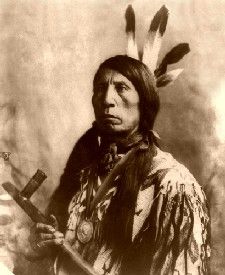
Jack Red Cloud.
What are you going to do?” he asked. “Stop, men, stop and think before you act! Will you murder your children, your women, yes, destroy your nation today?” He stood before them like a statue, and the men who held the two policemen helplessly paused for an instant. He went on: “You are brave today because you outnumber the white men, but what will you do tomorrow? There are railroads on all sides of you. The soldiers will pour in from every direction by thousands and surround you. You have little food or ammunition. It will be the end of your people. Stop, I say, stop now!
Jack Red Cloud, son of the old chief, rushed up to him and thrust a revolver almost in his face. “It is you and men like you,” he shouted, “who have reduced our race to slavery and starvation!” American Horse did not flinch but deliberately reentered the office, followed by Jack, still flourishing the pistol. But his timely appearance and eloquence had saved the day. Others of the police force had time to reach the spot, and a large crowd of friendly Indians had taken command of the situation.
When I entered the office, I found him alone but quite calm. “Where are the agent and the clerks?” I asked. “They fled by the back door,” he replied, smiling. “I think they are in the cellar. These fools outside had almost caught us asleep, but I think it is over now.”
American Horse was one of the earliest advocates of education for the Indians, and his son, Samuel, and nephew, Robert, were among the first students at Carlisle. I think one or two of his daughters were the most handsome full-blooded Indian girls I ever saw. His record as a councilor of his people and his policy in the new situation that confronted them was manly and consistent.
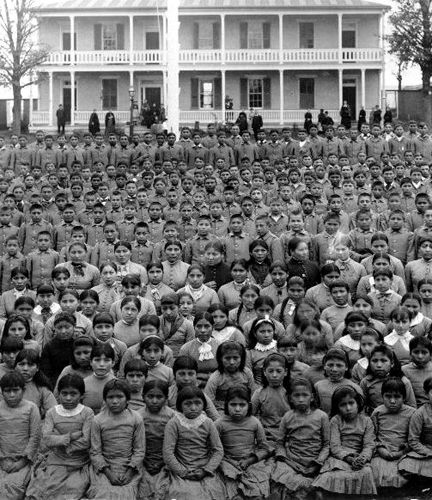
Carlisle Indian School.
Presently, all Indians who did not dance the Ghost Dance were ordered to come into camp at Pine Ridge agency. American Horse was the first to bring in his people. I was there at the time and talked with him daily. When Little was arrested, it had been agreed among the disaffected that he would resist, which meant he would be roughly handled. This was their excuse to attack the Indian police, which would probably lead to a general massacre or outbreak. I know that American Horse opposed this desperate move from the beginning, and it was believed that his life was threatened.
Compiled and edited by Kathy Alexander/Legends of America, updated April 2026.
About the Author and Article – Excerpted from the book Indian Heroes and Great Chieftains by Charles A. Eastman, 1918. (now in the public domain). Charles A. Eastman earned a medical degree from Boston University School of Medicine in 1890 and then began working for the Office of Indian Affairs later that year. He worked at the Pine Ridge Agency, South Dakota, and was an eyewitness to both events leading up to and following the Wounded Knee Massacre of December 29, 1890. He was part Sioux and knew many of the people he wrote about.
Also See:
Native American Heroes and Leaders
The Ghost Dance – A Promise of Fulfillment