
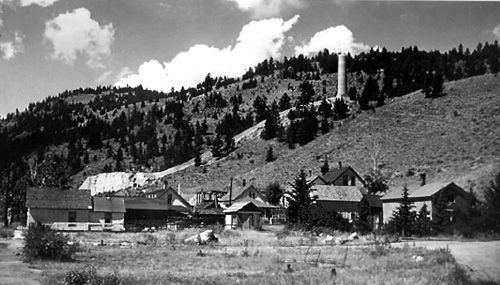
Basin, Montana, 1940s.
An artist’s retreat and destination for health-minded individuals seeking a cure near radon mines, the Basin Mining District began as a mining camp in the late 19th Century.
Gold was first found in the region as early as 1862, and a small settlement named Cataract was established at the confluence of the Boulder River and Cataract Creek, where prospectors staked claims. However, these first mining ventures were short-lived, as miners abandoned their claims for richer diggings on Grasshopper Creek. This would be just the first of a century of fitful starts and stops in what would become the Basin Mining District. Although some miners continued to work the creeks, rich deposits were found about 2 ½ miles further up the creek; however, the ore was generally too difficult and expensive to work.
Miners persisted, and after the easy placer deposits were nearly exhausted, many men began searching for lode veins, several of which were discovered in the 1870s. Again, however, no major work was completed because of high operating costs and the lack of an area smelter.
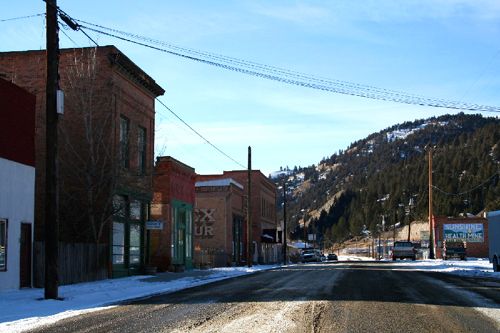
Basin, Montana, today, courtesy of Montana Pictures.net
That changed in 1880 when two miners, Lawson and Allport, started a new settlement called Basin City about half a mile upstream from the former camp of Cataract. What started as little more than a cluster of cabins evolved into a trading center serving the area’s mining operations. In 1880, a post office was established. The few remaining buildings in Cataract were relocated to Basin City, and soon, more buildings were constructed to support the significant lodes found at several mines, including the Bullion, Hope, Katy, and Morning Star Mines, among others.
Initially, miners had to haul the ore to Butte by wagon over about 30 miles of rugged roads. However, when a smelter was built in Basin, the camp began to prosper, though it would not reach its peak population until the 20th Century.
In the latter part of the 1800s, Basin suffered several fires, especially at the mines, including a blaze at the Katy Mill in 1895 that destroyed the hoisting plant and the shaft, and a fire at the concentrator in the Hope Gold Mine in 1896 that killed seven miners. These fires, accompanied by area flooding and low silver prices, led to the shutdown of both mines by 1896.
However, in 1905, the Basin Reduction Company acquired the Katy and Hope Mines and invested about $500,000 in improvements, including a 1,500-ton smelter and concentrator that reprocessed the mine tailings. Before long, the mill was running at full capacity.
Between 1906 and 1910, Basin’s population peaked at approximately 1,500 people. The town boasted numerous businesses, including a hardware store, a drugstore, a bank, a bakery, three hotels, a newspaper, four boarding houses, livery stables, a blacksmith, a sawmill, a bathhouse, a brewery, three grocery stores, several brothels, and 12 saloons. The town also sported several entertainment venues, including a dance pavilion, a grandstand, a baseball diamond, a playground, several organizations, a union hall, and numerous churches.
This brief boom, like others, was short-lived, and by 1911, the Katy and Hope Mines were shut down again.
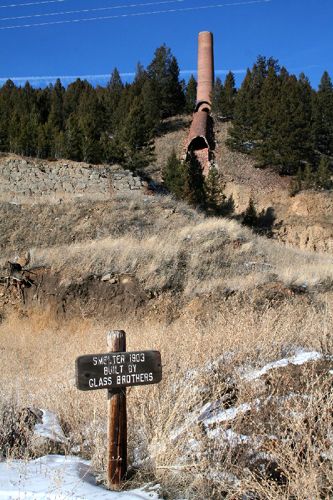
Basin Smelter.
Yet, the town had one last mining boom when the Jib Consolidated Mining Company purchased the Hope-Katy mine complex in 1919, and once again, mining began in earnest at the Hope-Katy and the White Elephant Mine. Digging deeper, the company produced about $1,700,000 in gold and, by 1924, became Montana’s largest gold producer. But by the following year, the operation was forced to close due to mismanagement, and trustees and creditors took over the properties. This signaled the end of Basin’s final mining boom. Since then, only small-scale mining and reworking of old mine dumps have occurred in the area.
Today, Basin is a small community of approximately 250 people that has gained a reputation as an artist’s haven. In 1993, a group of professional artists created the Montana Artists Refuge in Basin, which today sponsors several art events and supports local artists of all types, including painters, musicians, dancers, potters, writers, and more. But Basin’s biggest draw is its radon mines, including the Merry Widow and Sunshine Mines, which are marketed today for their reputed health-giving benefits.
Throughout the area, signs of Basin’s prosperous mining days can be seen in abandoned mining equipment, closed mine portals, and the ruins of a smelter and ore concentrator. Its tiny main street also boasts several historic buildings.
Basin is halfway between Butte and Helena along Interstate 15 at Exit 156.
©Kathy Alexander/Legends of America, updated October 2026.
Also See:
Ghost Towns & Mining Camps of Montana
Merry Widow Health Mine in Basin
Montana Ghost Town Photo Galleries
See Sources.