

State Lunatic Asylum No. 2, opened November 9, 1874.
Much madness is divinest sense
To a discerning eye;
Much sense the starkest madness.
‘Tis the majority
In this, as all, prevails
Assent, and you are sane;
Demur,–you’re straightway dangerous,
And handled with a chain.
– Emily Dickinson
Identified as one of the 50 most unusual museums in America, Glore’s Psychiatric Museum in St. Joseph, Missouri is a macabre collection of unsettling displays documenting the treatment of the mentally ill over the centuries. From a nineteenth-century dousing tank to an exhibit of more than 1,000 metal objects removed from a patient’s stomach, you will no doubt come away from this interesting museum highly enlightened and very glad you’re not crazy (assuming that you’re not.)
The story begins in 1872 when Missouri’s State Legislature approved $200,000 for the building of a Lunatic Asylum and St Joseph citizens convinced the legislature to locate it just east of their city. Opening its doors on November 9, 1874, the hospital was called the State Hospital for the Insane No.2, or more familiarly named the Lunatic Asylum #2. Beginning with 25 patients, the first hospital superintendent described the institution as “the noble work of reviving hope in the human heart and dispelling the portentous clouds that penetrate the intellects of minds diseased.” And so it was for the next 127 years.
In no time at all the hospital’s 275 beds filled when relatives could no longer handle the special needs of family members with mental illness. Soon, an additional 120 beds were added, then another 250, then more and more over the years, as the hopelessly mental ill poured through their doors. In the hospital’s early years, the asylum was a self-sufficient institution where the patients worked on a farm, raising crops and livestock, to provide food for the facility. Allegedly, the hospital needed only to purchase salt and sugar to supplement their food provisions.
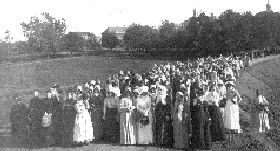
Lunatic Asylum #2 Patients on an afternoon stroll in 1902, photo courtesy Glore Psychiatric Museum.
The hospital continued to be referred to as the State Lunatic Asylum #2 until 1899 when it gained the name the St Joseph State Hospital. By the early 1950s, the facility had grown to nearly 3,000 beds and housed some of the most criminally insane individuals in the state, as well as those that could be rehabilitated, and others who were merely depressed. According to the museum, a few of these patients were just mildly depressed individuals who were dumped there by annoyed relatives. With modern medications, more and more patients began to return to society. Throughout its history, the hospital underwent a series of experimental treatments for its patients, some of which sound more like a cause rather than a cure for insanity.
In 1967, a museum was started in a ward of the St. Joseph State Hospital by a man named George Glore, a lifetime employee of the Missouri Department of Mental Health. Beginning with several full-sized replicas of 16th, 17th and 18th-century treatment devices that were created for a mental health awareness exhibit, he soon began to look for other items that would illustrate how the treatment of mental illness had progressed over the years. George Glore spent the larger part of his 41-year career with the Missouri Department of Mental Health in developing the largest collection of exhibits featuring the evolution of mental health care in the United States. Glore retired from government service in the 1990s.
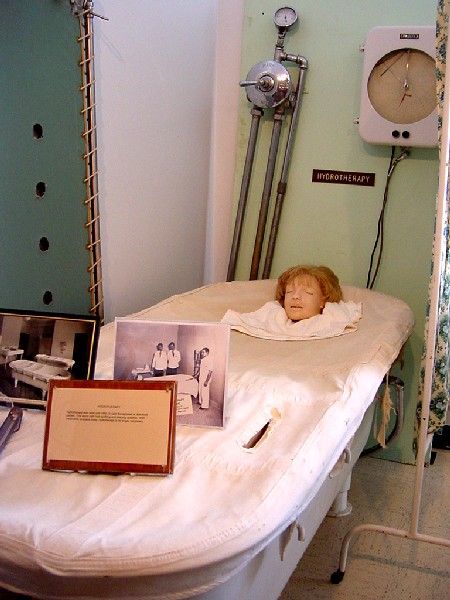
A display of hydrotherapy at the Glore Psychiatric Museum, April 2005, Kathy Weiser.
By the early 1990s, the majority of the patients of the asylum had been released back into society with the help of modern medications. In August 1994, the state of Missouri approved a bond that allowed for the large asylum campus and hospital to be converted into a correctional facility. By July 1997 a new state-of-the-art building was completed across the street from the original campus and the new Northwest Missouri Psychiatric Rehabilitation opened with 108 beds.
It was also in 1997 that Glore’s Psychiatric Museum was forced to move from the campus and soon relocated to a 1968 building that once served as a clinic for patients at the mental hospital, which now sits right outside the prison fence. The Western Reception, Diagnostic and Correctional Center opened on the old asylum campus in 1999, now confining over 1,800 inmates.
A visit to the “new” three-story museum is extraordinary as you view its many exhibits displaying how the mental health industry has changed over the centuries. While at the museum you will view treatments ranging from dousing tanks to cages, straitjackets, dungeons, and electroshock therapy.
More exhibits display mannequins that show examples of the unspeakable treatment received by the mentally ill, such as burning at the stake; douching tubs, where patients were drenched with ice-cold water; electroshock therapy; hydrotherapy, where patients were kept in water for hours on end, and a mannequin in a fever cabinet. Back in the old days, fever cabinets were used in the treatment of syphilis. Lined with rows of high wattage light bulbs, the treatment was utilized to elevate the patient’s body temperature, intending to kill the virus and cure the syphilis.
Also featured is a “Tranquilizer Chair” where patients were said to have sometimes been strapped into for as long as six months. While sitting in the chair, patients were subjected to all manner of treatments such as bloodletting with leeches or a knife, placing of their feet in scalding hot water, or more ice cold water dousing.
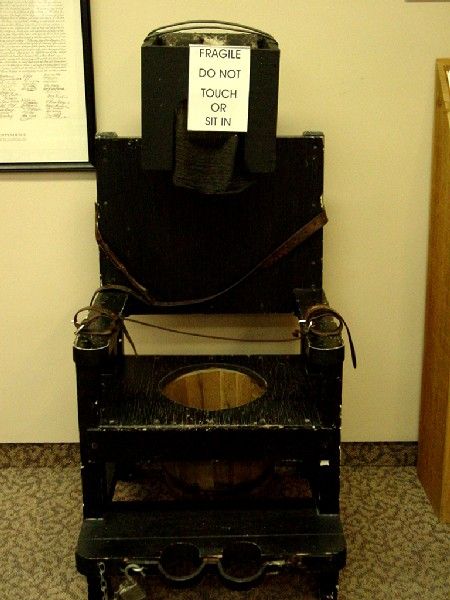
Patients were often strapped to a Tranquilizer Chair for as long as six months. April 2005, Kathy Weiser.
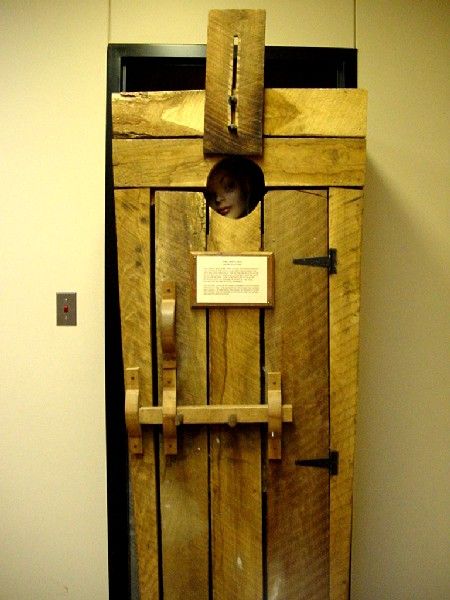
The Lunatic Box was used during the 18th and 19th centuries. April 2005, Kathy Weiser.
You’ll also see the Lunatic Box, used during the 18th and 19th centuries. Here, violent or “out-of-hand” patients were placed in a standing position in the coffin-like box until he or she became calm. In total darkness, these men and women would be made to stand for hours in their own excrement until their attendants decided they were controllable.
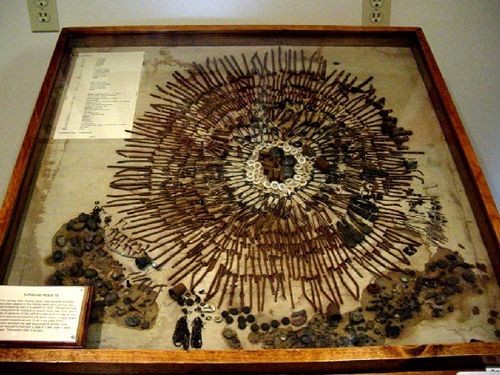
More than 1,400 metal objects were removed from a patient in 1929, April 2005.
More displays reveal several former patients’ unique disabilities. In one glass case is an arrangement of more than 1,400 metal objects, including nails, screws, pins, bottle caps, bolts and buttons swallowed over the years by a woman who was discovered eating a tasty nail in 1929. Though this patient with a compulsive need to swallow metal objects obviously survived the effects of the metal in her stomach, she died on the operating table, when the objects were removed.
The second floor of the Glore Psychiatric Museum displays many exhibits of former patients’ artwork and crafts, which includes everything from a few fine paintings to embroidery, and ceramic items that look very much like kindergarten displays.
Another display shows a television set stuffed with hundreds of letters and notes written by one of its patients. Evidently, in 1971 a male patient was seen inserting a piece of folded paper into the working television and the hospital’s electrician was called. When the back was removed from the set, more than 525 folded notes and letters were found that included the writings of the delusional patient.

Thousands of cigarette packages collected by a former patient of the asylum, April 2005, Kathy Weiser.
Yet another exhibit features more than 100,000 cigarette packages that a former patient collected, believing that he might redeem them for a new wheelchair for his ward. When the hospital discovered his ambition, they purchased a wheelchair for the facility and dedicated it in his name in 1969.
Around the block from the museum, on what was once the southeast corner of the hospital campus, is the old asylum cemetery. A monument sits here next to a large field, with the “new” prison visible behind the trees. The first burial was made here on December 12, 1874, and the last burial in October 1949. For us, this sad cemetery was as disturbing as the museum itself, as the majority of its tiny markers identify nothing more than an anonymous number upon their face. Of the hundreds of people that once passed through the old asylum and died here, there is not a name nor a date to identify these faceless “victims.” Though the cemetery allegedly has more than 2,000 bodies within its midst, no more than several hundred headstones are in the old graveyard.
For many years Missouri’s state hospital cemeteries were neglected by hospital administrators. In fact, in the 1960s, cemetery headstones were ordered to be pushed over and buried, as mowing around them was considered too costly.
Generally, when a relative was brought to the hospital for admission, the family was usually told to bring the clothes they wanted the patient to be buried in, because chances were. that he or she would never leave the hospital. Sadly, many of the patients at the hospital never had a single visitor, as family members were too embarrassed or ashamed. Many died lonely and unclaimed when their families could not be located.

Glore Asylum Cemetery with a view of prison (old asylum) in the background, April 2005, Kathy Weiser.
Today, the cemetery has been mostly restored, though several of the markers lay crumbling. All but a very few are unmarked. Even the nicest monument in the old graveyard, that of a woman named Ellen Ross, 1816-1865 has been vandalized. The name and date are barely legible and something is missing from the top of the headstone. Who was Ellen Ross? Who was Number 58 who lies almost obscured in the bank of the creek bed? As in life, these poor souls, have seemingly been forgotten.
Glore’s Psychiatric Museum has been featured on the popular television program, “Ripley’s Believe It or Not!”
The museum has now become a part of St Joseph Museums Inc., which supports several other museums in St. Joseph.
© Kathy Weiser/Legends of America, updated November 2019
Contact Information
Glore Psychiatric Museum
3408 Frederick Avenue
St Joseph, Missouri 64506
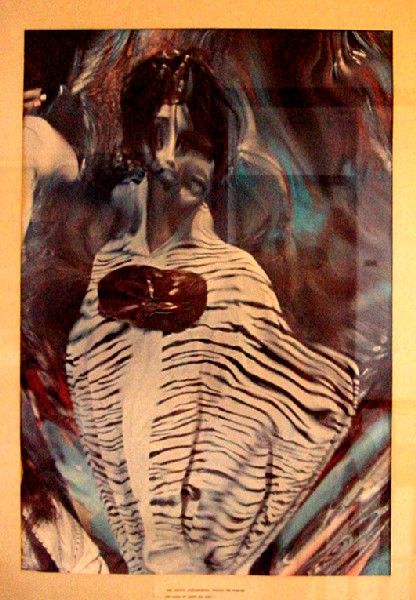
Example of patient’s work at the Glore Psychiatric Museum, April 2005, Kathy Weiser.
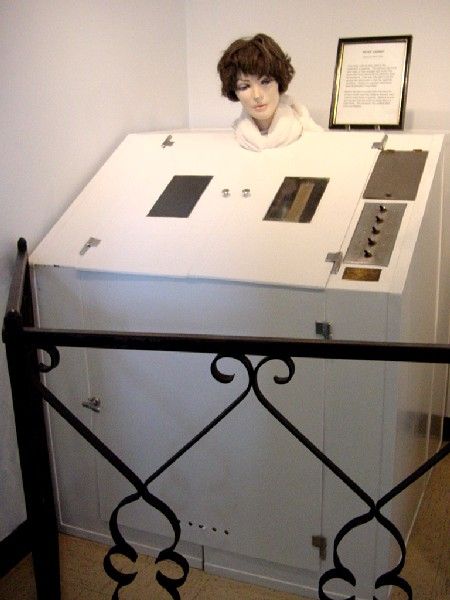
The Fever Cabinet was used to try to “sweat” syphilis out of a victim. April 2005, Kathy Weiser.
Also See:
St. Joseph – Jumping Off to the West
Quirky Missouri – Oddities and Roadside Attractions
Missouri (main page)